 NL·0502
Herbarium of the Nature Library
- Name
- Hydrophasianus chirurgus
- Family
- Jacanidae
- Native to
- Pakistan and India through Sri Lanka, Bangladesh and Southeast Asia to southern China and Taiwan; northern birds migrate
- Habitat
- Wetland
On eBird ↗
Pheasant-tailed Jacana
Live sightings near you, the range map, bar charts of when it is seen, and Macaulay Library photos and recordings.
Pheasant-tailed jacana
Hydrophasianus chirurgus
Also calledShuǐ zhì 水雉 (Chinese; 'water pheasant') · Renkaku レンカク (Japanese)
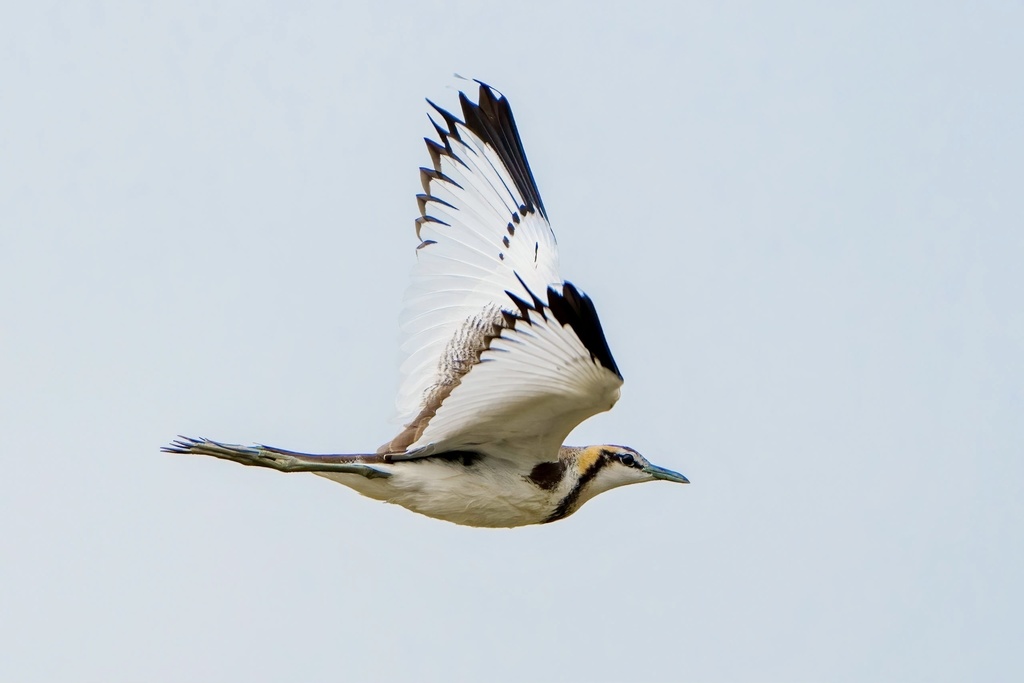
An elegant wetland bird that walks across lotus and water-lily leaves on enormously long toes, its breeding plumage chocolate and white with a golden nape and a long, curving pheasant-like tail. Females are polyandrous, mating with several males that each raise a clutch alone.
The pheasant-tailed jacana is a jacana in the monotypic genus Hydrophasianus. Like all other jacanas, they have elongated toes and nails that enable them to walk on floating vegetation in shallow lakes, their preferred habitat. They may also swim or wade in water reaching their body while foraging mainly for invertebrate prey. They are found in tropical Asia from Yemen in the west to the Philippines in the east and move seasonally in parts of their range. They are the only jacanas that migrate long distances and have different non-breeding and breeding plumages. The pheasant-tailed jacana forages by swimming or by walking on aquatic vegetation. Females are larger than males and are polyandrous, laying several clutches that are raised by different males in their harem. Wikipedia
What it can do
- iSpreads its weight over very long toes to walk on floating leaves
- iiFemales lay eggs for several males, which incubate and rear the young
- iiiMales can carry eggs or chicks under their wings to move them
In the field
Field marks
- aBreeding: chocolate-brown body, white face and neck, golden-yellow hindneck, long dark sickle tail
- bMostly white wings, very conspicuous in flight
- cNon-breeding: brown above, white below, with a dark breast band and no long tail
- dVery long legs and toes
- Voice
- A nasal, mewing 'me-onp' or 'tewn', often given in the breeding season
- Not to be confused with
- Bronze-winged jacana is dark glossy with a white eyebrow and short tail; non-breeding birds may recall a large wader but the toes and white wings are distinctive.
- Where to see it
- Keoladeo National Park; lotus lakes in Sindh (Haleji) and Bangladesh's haors; Taiwan's Guantian reserve
- When
- Resident in South Asia; breeding plumage during the monsoon (Jun–Sep)
Listen
Looking for field recordings…
Life & habits
- Diet
- Insects, snails and other invertebrates, and seeds of aquatic plants
- Habitat
- Lakes, ponds and marshes with floating vegetation such as lotus and water lilies
- Size
- About 39–58 cm in breeding plumage including tail
The female defends a territory containing several males' nests; each male incubates eggs on a floating nest.
Where it lives
Recorded sightings
—
geo-referenced records in GBIF, from museums, herbaria and field observers.
Native range
Pakistan and India through Sri Lanka, Bangladesh and Southeast Asia to southern China and Taiwan; northern birds migrate
Drag the globe to turn it. Dots are where records exist, not a range map; darker means more records.
In the stacks
Searching the stacks…
Every page naming Hydrophasianus chirurgus in the Biodiversity Heritage Library →
Marginalia
In Taiwan, a dedicated reserve for this species was created at Guantian after a high-speed rail line threatened its breeding wetlands.
Curiosity
It is the only jacana that is a long-distance migrant, with northern birds from China moving south for the winter.
Kinship



Photographs: iNaturalist contributors under the licences shown. Records: GBIF.org. Historical plates: Source Library (CC BY-SA 4.0; originals public domain). Summary text: Nature Library editors and Wikipedia (CC BY-SA). Medicinal and edibility notes are historical and educational, not advice. iNaturalist taxon 4589.