On eBird ↗
Wattled Jacana
Live sightings near you, the range map, bar charts of when it is seen, and Macaulay Library photos and recordings.
Wattled Jacana
Jacana jacana
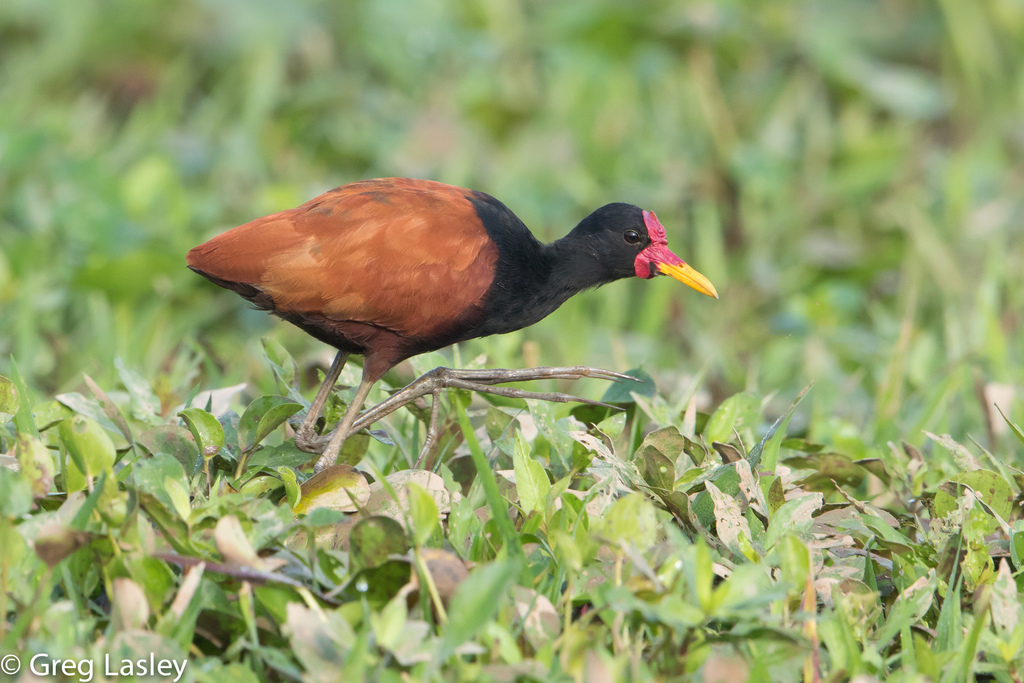
The wattled jacana (Jacana jacana) is a wader in the family Jacanidae found throughout much of South America east of the Andes, as well as western Panama and Trinidad. It is the only species in the Jacanidae family with such a large distribution. Wattled jacanas have long toes and claws which help them walk through aquatic vegetation. Like the majority of species of jacanas, the female is larger than the male, and forms harems of up to 4 or 5 males at any given time. There is also a major difference in proportional development or ornamentation (facial crest and wing size) and defense (length of wing spur) relative to body size when compared to males.
From the article Wattled jacana on Wikipedia (CC BY-SA), quoted section by section
Description
These are conspicuous and unmistakable birds. They are 17–23 cm (6.7–9.1 in) long, but the females are larger than the males. The adults have a chestnut back and wing coverts, with the rest of the body mainly black. In flight the greenish yellow flight feathers are obvious. Also visible are yellow bony spurs on the leading edge of the wings, which it can use to defend itself and its young. The yellow bill extends up as a red coot-like head shield and a reddish wattle, and the legs and very long toes are dull blue-grey. Young birds initially have entirely white underparts, and can always be identified by the presence of white in their plumage.
What it does
The wattled jacana's food is insects (such as beetles, grasshoppers and crickets), other invertebrates (e.g. ticks and mollusks), small fish, roots and seeds picked from the floating vegetation or the water's surface.
Wikipedia: “Diet”
Listen
Looking for field recordings…
Where it lives
Recorded sightings
—
geo-referenced records in GBIF, from museums, herbaria and field observers.
Drag the globe to turn it. Dots are where records exist, not a range map; darker means more records.
In the stacks
Searching the stacks…
Every page naming Jacana jacana in the Biodiversity Heritage Library →
This page is assembled live from iNaturalist, GBIF, Wikipedia, the Source Library and the Internet Archive. It is not yet part of the hand-edited codex. iNaturalist taxon 4580.