On eBird ↗
Bronze-winged Jacana
Live sightings near you, the range map, bar charts of when it is seen, and Macaulay Library photos and recordings.
Bronze-winged Jacana
Metopidius indicus
The bronze-winged jacana (Metopidius indicus) is a wader in the family Jacanidae. It is found across South and Southeast Asia and is the sole species in the genus Metopidius. Like other jacanas it forages on lilies and other floating aquatic vegetation, using its long feet and legs for balance. The sexes are alike but females are slightly larger and are polyandrous, maintaining a harem of males during the breeding season in the monsoon rains. Males maintain territories, with one male in the harem chosen to incubate the eggs and take care of the young. When threatened, young chicks may be carried to safety by the male under his wings.
From the article Bronze-winged jacana on Wikipedia (CC BY-SA), quoted section by section
Description
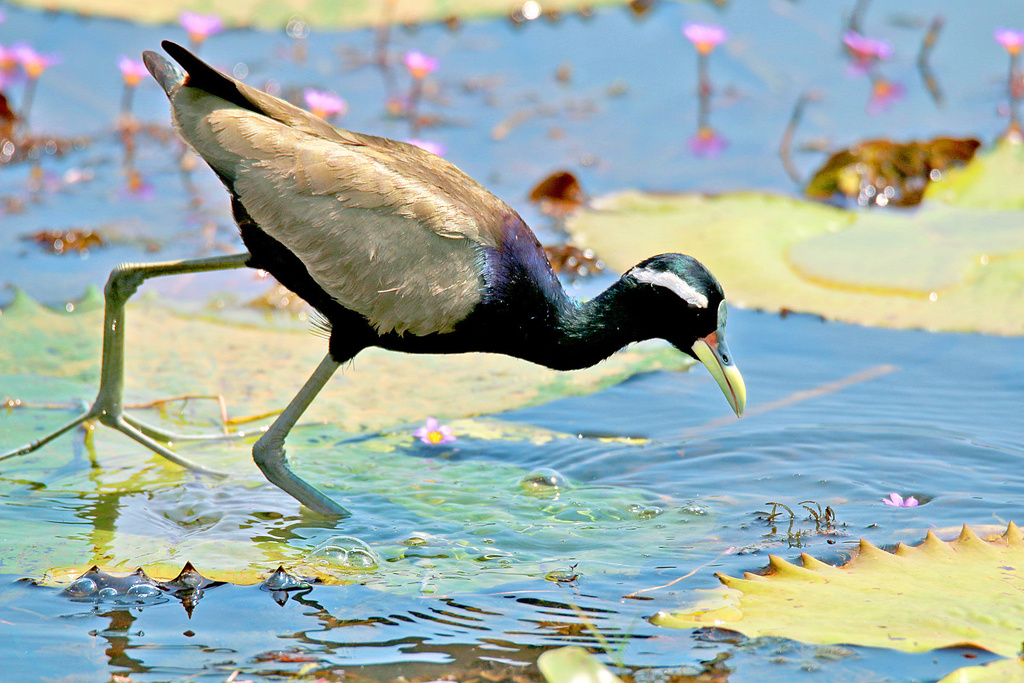
Bronze-winged jacanas are rail-like, large, short tailed birds that appear dark at a distance except for the supercilium. They are 29 cm (11 in) in length. The sexes are similar but the females are slightly larger than the males. The wings are bronzy brown with a green sheen and have a reduced tubercular carpal spur. The head, neck and breast are black and contrast with the broad white supercilium that runs from over the eye to the back of the neck. The lower back and tail coverts are chestnut. The tail is stubby and reddish brown with black terminal band. The greenish yellow bill has a red-base to the upper mandible. A lappet or frontal shield extends up over the forehead and is reddish purple. The legs are greenish. The toes are long and the straight and the elongated nail on the hind toe is longer than the toe. Downy chicks are light brown with a dark stripe running down the nape. Young birds have brown upperparts, a rufous crown, white underparts, a buff foreneck, an undeveloped frontal shield, and may have a dull supercilium. Adults can be confused at a distance with the common moorhen (which is found in similar habitat) and with the watercock and while young can appear similar to the young of the pheasant-tailed jacana, they lack the black necklace seen in that species.
Range & habitat
The species is widely distributed across the Indian subcontinent (but not Sri Lanka or western Pakistan) and Southeast Asia mainly in low elevations. Both this species and the pheasant-tailed jacana may be found in the same habitat. It is sedentary apart from seasonal dispersal in response to drought and rains. They are able to use wetlands covered in introduced weeds such as water hyacinth and make use of the cover provided by Ipomoea aquatica when breeding.
Wikipedia: “Distribution and habitat”
What it does
Bronze-winged jacanas are found singly or in pairs foraging on aquatic vegetation. They balance on their long legs and long toes, and feed on plant material (claimed to be purely incidental), insects and other invertebrates picked from the floating vegetation or the water's surface. Call is a wheezy piping seek-seek-seek given mostly in alarm. When threatened they sometimes hide by submerging themselves. The breeding season starts after the rains (June to September in India but occasional breeding in March rains reported in Rajasthan). Males defend territories from other males with open wing and neck stretched displays which can escalate to pecking. The territory maintenance activities are at a maximum from around 9 to 11 a.m. The nest is a small platform of stems and leaves of Pistia, Nymphoides, Hydrilla, and Eichhornia placed on a mat of vegetation but eggs may also be laid directly on the leaf of a lotus plant. The usual clutch is four, the eggs are very conical, glossy brown with irregular black zig-zag markings. Incubation and care of the young is entirely left to males. The eggs hatch in 29 days. Predation rates of eggs are high, up to 94% were lost in one study to various predators including birds and turtles. Young chicks may be sheltered between the wings and carried to safety. …
Wikipedia: “Behaviour and ecology”
Listen
Looking for field recordings…
Where it lives
Recorded sightings
—
geo-referenced records in GBIF, from museums, herbaria and field observers.
Drag the globe to turn it. Dots are where records exist, not a range map; darker means more records.
In the stacks
Searching the stacks…
Every page naming Metopidius indicus in the Biodiversity Heritage Library →
This page is assembled live from iNaturalist, GBIF, Wikipedia, the Source Library and the Internet Archive. It is not yet part of the hand-edited codex. iNaturalist taxon 4576.