- Animals
- ›Chordates
- ›Vertebrates
- ›Mammals
- ›Therians
- ›Placental Mammals
- ›Primates, Rodents, and Allies
- ›Rodents
- ›Mice, Rats, and Hamsters
- ›Muroids
- ›Old World Mice and Rats
- ›Gerbils
- ›Gerbillini
- ›Psammomys
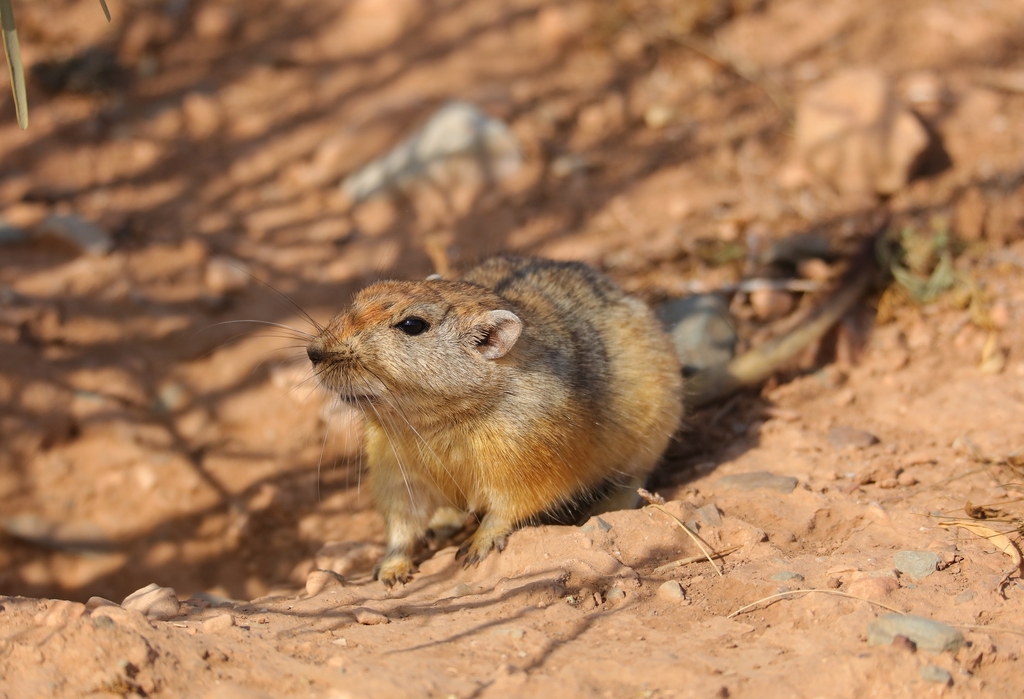
Fat Sand Rat
Psammomys obesus
The fat sand rat (Psammomys obesus) is a terrestrial mammal from the gerbil subfamily that is mostly found in North Africa and the Middle East, ranging from Mauritania to the Arabian Peninsula. This species usually lives in sandy deserts, but may also be found in rocky terrain or saline marsh areas. Fat sand rats are very selective in their diet, only eating stems and leaves of plants from the family Amaranthaceae, more commonly known as the amaranth family. In captivity, fat sand rats can become obese and rapidly develop diabetes-like symptoms when fed the diet typically given to other rodents. P. obesus has an average lifespan of 14 months in the wild and 3–4 years in captivity.
From the article Fat sand rat on Wikipedia (CC BY-SA), quoted section by section
Range & habitat
Fat sand rats dig burrows with multiple entrances directly under plants they consume, primarily selecting burrowing sites based on the abundance of Amaranthaceae shrubs in the area over any other factor such as cover. As such, their preferred type of habitat, and the distribution of fat sand rats in a particular habitat changes throughout the year in response to the different growing season of plants in the wadi beds or terraces that they inhabit. Wadi beds are typically populated with Amaranthaceae shrubs, and have dense vegetative cover, while terraces are very sparsely vegetated, leaving the habitat exposed. Distribution of the fat sand rat in a particular habitat is also influenced by the abundance of rainfall in the area, as well as the population density of the site from the previous season. During the winter, fat sand rats prefer the wadi habitat as a result of the vegetative growth during this time, but after a wet autumn, more individuals will burrow in a terrace habitat even when population density is low, as opposed to after a dry autumn, when individuals only burrow in terrace habitats when the population density is high. The burrowing activities of the rodents can impact their habitat, affecting the bacteria in the soil around their burrows such that nitrogen fixation and denitrification activity are decreased. …
Wikipedia: “Habitat selection”
What it does
Fat sand rats are preyed upon by many desert species, including several kinds of avian predators, snakes, desert cats, and members of the family Mustelidae. Depending on the type of habitat they have burrowed in, they are exposed to different risks concerning predation. In response to the threat of predation, they employ anti-predator vigilance behaviour when above ground, and will stop what they are doing to take an upright posture and survey the area or look intently in one direction. In addition to this posture, the rodents will thump their foot loudly and squeak before retreating into their burrow when frightened. There appears to be no reaction from other nearby individuals in response to this behaviour, so there may be no benefit in terms of warning conspecifics of predators in performing the foot thumping. Fat sand rats in the terrace habitat spend significantly more time engaging in this vigilance behaviour when they are above ground than individuals living in the wadi beds, but the behaviour is not costly in that it does not interrupt their foraging, as both groups spend equivalent amounts of time foraging. However, there is a difference in foraging behaviour between the two groups, as fat sand rats living in terraces tend to hoard their food more often than those living in wadi beds, and take less time to eat as well. …
Wikipedia: “Anti-predator behaviour”
In medicine
Although they remain lean when fed their natural, vegetable-based diet, fat sand rats can easily become obese and acquire type 2 diabetes mellitus when they are fed a normal rodent diet of grains. Therefore, they have been used as an animal model for studies on diabetes and obesity. Sequencing of the complete nuclear DNA genome of Psammomys obesus showed that the Pdx1 homeobox gene, a transcriptional activator of insulin, has undergone massive amino acid sequence changes in sand rat and other gerbil species driven by accumulation of GC-biased mutations (changes from A or T nucleotides to G or C nucleotides). It has been suggested that these changes affect function of the PDX1 protein and contributed to adaptation to low caloric intake or a diabetes-prone phenotype. However, a causative link has not been proven. Many regions of the sand rat genome, not only the Pdx1 gene, have been affected by accumulation of GC-biased mutations. Because they are diurnal, fat sand rats are also used as models for human seasonal affective disorder. The presence of fat sand rats in North Africa and the Middle East is of healthcare importance. …
Wikipedia: “Medical significance”
Listen
Looking for field recordings…
Where it lives
Recorded sightings
—
geo-referenced records in GBIF, from museums, herbaria and field observers.
Drag the globe to turn it. Dots are where records exist, not a range map; darker means more records.
In the stacks
Searching the stacks…
Every page naming Psammomys obesus in the Biodiversity Heritage Library →
This page is assembled live from iNaturalist, GBIF, Wikipedia, the Source Library and the Internet Archive. It is not yet part of the hand-edited codex. iNaturalist taxon 45734.