- Animals
- ›Chordates
- ›Vertebrates
- ›Mammals
- ›Therians
- ›Placental Mammals
- ›Primates, Rodents, and Allies
- ›Rodents
- ›Mice, Rats, and Hamsters
- ›Muroids
- ›Old World Mice and Rats
- ›Murines
- ›African and Indian Bush Rats
- ›Aethomys
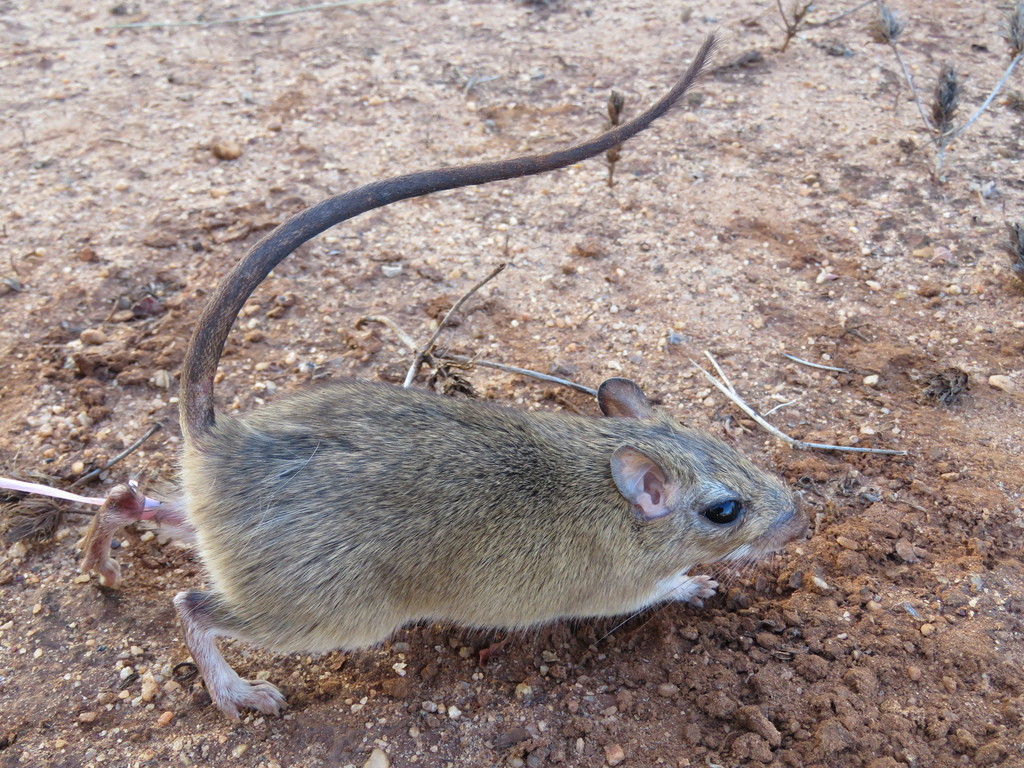
Red Veld Rat
Aethomys chrysophilus
The red rock rat, or red veld rat, (Aethomys chrysophilus) is a species of rodent in the family Muridae native to southern Africa.
From the article Red rock rat on Wikipedia (CC BY-SA), quoted section by section
Description
The red rock rat is a rat-sized murine rodent. Adults have a head-body length of 12 to 17 cm (4.7 to 6.7 in), with a long, 13 to 20 cm (5.1 to 7.9 in), tail, and weigh from 40 to 114 g (1.4 to 4.0 oz). Males are not significantly larger than females. The fur on the upper body and flanks is mostly reddish-brown, but mixed with dark brown or black hairs, producing an overall colour that varies from orange-yellow or cinnamon to medium brown. The underparts are white or very pale grey, with a clear dividing line from the fur elsewhere on the body. The head is robust, with a heavy snout. Females have three pairs of teats. Although red rock rats can be distinguished from most other species of the genus Aethomys by their size or bodily proportions, they appear essentially identical to Tete veld rats (Aethomys ineptus), and can only be reliably distinguished from them by genetic analysis or examination of the shape of their spermatozoa.
Range & habitat
Red rock rats are widely distributed across southern Africa, although the exact southern edge of their range is difficult to determine because of their extreme physical similarity to Tete veld rats, which are found in South Africa and Eswatini. Nonetheless, red rock rats are currently believed to live in east Africa from southern Kenya, through eastern Tanzania, Malawi, Mozambique, and Zimbabwe to the north-eastern border regions of South Africa. Further west, they are found through most of Zambia and Botswana to northern Namibia and south-western Angola, although it has been suggested that the Namibian populations may be A. ineptus. Across this region, red rock rats inhabit savannah or woodland areas with dense vegetation or rocky cover below 1,000 m (3,300 ft) elevation. They are often associated with miombo and mopane forest, but appear able to tolerate a wide range of habitats, so long as substantial ground cover is available. Although at least seven subspecies of red rock rats have been identified, the validity of some of these is questionable, not least because of potential confusion with Tete veld rats in earlier works. Fossils indistinguishable from the modern species have been found which are dated as far back as 3.7 million years ago, in the late Pliocene of South Africa.
Wikipedia: “Distribution and habitat”
What it does
Red rock rats are nocturnal and omnivorous, but feed mainly on plant matter, such as seeds, fruit, green leaves, and starchy roots. They shelter through the day in cup-like nests constructed in burrows, rock crevices, or termite mounds. In the wild, they appear territorial, reacting aggressively to intruders of their own species, but they are apparently able to tolerate each other after some time in captivity, establishing a stable dominance hierarchy. Within any given area, red rock rats are usually present in relatively low numbers, but their population turns over rapidly, increasing rapidly during the wet season, with population densities reaching up to 6 per hectare (2.4/acre), then crashing to 0.2 per hectare (0.081/acre) or less in the hot, dry, season. In the wild, they breed during the rainy season, typically between October and January, although they are capable of breeding at any time of year in captivity. Gestation lasts 29 days, and results in the birth of between one and five, but typically three, young. The young are initially blind and helpless, with thin black fur over most of the body, and naked undersides. The teeth are already erupted at birth, and the eyes open after 10 to 14 days. …
Wikipedia: “Biology and behaviour”
Listen
Looking for field recordings…
Where it lives
Recorded sightings
—
geo-referenced records in GBIF, from museums, herbaria and field observers.
Drag the globe to turn it. Dots are where records exist, not a range map; darker means more records.
In the stacks
Searching the stacks…
Every page naming Aethomys chrysophilus in the Biodiversity Heritage Library →
This page is assembled live from iNaturalist, GBIF, Wikipedia, the Source Library and the Internet Archive. It is not yet part of the hand-edited codex. iNaturalist taxon 45573.