- Animals
- ›Arthropods
- ›Chelicerates
- ›Arachnids
- ›Spiders
- ›Typical Spiders
- ›Entelegyne Spiders
- ›RTA Clade Spiders
- ›Oval calamistrum clade spiders
- ›Wolf Spiders and Allies
- ›Wolf Spiders
- ›Lycosinae
- ›Tigrosa
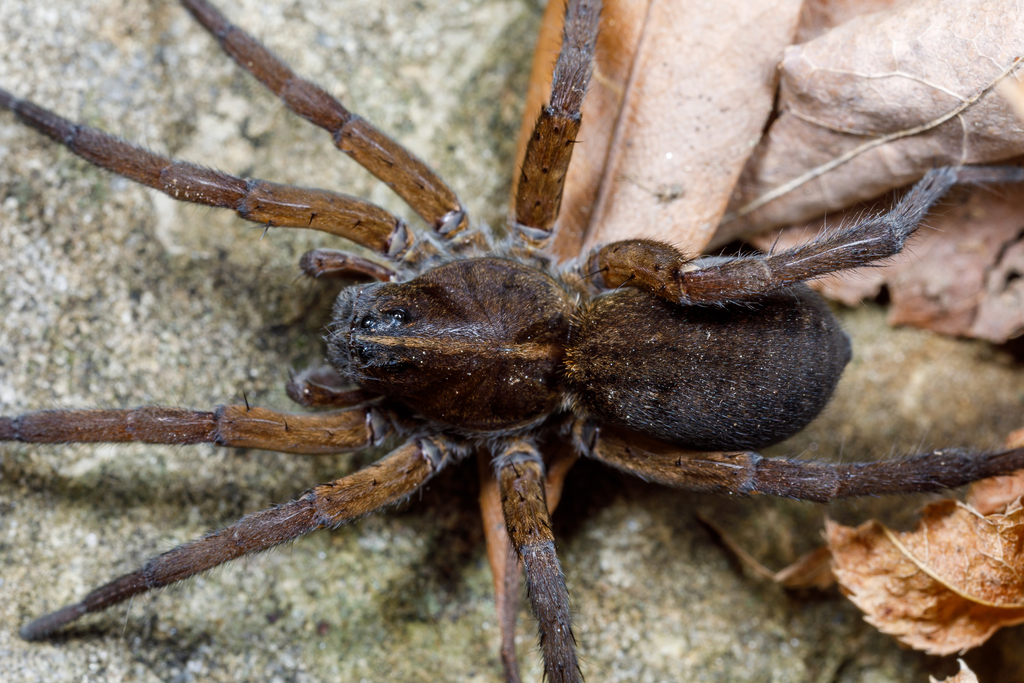
Wetland Giant Wolf Spider
Tigrosa helluo
Tigrosa helluo, commonly known as the Wetland Giant Wolf Spider, is a species of spider belonging to the family Lycosidae, also known as wolf spiders. T. helluo was formerly known as Hogna helluo before differences between dorsal color patterns, habitat preferences, body structures, etc. were discovered. The species is native to the United States, Canada, and Mexico. It can be found across the eastern half of the United States, primarily in the Northeast and New England, and as far west as Nebraska and Kansas. T. helluo can be found in diverse habitats including woods, marshes, fields, and riparian areas. Typically, members of this species prefer to live in wetter areas as opposed to dry environments. Males tend to live for around a year and females will live for close to two years.
The defining characteristic of T. helluo is its brown carapace and distinct yellow stripe starting from its anterior eyes extending down the cephalothorax. The underside of the abdomen has distinct black spots that distinguish T. helluo from other wolf spiders. At an average size of around 17 mm (0.67 in), T. helluo is one of the smaller wolf spiders. In addition, females tend to be larger than males in a display of sexual dimorphism.
From the article Tigrosa helluo on Wikipedia (CC BY-SA), quoted section by section
Description
Whereas average body length for Tigrosa can range from 10 to 31 mm (0.39 to 1.22 in) for females and 11 to 24 mm (0.43 to 0.94 in) for males, T. helluo body length averages 17 mm (0.67 in). Compared to its close relative T. aspersa, T. helluo is much smaller. T. helluo is also often mistaken for Pisaurina mira, the nursery web spider, due to the physical resemblance. However, the carapace of T. helluo consists of a brownish color contrasting with a distinctive yellow stripe that extends from the anterior eyes to the cephalothorax. Starting from the posterior median eyes, a set of fainter yellow stripes extends posteriorly. In addition, the underside of the abdomen is marked with several black spots. Patterns found on the dorsal side of the cephalothorax and abdomen are similar to those found on T. georgicola; however, the faint yellow stripes appearing on T. helluo do not extend as far. Black spots found on the abdomen of T. helluo are also not found on T. georgicola. Coloration in the legs differs between sexes, with males' legs appearing yellow without distinct markings and females' legs appearing reddish brown without additional markings or bands.
Range & habitat
In the United States, T. helluo can be found in a large variety of states in woods, marshes, and even grassy areas in northeastern states such as Connecticut. Females' nests are often found under stones or boards in fields and woods. These nests consist of burrows lined with silk. However, in states like Florida and Mississippi, T. helluo is most often found in wetter areas such as marshes and lakes.
Wikipedia: “Habitat”
What it does
Mating for T. helluo usually occurs in May or June. Males will live for just over one year while females will often live for around two years. Maturation occurs in males between May and September. Egg sacs are made in May and July and can range from 8 to 12 mm (0.31 to 0.47 in) in diameter. The eggs by themselves can appear tan or yellow and are around 1 to 2 mm (0.04 to 0.08 in) in diameter. Females will carry these eggs in an egg sac on their back until they hatch. Even after hatching, the female will continue to carry the hatchlings on her back until they mature enough to hunt by themselves. Female maturation can occur at any point during the year. Once mature, females will begin to overwinter during colder months. Males will typically die before it gets too cold. As T. helluo matures, it will molt periodically. Time and duration of molting is dependent on nutritional intake and consequent growth potential. The frequency of molting is based on the nutritional reserves of an individual T. helluo. Individuals that feed more often will molt less frequently during maturation.
Wikipedia: “Reproduction and life cycle”
Where it lives
Recorded sightings
—
geo-referenced records in GBIF, from museums, herbaria and field observers.
Drag the globe to turn it. Dots are where records exist, not a range map; darker means more records.
In the stacks
Searching the stacks…
Every page naming Tigrosa helluo in the Biodiversity Heritage Library →
This page is assembled live from iNaturalist, GBIF, Wikipedia, the Source Library and the Internet Archive. It is not yet part of the hand-edited codex. iNaturalist taxon 455063.