On eBird ↗
Whiskered Auklet
Live sightings near you, the range map, bar charts of when it is seen, and Macaulay Library photos and recordings.
Whiskered Auklet
Aethia pygmaea
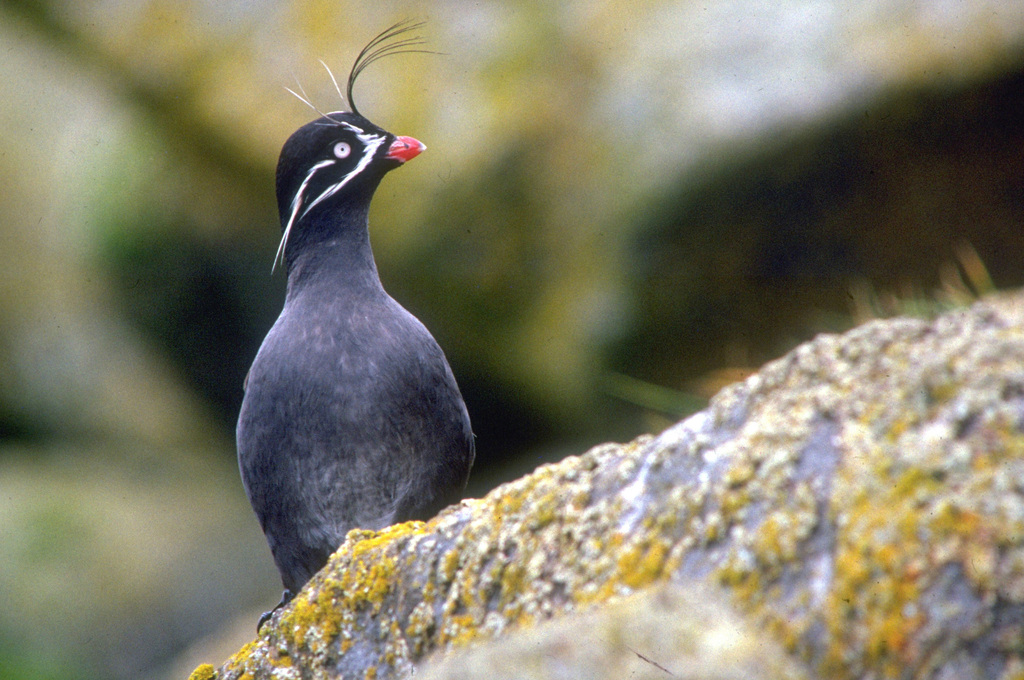
The whiskered auklet (Aethia pygmaea) is a small seabird of the auk family. It has a more restricted range than other members of its genus, Aethia, living only around the Aleutian Islands and on some islands off Siberia (like Commander Islands), and breeding on these islands. It is one of the smallest alcids, only the closely related least auklet being smaller. Its name is derived from the long white feathers on its face that are part of its breeding plumage.
The whiskered auklet is a poorly studied species and much research needs to be undertaken on the species. It was originally described as two different species, from specimens collected at different ends of its range, however research has shown that it is a single species with clinal variation along its range. It is not thought to undertake migration, but instead attends its breeding islands year round, and has been shown to roost on land all year round, an unusual trait in the family. Whiskered auklets lay a single egg in a rocky crevice, in loose colonies with other whiskered auklets and also other colonial seabirds. Both parents take part in incubation and chick rearing. The whiskers have been shown to help them sense their way to and out of their nests at night.
From the article Whiskered auklet on Wikipedia (CC BY-SA), quoted section by section
Description
An odd characteristic of this bird, which is also shared with the crested auklet, is that its plumage smells of citrus. Fishing boats pose a huge threat to this bird, since it is attracted to lights at night.
Listen
Looking for field recordings…
Where it lives
Recorded sightings
—
geo-referenced records in GBIF, from museums, herbaria and field observers.
Drag the globe to turn it. Dots are where records exist, not a range map; darker means more records.
In the stacks
Searching the stacks…
Every page naming Aethia pygmaea in the Biodiversity Heritage Library →
This page is assembled live from iNaturalist, GBIF, Wikipedia, the Source Library and the Internet Archive. It is not yet part of the hand-edited codex. iNaturalist taxon 4545.