On eBird ↗
Crested Auklet
Live sightings near you, the range map, bar charts of when it is seen, and Macaulay Library photos and recordings.
Crested Auklet
Aethia cristatella
The crested auklet (Aethia cristatella) is a small seabird of the family Alcidae, distributed throughout the northern Pacific and the Bering Sea. The species feeds by diving in deep waters, eating krill and a variety of small marine animals. It nests in dense colonies of up to 1 million individuals in the Bering Sea and the Sea of Okhotsk. It often breeds in mixed-species colonies with the least auklet, a smaller congener.
The species is known for its sexual ornaments, found in both males and females. These include colorful plumage with a forehead crest, a striking scent recalling citrus fruit, and a loud trumpet call, all of which appear to have evolved through sexual selection. The total population is around 6 million, almost half in North America. It is in general considered to be of least concern, though the Alaskan population faces additional threats from predation and oil spills.
From the article Crested auklet on Wikipedia (CC BY-SA), quoted section by section
Description
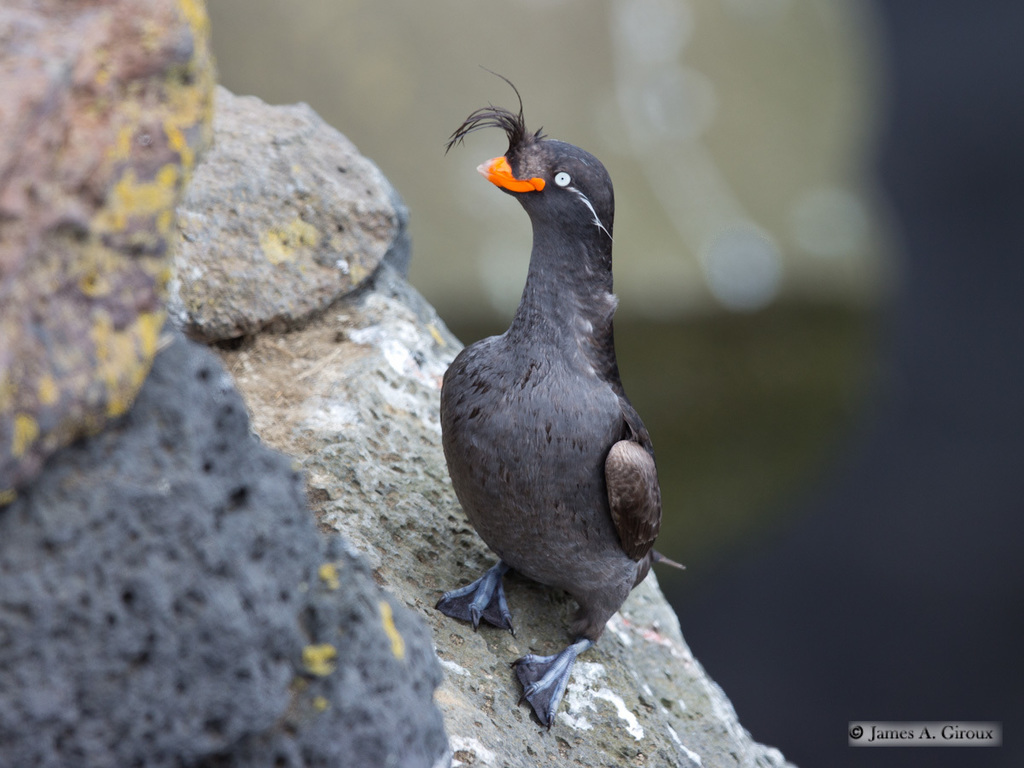
The crested auklet can measure 18–27 cm (7.1–10.6 in) in length, 34–50 cm (13–20 in) in wingspan and weigh 195–330 g (6.9–11.6 oz). They have a reddish-orange and yellow tipped bill, yellowish white irises, and white auricular plumes from their eyes to their ears. Their bodies, wings, and tails are primarily dark sooty grey, while their legs and feet are grey and claws black. The males and females are very similar, although the females have slightly smaller and less curved bills, additionally slightly smaller crests. Crested auklets are known for their forehead crests, which is made of black forward-curving feathers. These forehead crests are highly variable, and can have between two and twenty three narrow forward curving feathers. The average auklet has 12 crest feathers, which are of variable length, between 8.1 and 58.5 millimetres. Auklets have auricular plumes and a bright orange bill with curved accessory plates. Like forehead crests, these features vary widely within auklet populations. The crested auklet is recognized primarily by two characteristics during the breeding season. The first is its crest, a group of bristle feathers located on top of its head above its eyes. The second is a social odor that the auklets produce during the breeding season, described as smelling like tangerines. …
Range & habitat
Crested auklets are found throughout the northern Pacific Ocean and Bering Sea. They are particularly prevalent during the non-breeding winter months along the Aleutian Islands, Kuril Islands and the Russian island of Sakhalin. They travel to breeding locations on the islands and shorelines of the Sea of Okhotsk and the Bering Sea during the late spring and summer. Their habitats consist of slopes, boulder fields, lava flows, and sea cliffs. They are often found with other auklet species such as the least auklet. On a daily basis, crested auklets circle 500 meters above the sea and the breeding colonies. This circling is triggered by disturbances and predators posing a threat.
Wikipedia: “Distribution and habitat”
What it does
Crested auklets primarily forage in deep waters, however sometimes in areas closer to the shore, but always in large flocks. Little is known about the winter diets, however, it is suggested that they feed on a variety of marine invertebrates. Crested auklets are planktivores. Their diet consists mainly of krill, but they are also known to eat copepods, pteropods (such as Limacina), amphipods and larval fishes. Crested auklets dive from the surface of the water to catch their food. This behavior has been described as underwater "flight".
Wikipedia: “Diet”
Listen
Looking for field recordings…
Where it lives
Recorded sightings
—
geo-referenced records in GBIF, from museums, herbaria and field observers.
Drag the globe to turn it. Dots are where records exist, not a range map; darker means more records.
In the stacks
Searching the stacks…
Every page naming Aethia cristatella in the Biodiversity Heritage Library →
This page is assembled live from iNaturalist, GBIF, Wikipedia, the Source Library and the Internet Archive. It is not yet part of the hand-edited codex. iNaturalist taxon 4542.