- Animals
- ›Chordates
- ›Vertebrates
- ›Mammals
- ›Therians
- ›Placental Mammals
- ›Primates, Rodents, and Allies
- ›Rodents
- ›Mice, Rats, and Hamsters
- ›Muroids
- ›Old World Mice and Rats
- ›Murines
- ›Australasian Mice and Rats
- ›Xeromys
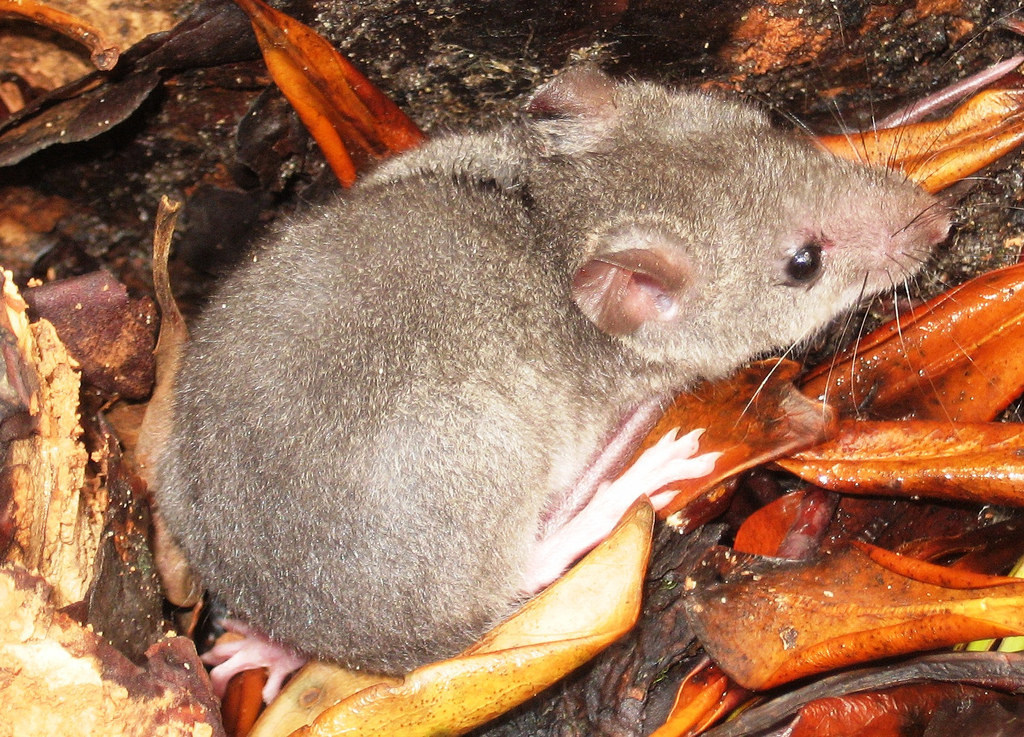
Water Mouse
Xeromys myoides
Xeromys myoides, also known as the water mouse, marine mouse, mangrove mouse, false water rat, manngay and yirrkoo, is a species of rodent native to waterways of Australia and Papua New Guinea.
From the article Xeromys myoides on Wikipedia (CC BY-SA), quoted section by section
Description
False water rats have markedly long, flattened heads with small eyes and short, rounded ears that are 10 to 14 millimetres in length. These rats possess just two molars on each side of the upper and lower jaw. Their upper incisors are yellow or orange and the lower incisors are white. The head and body length is approximately 100 mm and characterised by a hunched body shape, the recorded size range is from 85 to 120 mm. The tail length is 85–100 mm and the hind-foot length is 23–26 mm. The body fur is water-resistant and dark gray, which gradually blends into the white underside, the hair is short and lustrous. The hands and feet are covered with fine, white hairs. Their feet are not webbed like other water rats (Hydromys chrysogaster), which gives them their common name "false" water rat. The tail is sparsely haired and lacks the white tip found in the more common water rat. In addition, the tails of these rats are scaled. The average weight is 42 grams, and may vary from 35 to 55 g. This murid species has a total of four teats, two pairs at the inguinal region. They exude a strong musky odour.
X. myoides resembles no other species found within its habitat.
Range & habitat
The false water rat (Xeromys myoides) lives in Australia and Papua New Guinea. Once believed to be restricted to Southeast Queensland and the Northern Territory, the false water rat has subsequently been found in the central and southern parts of Queensland, North Stradbroke Island off the coast of Southeast Queensland, Melville Island, and southwest Western Province, Papua New Guinea. False water rats primarily live in mangrove communities and shallow areas surrounding lagoons, swamps, and lakes. The water may be saline or fresh. Their nests are made at the base of mangrove trees. Their nests are very similar to termite mounds. They are made of leaves, mud, and may be as high as 60 centimetres. There is usually one opening and on the inside it is a complex system of tunnels which connects to multiple chambers. Since the tunnels are very complex sometimes the homes can overlap. This behaviour shows that they are social and very friendly. Because of their lack of webbed feet and their inability to swim, their nests are generally built near shallow water. This allows them to wade in water instead of swimming and diving in search of their food.
Wikipedia: “Distribution and habitat”
What it does
False water rats appear to depend on mangrove and intertidal salt marsh habitats for food. Their diet consists of invertebrates such as crabs, small mud lobsters, marine shellfish, snails and worms. They generally eat during the night and rest during the day. Their estimated home range used for foraging is 0.8 ha for males and 0.6 ha for females; however they can travel for up to 2.9 km each night.
Wikipedia: “Diet”
Listen
Looking for field recordings…
Where it lives
Recorded sightings
—
geo-referenced records in GBIF, from museums, herbaria and field observers.
Drag the globe to turn it. Dots are where records exist, not a range map; darker means more records.
In the stacks
Searching the stacks…
Every page naming Xeromys myoides in the Biodiversity Heritage Library →
This page is assembled live from iNaturalist, GBIF, Wikipedia, the Source Library and the Internet Archive. It is not yet part of the hand-edited codex. iNaturalist taxon 45385.