- Animals
- ›Chordates
- ›Vertebrates
- ›Mammals
- ›Therians
- ›Placental Mammals
- ›Primates, Rodents, and Allies
- ›Rodents
- ›Mice, Rats, and Hamsters
- ›Muroids
- ›Old World Mice and Rats
- ›Murines
- ›Australasian Mice and Rats
- ›Pseudomys
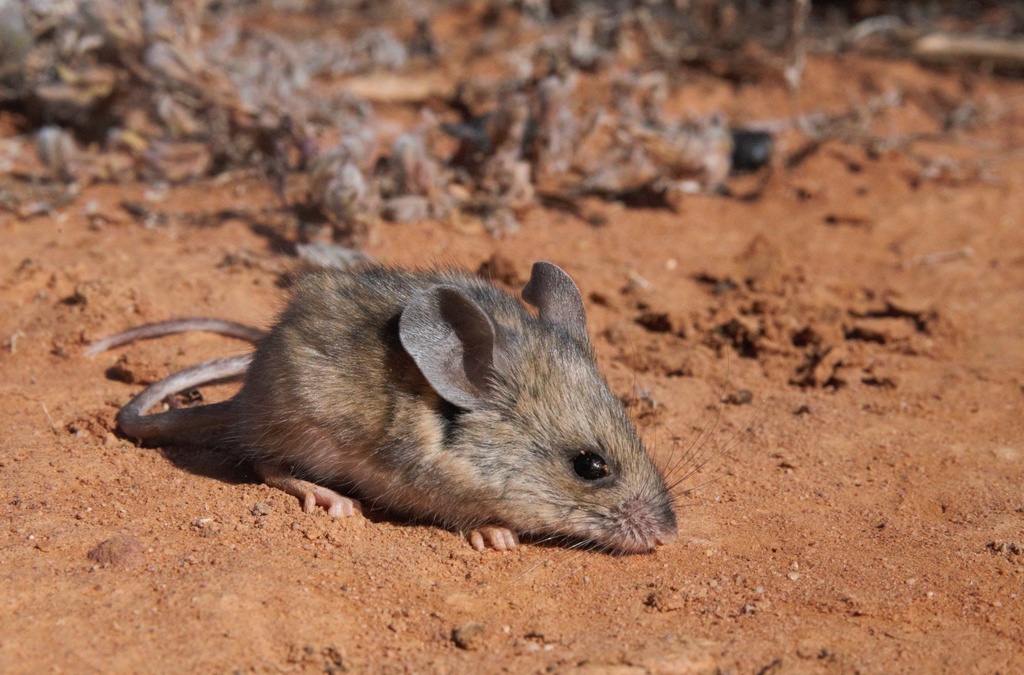
Bolam's Mouse
Pseudomys bolami
Bolam's mouse (Pseudomys bolami) is a species of nocturnal, burrowing rodent in the family Muridae that inhabits the semi arid and southern arid regions of Australia. It has a number of physiological and behavioural adaptations developed to cope with the extremely varied climatic conditions. Many of these adaptations allow it to survive in extremely arid conditions by conserving water. Examples of these adaptations include the ability survive by extracting water from seeds alone, the production of...
From the article Bolam's mouse on Wikipedia (CC BY-SA), quoted section by section
Description
Bolam's mouse is the size of a house mouse although slimmer in appearance with larger eyes, feet and ears with a longer tail. It is also quieter than a house mouse when handled and lacks a musty odour. Other distinguishing features include the absence of notched upper incisors which are characteristic of the house mouse. The weight of males and females is between 9 and 16 grams (0.32 and 0.56 oz). The body length is 50–80 millimetres (2.0–3.1 in) with a tail length of 71–103 mm (2.8–4.1 in). The fur is a dull grey-brown that blends from white at the base to much darker at the tips. It is very similar in appearance to the sandy inland mouse, Pseudomys hermannsburgensis, but with a longer hindfoot (18.4–20.1 mm (0.72–0.79 in)), 4–6 hairs per tail scale and longer ears (15.2–18.6 mm (0.60–0.73 in)).
Range & habitat
It has a wide distribution that ranges from south west Western Australia through South Australia to south western New South Wales. The range of the species has declined in recent times with the species no longer found in the Sunset region of South Australia and Victoria. Fossil evidence shows that its range has also contracted in New South Wales where it formerly occupied much of the west of the state including Mutawintji National Park in the north west. The range of Bolam's mouse is generally south of that of the sandy inland mouse with very little overlap in distribution.
Wikipedia: “Distribution”
What it does
Bolam's mouse is an omnivorous rodent that feeds on a mixture of seed, plant material, invertebrates and fungus. Due to the high variability of food resources available to P. bolami its diet is seasonally varied. Generally seeds particularly those of Maireana astrotricha occupy the majority of the diet when conditions are suitable for seed production. Plant material including leaves, floral material, stems and roots generally make up more than 30% of the diet. Invertebrates make up more than 10% of the diet and fungus makes up less than 1%.
Wikipedia: “Diet”
Listen
Looking for field recordings…
Where it lives
Recorded sightings
—
geo-referenced records in GBIF, from museums, herbaria and field observers.
Drag the globe to turn it. Dots are where records exist, not a range map; darker means more records.
In the stacks
Searching the stacks…
Every page naming Pseudomys bolami in the Biodiversity Heritage Library →
This page is assembled live from iNaturalist, GBIF, Wikipedia, the Source Library and the Internet Archive. It is not yet part of the hand-edited codex. iNaturalist taxon 45213.