- Animals
- ›Chordates
- ›Vertebrates
- ›Mammals
- ›Therians
- ›Placental Mammals
- ›Primates, Rodents, and Allies
- ›Rodents
- ›Mice, Rats, and Hamsters
- ›Muroids
- ›Old World Mice and Rats
- ›Murines
- ›Australasian Mice and Rats
- ›Pseudomys
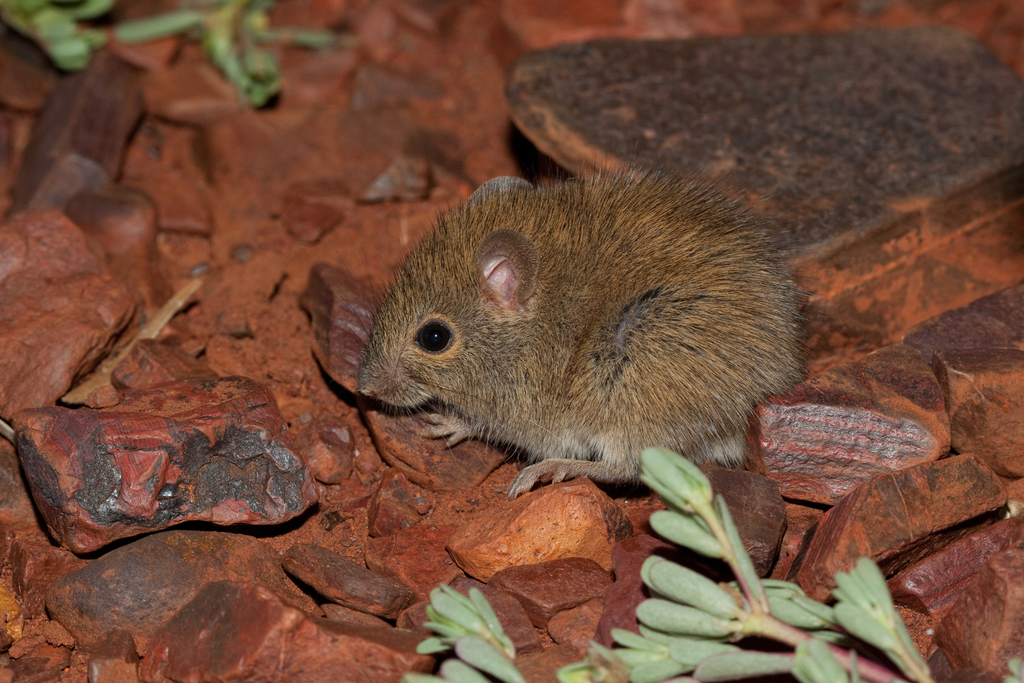
Desert Mouse
Pseudomys desertor
The desert mouse (Pseudomys desertor), also known as the brown desert mouse, is a species of rodent in the family Muridae. It is endemic to Australia. The first desert mouse specimen was collected by Australian zoologist Gerard Krefft on the Blandowski Expedition in 1856-57, between Gol Gol Creek and the Darling River.
From the article Desert mouse on Wikipedia (CC BY-SA), quoted section by section
Description
The desert mouse has bright chestnut brown fur above, interspersed with long dark guard hairs which give it a spiny appearance. Its belly fur is a light grey-brown. The tail looks scaly and slightly bi-coloured, with length equal to or shorter than the animal's head-body length. A defining feature of the desert mouse is its pale orange eye-ring, which may be used to distinguish it from the Western chestnut mouse Pseudomys nanus where their habitat overlaps in the northern Tanami Desert. Typical measurements for the desert mouse are 70–105 mm for head-body length, and 67–103 mm for tail length. Weight is between 15-35 g.
Range & habitat
Widespread throughout the arid zone of Australia, the desert mouse also inhabits in the north dry savannah region of Queensland. Its preferred habitat ranges from sand dunes with spinifex to rocky hillsides, which it uses to create shallow burrows. Fossilized remains of the desert mouse have been found from Cape Range National Park and the Nullarbor Plain in Western Australia, to the northern Flinders Ranges of South Australia, and Lake Victoria in New South Wales. When combined with modern records, these fossil records suggest that the species once had an even more extensive range across arid Australia.
Wikipedia: “Distribution and habitat”
What it does
Predominantly a folivore, the desert mouse has also been known to eat seeds and invertebrates when leaves and shoots are less widely available. Laboratory studies of the desert mouse have found its water requirements to be quite low.
Wikipedia: “Diet”
Listen
Looking for field recordings…
Where it lives
Recorded sightings
—
geo-referenced records in GBIF, from museums, herbaria and field observers.
Drag the globe to turn it. Dots are where records exist, not a range map; darker means more records.
In the stacks
Searching the stacks…
Every page naming Pseudomys desertor in the Biodiversity Heritage Library →
This page is assembled live from iNaturalist, GBIF, Wikipedia, the Source Library and the Internet Archive. It is not yet part of the hand-edited codex. iNaturalist taxon 45204.