- Animals
- ›Chordates
- ›Vertebrates
- ›Mammals
- ›Therians
- ›Placental Mammals
- ›Primates, Rodents, and Allies
- ›Rodents
- ›Mice, Rats, and Hamsters
- ›Muroids
- ›Old World Mice and Rats
- ›Murines
- ›Australasian Mice and Rats
- ›Pseudomys
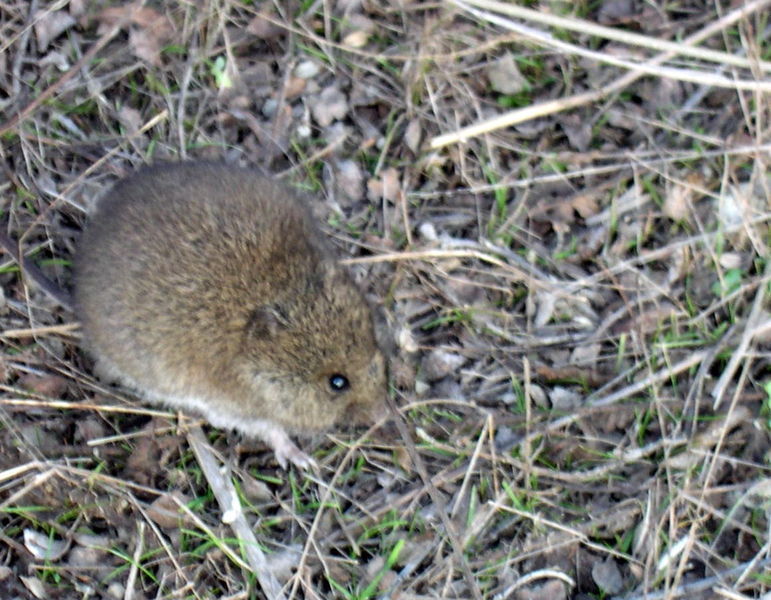
Western Mouse
Pseudomys occidentalis
The western mouse or walyadji (Pseudomys occidentalis) is a species of rodent in the family Muridae. Once widespread across a larger range, it has become restricted to around ten reserves of remnant bushland in Southwest Australia and declared near threatened by extinction. They are small and robust mice that live in burrows in sandy soil, venturing out at night to forage in nearby area.
From the article Western mouse on Wikipedia (CC BY-SA), quoted section by section
Description
This mouse is roughly 10 centimeters long, not counting its tail, which may be up to 14 centimeters in length. It weighs an average of 34 grams. It has a soft, fine, dark gray and yellowish buff pelage that is interspersed with black guard hairs. The feet are white. The species is distinguished by the aquiline profile of nose, and its long tail. The range of measurements for the head and body combined is 88 to 110 millimetres, exceeded by the tail's length of 120 to 140 mm. The hind feet of Pseudomys occidentalis are 24 to 28 mm, relatively long for the genus, with interdigital pads that are larger than the terminal pads. The proportion of the pads and lack of granulation over the surface of the hind foot distinguishes the species from the ash-grey species Pseudomys albocinereus. They have two pairs of inguinal teats. The weight range of the species is 30 to 55 grams.
Range & habitat
The distribution range once extended across Southwest Australia and into the arid interior, this became restricted to a few areas near the Ravensthorpe Range, at Fitzgerald River National Park, and several isolated populations in the southern wheatbelt. This mouse lives in loamy soils in areas that have not been burnt recently, and not known at any location that has been subjected to fire in the preceding 30 to 50 years. The terrain has climax vegetation, especially the desert quandong Santalum acuminatum and sedge-like plants. The substrate of the ecological communities in which they are known to remain is sandy or sandy-clay soil that is often intermixed with gravel. Plant genera associated with their remnant sites are Eucalyptus, Acacia, Isopogon, Allocasuarina and Melaleuca, and the vegetation of their habitat is highly variable, including open woodlands, low and tall shrubland, mallee and heath in open to dense arrangements of plants. After being identified in 1951, the species was known by five specimens until the region's survey and collection of mammals was begun by the state's museum in 1971.
Wikipedia: “Distribution and habitat”
What it does
The subterranean nests have a single entrance, a shaft that connects to a network 200 to 300 millimetres below the ground. The main tunnel has a nest site at the opposite end of a loop, two to three metres from the entrance, with a network of other loops extending as annexes to the central tunnel. The site may be occupied by up to ten individuals.
Wikipedia: “Behaviour”
Listen
Looking for field recordings…
Where it lives
Recorded sightings
—
geo-referenced records in GBIF, from museums, herbaria and field observers.
Drag the globe to turn it. Dots are where records exist, not a range map; darker means more records.
In the stacks
Searching the stacks…
Every page naming Pseudomys occidentalis in the Biodiversity Heritage Library →
This page is assembled live from iNaturalist, GBIF, Wikipedia, the Source Library and the Internet Archive. It is not yet part of the hand-edited codex. iNaturalist taxon 45201.