- Animals
- ›Chordates
- ›Vertebrates
- ›Mammals
- ›Therians
- ›Placental Mammals
- ›Primates, Rodents, and Allies
- ›Rodents
- ›Mice, Rats, and Hamsters
- ›Muroids
- ›Old World Mice and Rats
- ›Murines
- ›Australasian Mice and Rats
- ›Notomys
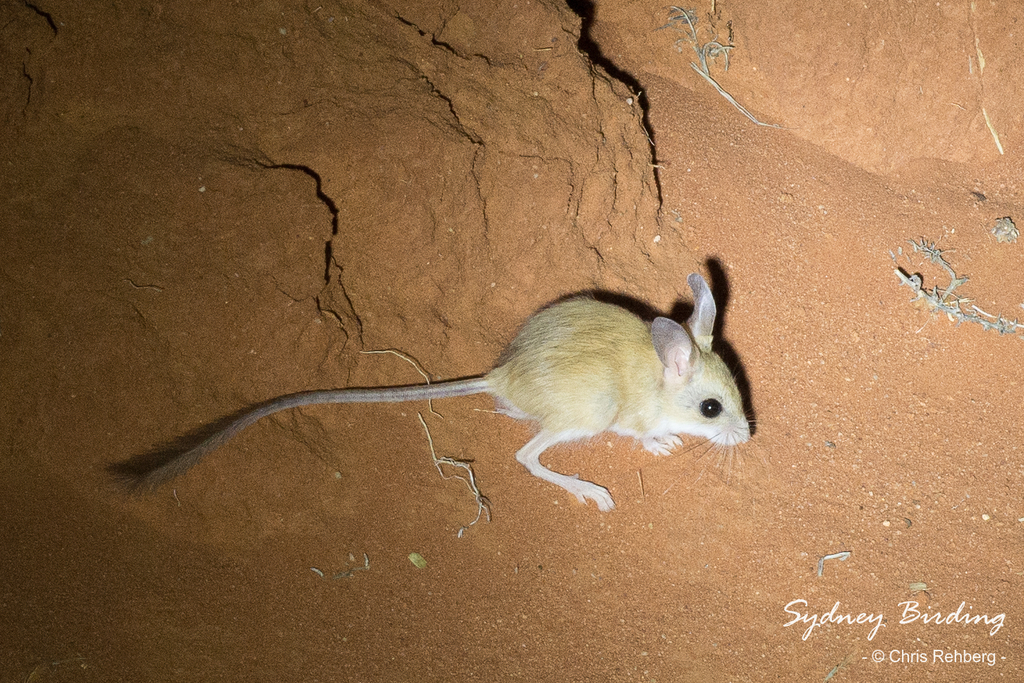
Dusky Hopping Mouse
Notomys fuscus
The dusky hopping mouse (Notomys fuscus) is an Australian native rodent specialised for the deep desert. Like all hopping mice it has strong front teeth, a long tail, dark eyes, big ears, well-developed haunches and very long, narrow hind feet. It weighs between 20 and 50 g (0.71 and 1.76 oz). (Compare with the common house mouse, at 10 to 25 g (0.35 to 0.88 oz).)
From the article Dusky hopping mouse on Wikipedia (CC BY-SA), quoted section by section
Description
The dusky hopping mouse has pale orange-brown upper parts, occasionally with grey tinged streaks. The under parts are grey-white. It grows to 80–115 mm long, with an average weight of 35 g. The tail is between 120 and 155 mm long, ending in a tuft of dark hairs. They have a well-developed throat pouch, with an opening surrounded by a fleshy margin with inward pointing, coarse white hairs. Its ears are large and furless for dissipating heat, and they have prominent dark eyes, and strong incisor teeth. It has short front legs, and long, elongated hind feet. with only three pads on the sole. Male reproductive anatomy is distinctive. The glans is small and tapered towards the tip. The surface has large dorsally projecting spines, with slightly curved tips. The testes are extremely small compared to other native rodents. Females have two pairs of inguinal teats.
Range & habitat
The species historically inhabited large areas of central Australia, south-west Queensland, and far west South Australia, and Western Australia. Sub-fossil specimens were found in far-south South Australia, near the Flinders Ranges. Populations were recorded in the Northern Territory, however have not been observed since 1939. Distribution has shown a marked decline of more than 90% since the arrival of Europeans, with populations now patchy and highly fragmented. It is currently thought to be restricted to the Cobblers Sandhills and Strzelecki Desert in north-east South Australia, south-west Queensland and far north-west New South Wales. The species was presumed to be extinct in New South Wales, before being re-discovered in Sturt National Park in 2003. Since then, a number of sightings have been recorded near Broken Hill, New South Wales.
Wikipedia: “Distribution”
What it does
The dusky hopping mouse is a social species, living in colonies of up to five individuals. They live in burrows consisting of vertical shafts with a series of entrances approximately 3 cm in diameter, leading to a network of horizontal tunnels and chambers extending up to 2m deep. Notomys species dig their burrows from below, resulting in an absence of loose sand surrounding the entrance holes. This species prefers to forage at night in sheltered microhabitats, rather than open areas, to avoid the risk of predation. It is an opportunistic, omnivorous feeder, however is considered a granivore (74% of the diet). Green plant material, insects, and fruits are also eaten. It does not need to drink water. The neck throat pouch is a glandular area, used for marking territories. Females may scent-mark their young, ensuring they acquire a smell that grants them acceptance within the colony.
Wikipedia: “Behaviour”
Listen
Looking for field recordings…
Where it lives
Recorded sightings
—
geo-referenced records in GBIF, from museums, herbaria and field observers.
Drag the globe to turn it. Dots are where records exist, not a range map; darker means more records.
In the stacks
Searching the stacks…
Every page naming Notomys fuscus in the Biodiversity Heritage Library →
This page is assembled live from iNaturalist, GBIF, Wikipedia, the Source Library and the Internet Archive. It is not yet part of the hand-edited codex. iNaturalist taxon 45114.