- Fungi Including Lichens
- ›Basidiomycete Fungi
- ›Higher Basidiomycetes
- ›Mushrooms, Bracket Fungi, Puffballs, and Allies
- ›Agaricomycetidae
- ›Common Gilled Mushrooms and Allies
- ›Omphalinineae
- ›Omphalinaceae
- ›Infundibulicybe
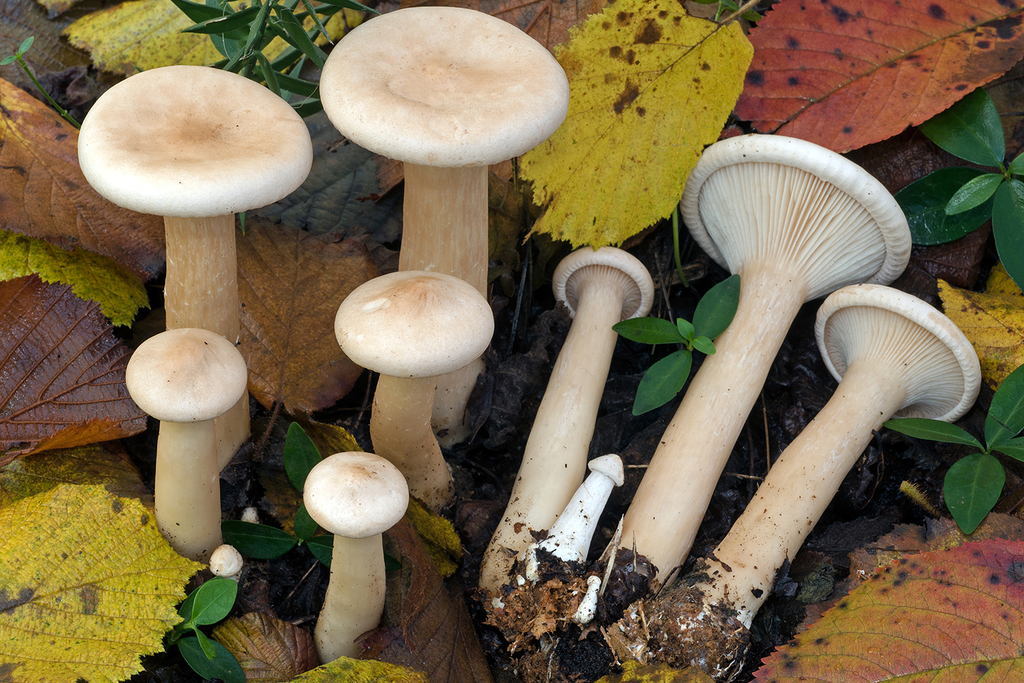
Trooping Funnel
Infundibulicybe geotropa
Infundibulicybe geotropa, also known as the trooping funnel or monk's head, is a funnel-shaped toadstool widely found in Europe and (less commonly) in North America. A large sturdy cream- or buff-coloured funnel-shaped mushroom, it grows in mixed woodlands, often in troops or fairy rings, one of which is over half a mile wide. Although edible, it could be confused with some poisonous species of similar colouration and size.
From the article Infundibulicybe geotropa on Wikipedia (CC BY-SA), quoted section by section
Description
A cream- or buff-coloured mushroom, the cap may reach 20 cm (8 in) in diameter. It has a prominent boss and looks small in relation to the large stem in young specimens. As the mushroom ages, the cap changes from convex with inrolled margins to more funnel shaped. The decurrent gills are the same colour as the cap. The stipe is bulbous, larger at the base and 10–20 cm (4–8 in) high. The spore print is white. There is a sweet smell, which has been likened to the odour of bitter almonds. The white flesh is firm in young specimens.
Similar species. It can be mistaken for the similar-coloured and also edible miller (Clitopilus prunulus), but the latter species has pink spores. However, there are a number of similar white or pale mushrooms which are poisonous; young specimens of Entoloma sinuatum can be distinguished by their sinuate gills and mealy smell. The unpleasant-tasting Melanoleuca grammopodia is similar, but has a more pale brownish cap and musky odour.
Range & habitat
Trooping funnel is found in mixed woodlands, especially grassy clearings, in autumn. Often gregarious, it can form fairy rings, and has a complex mycelium. It is abundant and widespread in Europe (August to November), and less common in North America. One fairy ring in Belfort, eastern France, has been reported at over half a mile in diameter and estimated at 800 years of age. It is thought to be the largest known fairy ring.
Wikipedia: “Distribution and habitat”
At the table
Only young mushrooms are recommended for eating, as older ones lose their pleasant taste, and the flesh becomes leathery in consistency. The stipes of all aged specimens are generally discarded. The fungus is popular in northern Italy, where it is roasted or cooked in stews and frittatas, or preserved in oil.
== References ==
Wikipedia: “Edibility”
Where it lives
Recorded sightings
—
geo-referenced records in GBIF, from museums, herbaria and field observers.
Drag the globe to turn it. Dots are where records exist, not a range map; darker means more records.
In the stacks
Searching the stacks…
Every page naming Infundibulicybe geotropa in the Biodiversity Heritage Library →
This page is assembled live from iNaturalist, GBIF, Wikipedia, the Source Library and the Internet Archive. It is not yet part of the hand-edited codex. iNaturalist taxon 451026.