- Animals
- ›Chordates
- ›Vertebrates
- ›Mammals
- ›Therians
- ›Placental Mammals
- ›Primates, Rodents, and Allies
- ›Rodents
- ›Mice, Rats, and Hamsters
- ›Muroids
- ›Hamsters, Voles, Lemmings, and Allies
- ›South American Mice and Rats
- ›Oldfield and Climbing Mice
- ›Chilomys
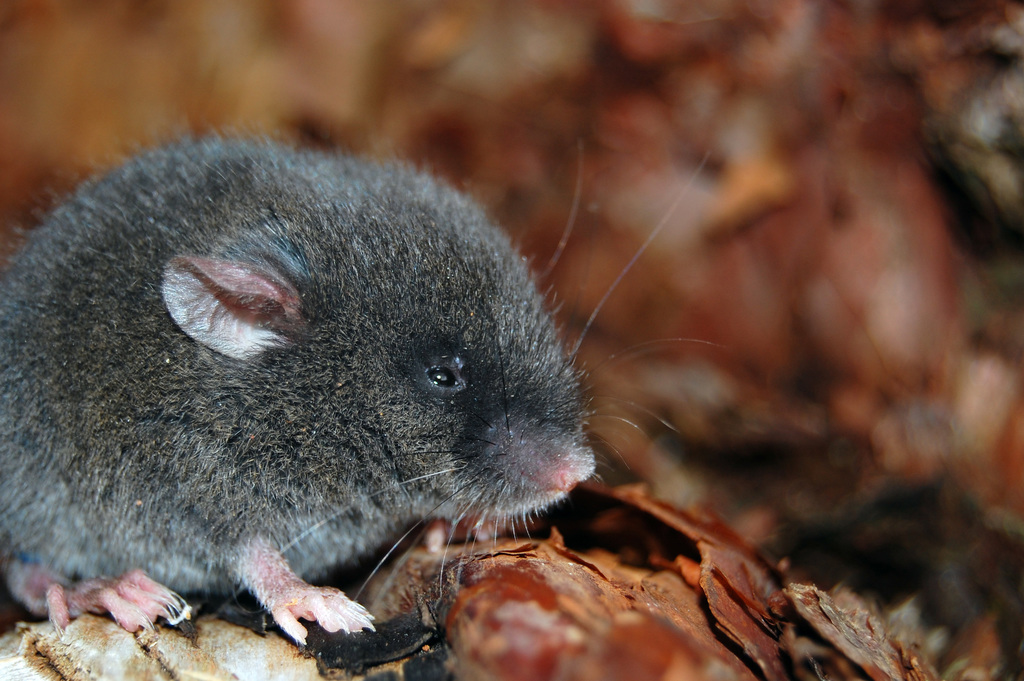
Colombian forest mouse
Chilomys instans
The Colombian forest mouse (Chilomys instans) is a species of rodent in the family Cricetidae. Some authorities consider it to be the only species in the genus Chilomys, while others accept Chilomys fumeus as being a valid species, and it may form part of a species complex. It is found in Colombia, Ecuador, and Venezuela.
From the article Colombian forest mouse on Wikipedia (CC BY-SA), quoted section by section
Description
Chilomys instans is very similar to Chilomys fumeus in size and appearance. Both are small sigmodontines, with a head-and-body length of 72 to 102 mm (2.8 to 4.0 in) and a tail length of 102 to 137 mm (4.0 to 5.4 in). The ears are medium-sized and clad in short hairs, and the body fur is woolly and short. The dorsal surface is dark grey to greyish-brown and the underparts are a similar colour. The hind feet are narrow, and the slender tail is clad with short hairs, and often has a white tip. There are three pairs of mammary glands. The chief differences between the two species lies in the morphology of the skull.
Range & habitat
The Colombian forest mouse is native to South America. It occurs in mountainous areas of Venezuela, Colombia and Ecuador, in humid forests at altitudes of between 1,000 and 3,700 m (3,300 and 12,100 ft).
Wikipedia: “Distribution and habitat”
What it does
Little is known of the behaviour. It seems to be nocturnal and lives on the ground where it creates runways among the mosses of the forest floor. Its diet includes insects, worms and plant material, and three new species of beetle have been identified from the stomach contents of this mouse in Colombia. The larger woodland Oldfield mouse (Thomasomys hylophilus) shares its range.
Wikipedia: “Ecology”
Listen
Looking for field recordings…
Where it lives
Recorded sightings
—
geo-referenced records in GBIF, from museums, herbaria and field observers.
Drag the globe to turn it. Dots are where records exist, not a range map; darker means more records.
In the stacks
Searching the stacks…
Every page naming Chilomys instans in the Biodiversity Heritage Library →
This page is assembled live from iNaturalist, GBIF, Wikipedia, the Source Library and the Internet Archive. It is not yet part of the hand-edited codex. iNaturalist taxon 45054.