- Animals
- ›Chordates
- ›Vertebrates
- ›Mammals
- ›Therians
- ›Placental Mammals
- ›Primates, Rodents, and Allies
- ›Rodents
- ›Mice, Rats, and Hamsters
- ›Muroids
- ›Hamsters, Voles, Lemmings, and Allies
- ›Vesper Rats
- ›Otonyctomys
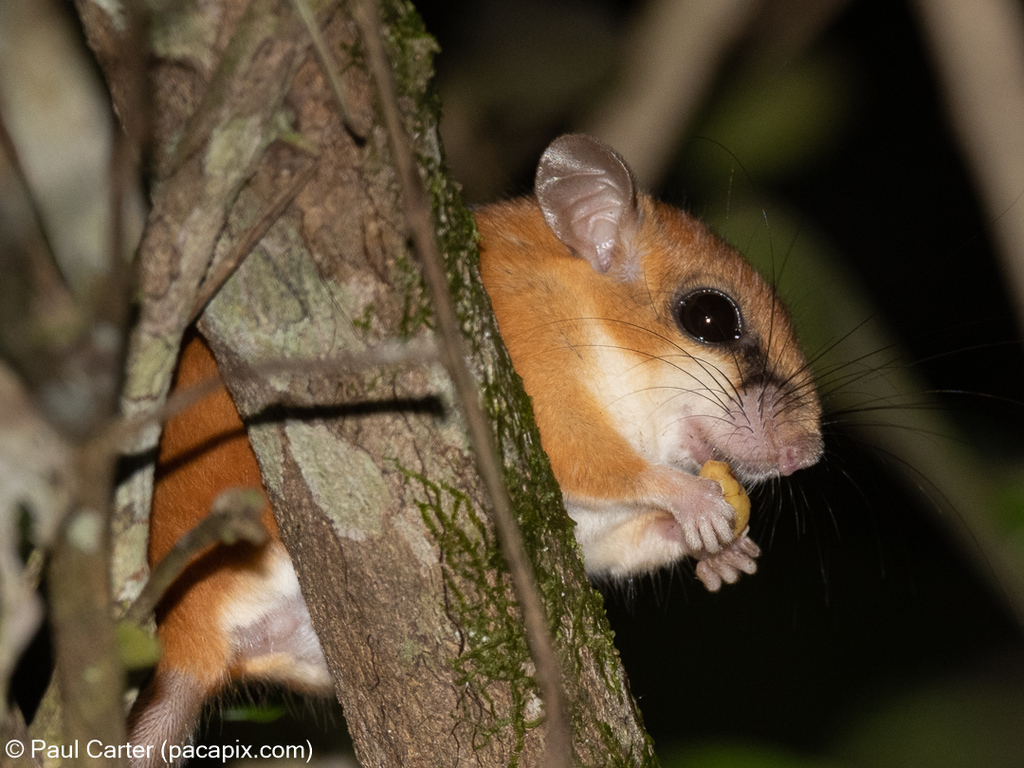
Hatt's Vesper Rat
Otonyctomys hatti
Hatt's vesper rat (Otonyctomys hatti), also known as Hatt's vesper mouse or Yucatán vesper rat, is a species of rodent in the family Cricetidae. It is the only species in the genus Otonyctomys. It is named for its discoverer, Robert T. Hatt.
From the article Hatt's vesper rat on Wikipedia (CC BY-SA), quoted section by section
Description
Hatt's vesper rat has a typical rat-like appearance, and closely resembles the related Sumichrast's vesper rat, from which it can most easily be distinguished by its much larger auditory bullae. It is relatively small for a rat, both sexes having a head body length of 9 to 12 centimetres (3.5 to 4.7 in), and a long, 6 to 13 centimetres (2.4 to 5.1 in), tail. Adults weigh from 23 to 36 grams (0.81 to 1.27 oz). The rat is brightly coloured, with bright russet or yellowish fur over most of the body, and creamy or white underparts. The face has a short, rounded snout, and conspicuous black markings in front of the eyes, stretching as far as the whiskers. Younger individuals tend to be duller in colour, and have less glossy fur than the adults. The tail is thickly covered with brown fur along its entire length, although the ears are largely hairless. Females have four abdominal teats.
Range & habitat
Hatt's vesper rat is found throughout the Yucatán Peninsula, in the Mexican states of Campeche, Yucatán, and Quintana Roo, and in northern Guatemala and Belize. It inhabits broadleaf tropical forests close to water and below about 250 metres (820 ft) elevation. It has generally been recorded in trees or lianas, on fallen wood, or even in the rafters of houses, and may be largely arboreal in its habits.
Wikipedia: “Distribution and habitat”
Listen
Looking for field recordings…
Where it lives
Recorded sightings
—
geo-referenced records in GBIF, from museums, herbaria and field observers.
Drag the globe to turn it. Dots are where records exist, not a range map; darker means more records.
In the stacks
Searching the stacks…
Every page naming Otonyctomys hatti in the Biodiversity Heritage Library →
This page is assembled live from iNaturalist, GBIF, Wikipedia, the Source Library and the Internet Archive. It is not yet part of the hand-edited codex. iNaturalist taxon 45023.