- Animals
- ›Chordates
- ›Vertebrates
- ›Mammals
- ›Therians
- ›Placental Mammals
- ›Primates, Rodents, and Allies
- ›Rodents
- ›Mice, Rats, and Hamsters
- ›Muroids
- ›Hamsters, Voles, Lemmings, and Allies
- ›Hamsters
- ›Cricetulus
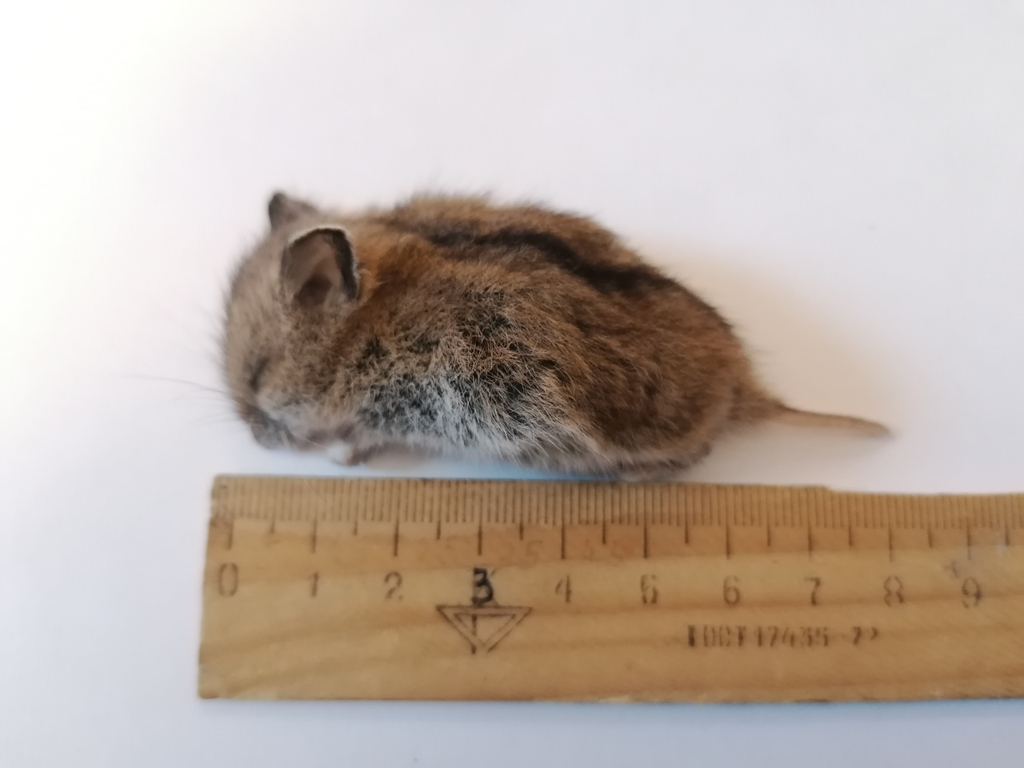
Striped Dwarf Hamster
Cricetulus barabensis
The Chinese striped hamster (Cricetulus barabensis), also known as the striped dwarf hamster, is a species of hamster. It is distributed across North Asia from southern Siberia through Mongolia and northeastern China to northern North Korea. An adult Chinese striped hamster weighs 20 to 35 g (0.7 to 1.2 oz), and has a body length of 72 to 116 mm (2.8 to 4.6 in) with a tail of 15 to 26 mm (0.6 to 1.0 in). It is smaller and has a much shorter tail than the greater long-tailed hamster, Tscherskia triton, which inhabits much of the same range.
From the article Chinese striped hamster on Wikipedia (CC BY-SA), quoted section by section
Description
The Chinese striped hamster has a head and body length of between 72 and 116 mm (2.8 and 4.6 in) and a tail length of 15 to 26 mm (0.6 to 1.0 in) and a weight of 20 to 35 g (0.7 to 1.2 oz). The snout is short, the eyes set wide apart and the ears are neat and rounded, blackish fringed with white. The dorsal surface is pale greyish-brown with a faint blackish dorsal stripe running along the spine. The underparts are grey, the hairs having white tips. The tail is about thirty percent of the combined length of the head and body.
Range & habitat
The Chinese striped hamster is native to central and eastern Asia. Its range includes Western Siberia, Tuva, the Trans-Baikal region, Mongolia, northeastern China, Primorsky Krai and Korea. Its typical habitat is arid and semiarid grasslands, steppe and semi-desert. It also occupies farmland and sometimes moves into buildings.
Wikipedia: “Distribution and habitat”
What it does
The Chinese striped hamster digs a burrow in which several individuals live. This is up to a metre long and up to half a metre below the surface of the ground. There are usually several entrances about 2.5 cm (1 in) in diameter and side passages ending in storage chambers or nesting chambers. This hamster is most active in the early hours of the night when it emerges from its burrow to forage for seeds of grains and legumes. It carries food in its cheek pouches and excess food is stored in the burrow. It hibernates during the winter, emerging in February or March. Reproductive activity takes place through spring, summer and autumn, and there may be as many as five litters in this period. Breeding peaks in March and April, and there is another peak in autumn. The average litter size is six or seven, but up to ten offspring have been recorded.
Wikipedia: “Behaviour”
Listen
Looking for field recordings…
Where it lives
Recorded sightings
—
geo-referenced records in GBIF, from museums, herbaria and field observers.
Drag the globe to turn it. Dots are where records exist, not a range map; darker means more records.
In the stacks
Searching the stacks…
Every page naming Cricetulus barabensis in the Biodiversity Heritage Library →
This page is assembled live from iNaturalist, GBIF, Wikipedia, the Source Library and the Internet Archive. It is not yet part of the hand-edited codex. iNaturalist taxon 44913.