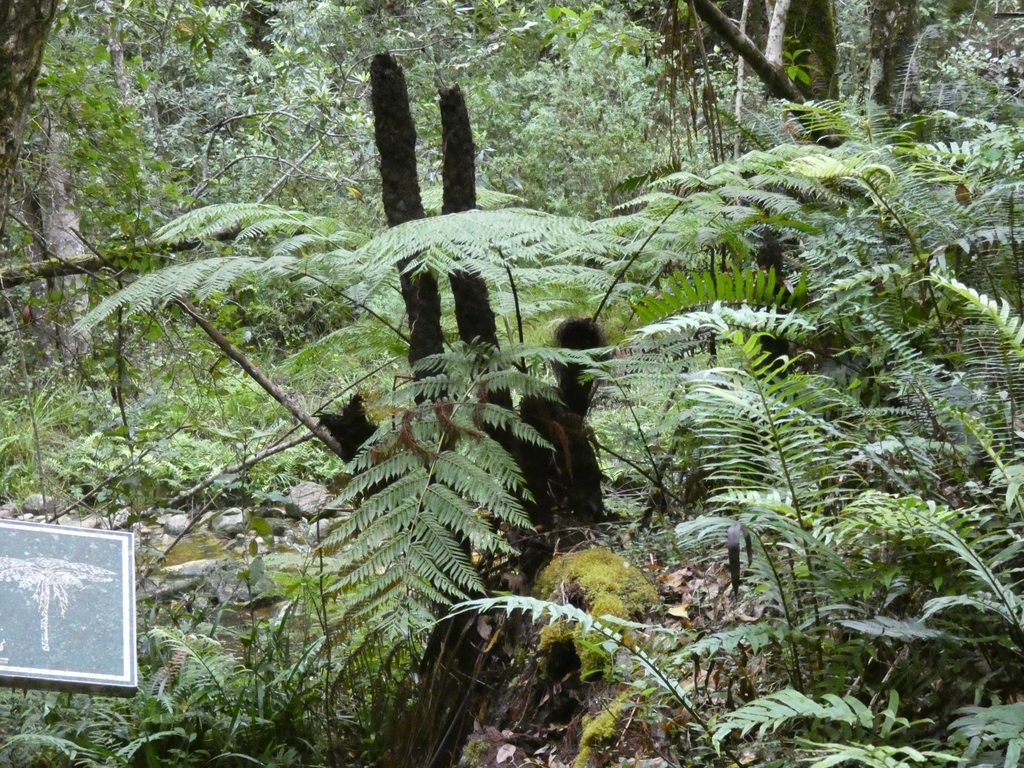
Forest Tree Fern
Cyathea capensis
Gymnosphaera capensis, synonyms Alsophila capensis and Cyathea capensis, (known as the "forest tree fern") is a regionally widespread and highly variable species of tree fern. It is indigenous to Southern Africa (subsp. capensis) and South America (subsp. polypodioides).
From the article Gymnosphaera capensis on Wikipedia (CC BY-SA), quoted section by section
Description
Both subspecies of Gymnosphaera capensis have a slender, erect trunk that is up to 4.5 metres (15 ft) tall (occasionally even 6 metres (20 ft)) and about 15 cm in diameter. The fronds are tripinnate, born on long stipes (stalks), and 2–3 m in length. The main stem of the leaf (rachis) is smooth to slightly warty and covered in scales that range from tan to brown or dark brown. The frond stalks are covered with dark brown or black scales. The smallest leaflets (pinnae) have toothed (serrated) margins. The lowest pinnae may be separated from the others along the rachis and form a clump around the crown, similar to the "wig" of Gymnosphaera baileyana. This moss-like tuft of tiny, reduced leaves is distinctive for Gymnosphaera capensis, and can be used to identify this species across its range. The sori occur in two rows, one along each side of the pinnule midvein, and are covered by scale-like indusia.
Range & habitat
This fern is the only member of the family Cyatheaceae native to both Africa and the Americas. The species is divided into two subspecies:
Gymnosphaera capensis ssp. capensis is native to the Old World tropics in Africa. It is found in Malawi, Mozambique, Tanzania, Eswatini (Swaziland), Zimbabwe, and South Africa (from the Western Cape province to KwaZulu-Natal and Mpumalanga). It grows in cool, shady, moist forest, beside rivers and waterfalls. It is found at elevations of 360–1,820 metres (1,180–5,970 ft). The specific epithet capensis refers to the Cape of Good Hope in South Africa, where the type specimen was collected. Gymnosphaera capensis subsp. polypodioides is native to the New World tropics in South America. It is endemic to southeastern Brazil in montane Atlantic Forest habitats, at elevations of 900–2,000 metres (3,000–6,600 ft).
Wikipedia: “Distribution”
How it is grown
Gymnosphaera capensis is cultivated as an ornamental plant. It is relatively easy to grow if provided with a semi-shady, moist and sheltered environment, and can likely tolerate several degrees of frost.
== References ==
Wikipedia: “Cultivation”
Where it lives
Recorded sightings
—
geo-referenced records in GBIF, from museums, herbaria and field observers.
Drag the globe to turn it. Dots are where records exist, not a range map; darker means more records.
In the stacks
Searching the stacks…
Every page naming Cyathea capensis in the Biodiversity Heritage Library →
This page is assembled live from iNaturalist, GBIF, Wikipedia, the Source Library and the Internet Archive. It is not yet part of the hand-edited codex. iNaturalist taxon 447717.