- Animals
- ›Chordates
- ›Vertebrates
- ›Ray-finned Fishes
- ›Spiny-rayed fishes
- ›Pipefishes and Allies
- ›Syngnathoidei
- ›Pipefishes, Seahorses, and Seadragons
- ›Tail-brooding Pipefishes
- ›Syngnathus
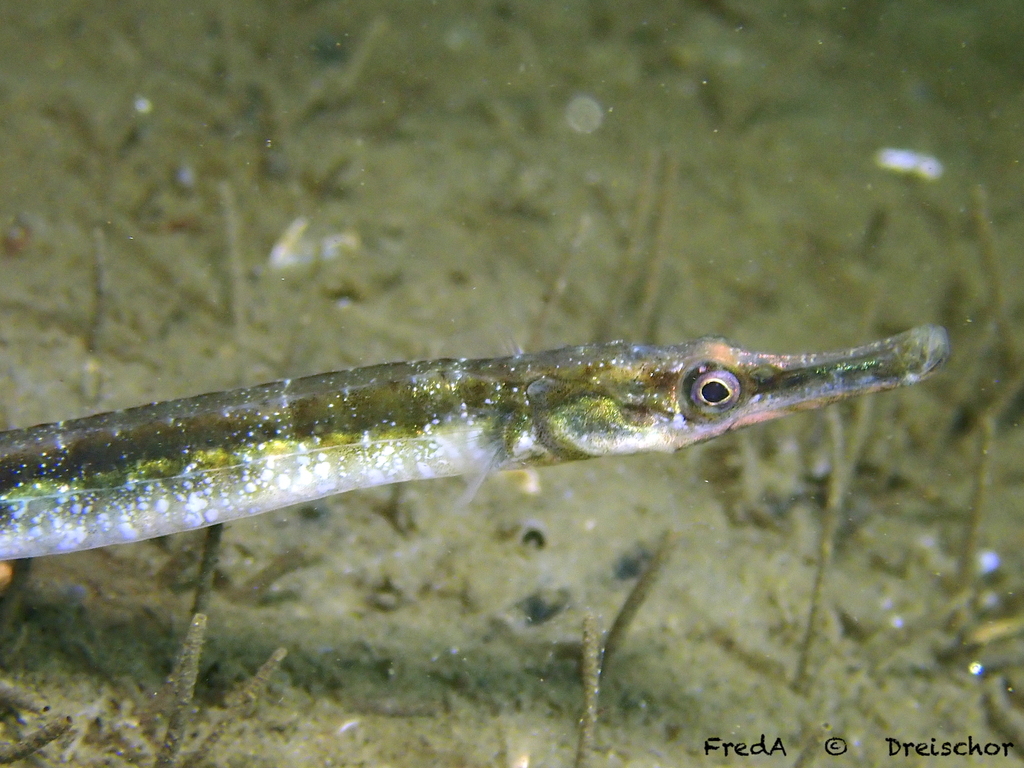
Lesser Pipefish
Syngnathus rostellatus
The lesser pipefish or Nilsson's pipefish, Syngnathus rostellatus, is a pipefish similar to the greater pipefish, but with no crest above the head. Usually it reaches up to 17 centimetres (6.7 in) in length, maximally 18 centimetres (7.1 in), although in South Wales they are usually not more than 10 to 13 centimetres (3.9 to 5.1 in) long. They have a light to dark green-brown colour with bar-like markings on the sides (compare the greater pipefish). Lesser pipefish are...
From the article Lesser pipefish on Wikipedia (CC BY-SA), quoted section by section
Description
The head has a long, thin, round snout with a small up-turned mouth; the eyes are small and situated well back towards the gill covers. The body is long and thin, covered with bony plates; the dorsal fin situates halfway along the body, and pelvic fins are found below this. The caudal fin is shaped like a fan, and small pectoral fins are situated behind the gills. The lesser and greater pipefish species differ because one has a crest on the head while one doesn't. However, they are still quite similar: a fully grown lesser pipefish and a young greater pipefish share similar coloration and markings, they both have a caudal fin, and they swim in a similar style. One distinguishing feature of the lesser pipefish is a continuous black line from the gills down the belly to the tail, although this is not very apparent on very young specimens.
Range & habitat
The lesser pipefish is found in the eastern Atlantic, from Norway, the British Isles, the Bay of Biscay, and western Portugal. There is one record as well in the Mediterranean Sea, off Malaga, Spain, dating from 1981; reports from the eastern Mediterranean have proven to be misidentifications.
Wikipedia: “Distribution”
Where it lives
Recorded sightings
—
geo-referenced records in GBIF, from museums, herbaria and field observers.
Drag the globe to turn it. Dots are where records exist, not a range map; darker means more records.
In the stacks
Searching the stacks…
Every page naming Syngnathus rostellatus in the Biodiversity Heritage Library →
This page is assembled live from iNaturalist, GBIF, Wikipedia, the Source Library and the Internet Archive. It is not yet part of the hand-edited codex. iNaturalist taxon 446544.