- Animals
- ›Chordates
- ›Vertebrates
- ›Ray-finned Fishes
- ›Spiny-rayed fishes
- ›Blennies, Damselfishes and Allies
- ›Blennies
- ›Triplefins
- ›Tripterygiinae
- ›Forsterygion
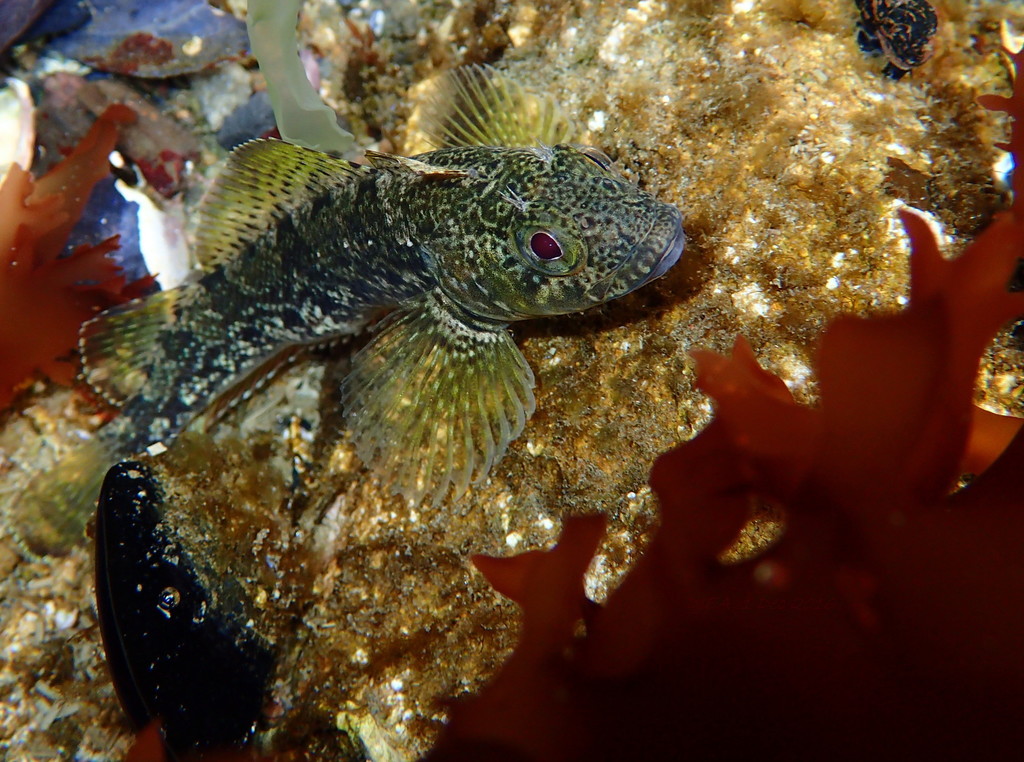
Mottled Triplefin
Forsterygion capito
Forsterygion capito, known commonly as the spotted robust triplefin, is a species of triplefin blenny in the genus Forsterygion. It was described by Jenyns in 1842.
From the article Spotted robust triplefin on Wikipedia (CC BY-SA), quoted section by section
Description
The spotted robust triplefin has a maximum length of 9.4 cm (3.7 in). The fish generally has a mottled grey and brown coloration that often blends well with its surroundings. Triplefins can also have reddish or yellowish hues that make a good camouflage among rocks and seaweed. The colors of Forsterygion capito make it almost invisible to predators, while some species of triplefins can have bright coloration. The average weight of the triplefin is about 4.4 grams (0.16 oz). Fishes in the family Tripterygiidae have three dorsal fins and scales on each side of their bodies. the first dorsal fin is smaller than the others and the middle dorsal fin has a total of 23 to 28 spines and 13 to 15 soft rays. The anal fin has one to two spines and 24 to 27 soft rays. The pectoral fins are broad for stability and good movement along the substrate. It has a large head compared to a slimmer, long body, and the tail fin is slightly rounded. The snout typically has a concave downward sloping profile, or rarely steep. Most males of the triplefin species during the reproductive season, in autumn, assume a dark spawning coloration.
Range & habitat
The spotted robust triplefin is an endemic species to New Zealand, which means it is not found anywhere else in the world. Worldwide the triplefin fauna includes approximately 30 genera and 130 species. But the greatest diversity and numbers are in the New Zealand region, which has 14 genera and 26 species of triplefin. Remarkably, 12 of these 14 genera are entirely unique to New Zealand. While the species are primarily confined to New Zealand, three of these species were accidentally introduced to Australia, where they now also occur.
Wikipedia: “Natural global range”
What it does
Spawning season is said to be both in spring and early summer, and for some species it takes place in winter or early spring. Body size, population density and nest quality are factors that have a large impact on reproductive success. When the female is ready to spawn she moves into the territory of a male. The choice of male shows that females often prefer bigger males with territories offering maximum choice of nesting sites. When she is in the nest, the female lays eggs in batches and lets the male fertilise them by moving aside regularly. The eggs are about 1 to 1.5 mm in diameter. After spawning, the female triplefin plays no role in care, and the male guards the eggs until they hatch. The eggs are hemispherical and are attached to the nesting sites by numerous sticky threads covering them. Hatching happens after about 7–10 days in warm northern waters, and 18 days in cold waters. After that, the hatchlings live planktonic in the water for two to three months, and they are about 0.5 cm long at the time. The juveniles grow fast and reach sexual maturity just before they turn one year old. Settlement happens when the juveniles are about 1.5–2 cm long, which is between August and January. The population of adult triplefins tends to decline in the period when hatchlings grow into juveniles. …
Wikipedia: “Life cycle/phenology”
Where it lives
Recorded sightings
—
geo-referenced records in GBIF, from museums, herbaria and field observers.
Drag the globe to turn it. Dots are where records exist, not a range map; darker means more records.
In the stacks
Searching the stacks…
Every page naming Forsterygion capito in the Biodiversity Heritage Library →
This page is assembled live from iNaturalist, GBIF, Wikipedia, the Source Library and the Internet Archive. It is not yet part of the hand-edited codex. iNaturalist taxon 446018.