- Animals
- ›Chordates
- ›Vertebrates
- ›Mammals
- ›Therians
- ›Placental Mammals
- ›Primates, Rodents, and Allies
- ›Rodents
- ›Mice, Rats, and Hamsters
- ›Muroids
- ›Hamsters, Voles, Lemmings, and Allies
- ›South American Mice and Rats
- ›Rice Rats
- ›Oryzomys
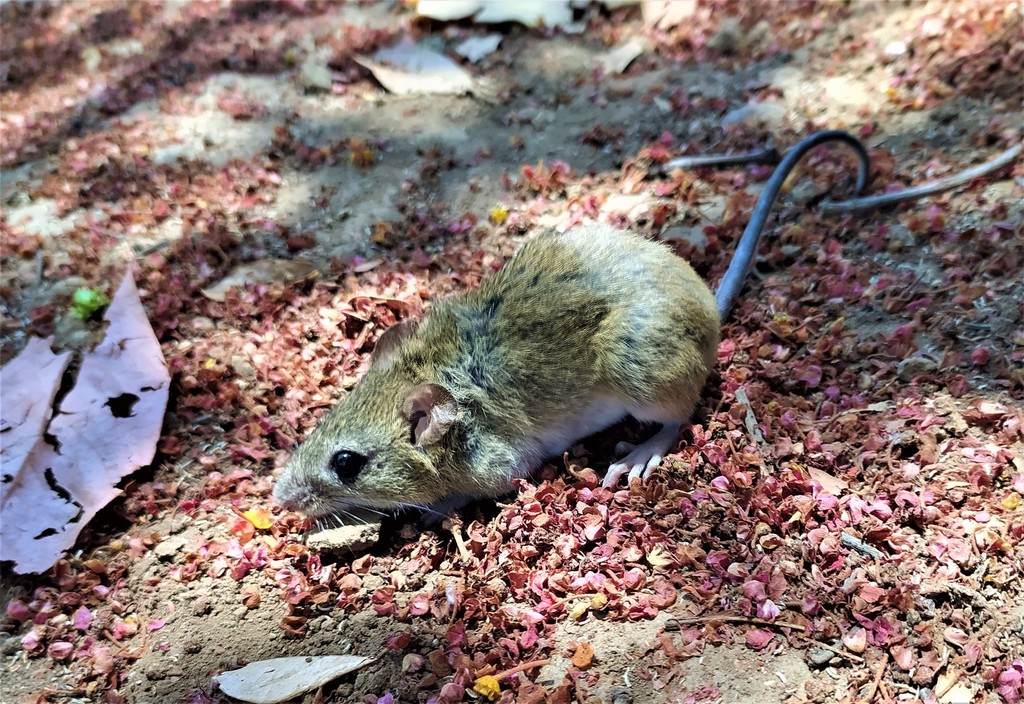
Coues's Marsh Rice Rat
Oryzomys couesi
Oryzomys couesi, also known as Coues's rice rat, is a semiaquatic rodent in the family Cricetidae occurring from southernmost Texas through Mexico and Central America into northwestern Colombia. It is usually found in wet habitats, such as marshes, but also lives in drier forests and shrublands. Weighing about 43 to 82 g (1.5 to 2.9 oz), O. couesi is a medium-sized to large rat. The coarse fur is buff to reddish above and white to buff below. The hindfeet show some specializations for life in the water, such as reduced ungual tufts of hair around the digits. It has 56 chromosomes. There is much geographic variation in size, proportions, color, and skull features. Oryzomys couesi is active during the night and builds nests of vegetation that are suspended among reeds about 1 m (3.3 ft) above the ground. It is an excellent swimmer and dives well, but can also climb in vegetation. An omnivore, it eats both plant and animal food, including seeds and insects. It breeds throughout the year; females give birth to about four young after a pregnancy of 21 to 28 days. The species may be infected by several different parasites and by two hantaviruses.
The species was first described in 1877, the first of many related species from the region described until the 1910s. In 1918, Edward Alphonso Goldman consolidated most into the single species O. couesi and in 1960 Raymond Hall united this taxon with its United States relative, the marsh rice rat (O.
From the article Oryzomys couesi on Wikipedia (CC BY-SA), quoted section by section
Description
O. couesi is a medium-sized to large rat with coarse fur that is buff to reddish above, becoming paler towards the sides and cheeks and darker on the rump and face. The underparts are white to buff. The fur is shorter, brighter, and more intense in color than in the marsh rice rat. The snout ends bluntly and the moderately large eyes show reddish eyeshine. The small ears are black on the outside and the inside is covered with short, gray to buff or red hairs. The long tail is dark brown above and white to light brown below. The feet are long and stout. On the forefeet, the ungual tufts (tufts of hair on the digits) are present. Many of the pads on the hindfeet are reduced, as are the ungual tufts, and small interdigital webs may be present in at least some specimens. Some of these traits are common adaptations to life in the water in oryzomyines. As in most other oryzomyines, females have eight mammae. Head and body length is 98 to 142 mm (3.9 to 5.6 in), tail length is 107 to 152 mm (4.2 to 6.0 in), hindfoot length is 27 to 33 mm (1.1 to 1.3 in), ear length is 13 to 18 mm (0.51 to 0.71 in), and body mass is 43 to 82 g (1.5 to 2.9 oz). …
What it does
The distribution of Oryzomys couesi extends from southern Texas and central Sonora, but not the central plateau of Mexico, through Central America south and east to northwestern Colombia; see under "Taxonomy" for details. The species has also been found in late Pleistocene cave deposits in Mexico and Honduras. It is common in watery habitats, such as marshes and small streams, but also occurs in forests and shrublands with sufficient cover. In addition, it is found in sugarcane and rice fields. In Texas, it occurs in marsh vegetation along resacas (oxbow lakes) and in Veracruz, it has even been found on the dry coastal plain among shrubs. It occurs from 2,300 m (7,500 ft) altitude down to sea level. On Cozumel, the proportion of juveniles and females is higher near roads that function as habitat edges. Cozumel rice rats rarely cross roads, which may isolate subpopulations on the island. Oryzomys couesi lives on the ground and is semiaquatic, spending much time in the water, as Alston in his original description already recognized, but is also a good climber. A study in Costa Rica found that O. couesi is an excellent swimmer, diving well and using its tail to propel itself. It is probably able to forage underwater, which may help differentiate its niche from that of the ecologically similar cotton rat Sigmodon hirsutus, which also swims well, but does not dive. When disturbed, O. …
Wikipedia: “Ecology and behavior”
In human culture
Edward Alston first described Oryzomys couesi in 1877, using three specimens from Mexico and Guatemala. He named the animal Hesperomys couesi, placing it in the now-defunct genus Hesperomys, and noted similarities to the marsh rice rat (then called Hesperomys palustris) and two species now placed in Tylomys. The specific name, couesi, honors American naturalist Elliott Coues, who had done much work on North American rodents. In 1893, Oldfield Thomas wrote that the species, by then placed in the genus Oryzomys as Oryzomys couesi, had caused much confusion about its identity, because the three specimens (one from Cobán, Guatemala, and two from Mexico) used by Alston in fact belonged to two or three different species. He restricted the name couesi to the animal from Guatemala, and introduced the new name Oryzomys fulgens for one of the Mexican animals. Several other related species were described from the early 1890s onwards and in 1901 Clinton Hart Merriam united many of those into a palustris-mexicanus group of species, which also included the marsh rice rat. Edward Alphonso Goldman revised North American Oryzomys in 1918 and consolidated many forms into a single species Oryzomys couesi, with ten subspecies distributed from southern Texas and western Mexico south to Costa Rica. …
Wikipedia: “History”
Listen
Looking for field recordings…
Where it lives
Recorded sightings
—
geo-referenced records in GBIF, from museums, herbaria and field observers.
Drag the globe to turn it. Dots are where records exist, not a range map; darker means more records.
In the stacks
Searching the stacks…
Every page naming Oryzomys couesi in the Biodiversity Heritage Library →
This page is assembled live from iNaturalist, GBIF, Wikipedia, the Source Library and the Internet Archive. It is not yet part of the hand-edited codex. iNaturalist taxon 44469.