- Animals
- ›Chordates
- ›Vertebrates
- ›Mammals
- ›Therians
- ›Placental Mammals
- ›Primates, Rodents, and Allies
- ›Rodents
- ›Ctenohystricans
- ›Hystricognaths
- ›Degus, Hutias, Tuco-tucos, and Allies
- ›Spiny Rats and Hutias
- ›Echimyines
- ›Terrestrial Spiny Rats and Allies
- ›Proechimys
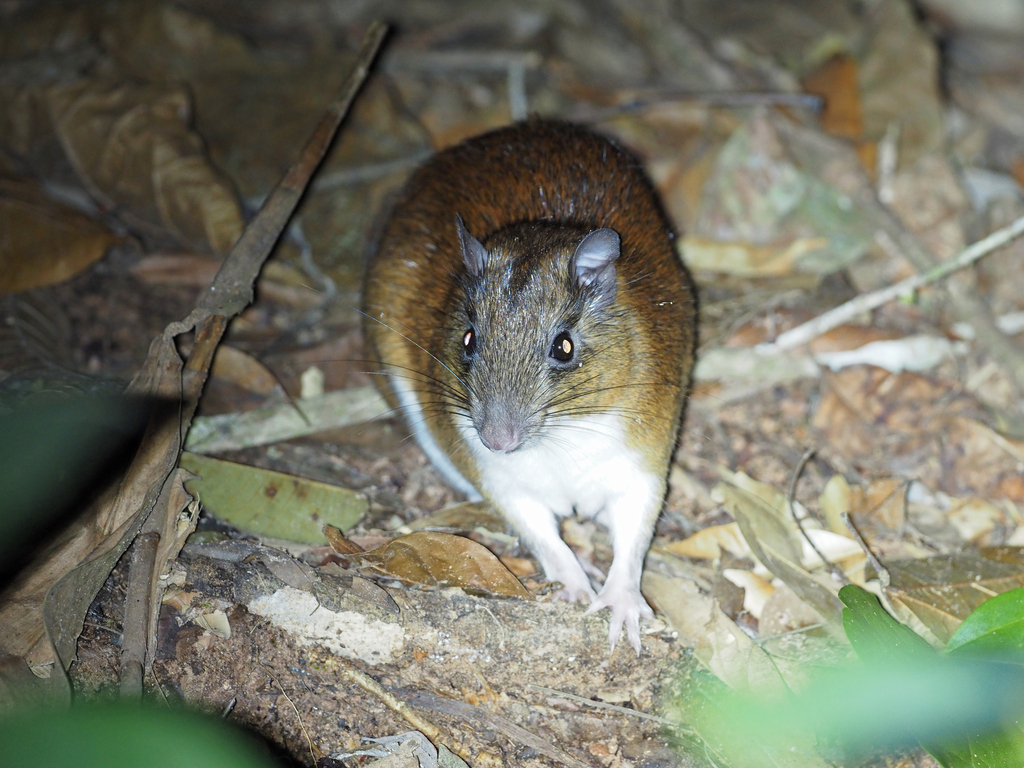
Long-tailed Spiny Rat
Proechimys longicaudatus
The long-tailed spiny rat, Proechimys longicaudatus, is a spiny rat species from South America. It is found in Bolivia, Brazil and Paraguay.
From the article Long-tailed spiny rat on Wikipedia (CC BY-SA), quoted section by section
Description
The long-tailed spiny rat is a large rat with a head-and-body length of between 187 and 250 mm (7.4 and 9.8 in) and a tail length of 121 to 200 mm (4.8 to 7.9 in). The fur is less bristly than in other related species. The upper parts are a glossy chestnut colour becoming more orange on the flanks. The underparts are white, and there is a clear line separating upper and lower parts. The tail is chestnut above and pale below. The tails are missing on some individuals, reflecting the lizard-like ability of many echimyids to detach their tails when attacked by predators.
Range & habitat
This species has a range in South America extending from southern Bolivia and northern Paraguay to western and central Brazil. It is terrestrial and inhabits dry primary and secondary forest, as well as cerrado and habitats with cleared areas and patches of forest. It usually occurs at altitudes below 500 m (1,600 ft) but has been recorded up to about 1,000 m (3,300 ft).
Wikipedia: “Distribution and habitat”
What it does
A study was undertaken in Bolivia to establish which small rodents were reservoir hosts for Leishmania, the causal agent for the human disease leishmaniasis. It was found that Oryzomys nitida and Oryzomys acritus were often implicated but that P. longicaudatus did not harbour the infection.
Wikipedia: “Ecology”
Listen
Looking for field recordings…
Where it lives
Recorded sightings
—
geo-referenced records in GBIF, from museums, herbaria and field observers.
Drag the globe to turn it. Dots are where records exist, not a range map; darker means more records.
In the stacks
Searching the stacks…
Every page naming Proechimys longicaudatus in the Biodiversity Heritage Library →
This page is assembled live from iNaturalist, GBIF, Wikipedia, the Source Library and the Internet Archive. It is not yet part of the hand-edited codex. iNaturalist taxon 43972.