- Animals
- ›Chordates
- ›Vertebrates
- ›Mammals
- ›Therians
- ›Placental Mammals
- ›Primates, Rodents, and Allies
- ›Rodents
- ›Ctenohystricans
- ›Hystricognaths
- ›Degus, Hutias, Tuco-tucos, and Allies
- ›Spiny Rats and Hutias
- ›Echimyines
- ›Arboreal Spiny Rats
- ›Kannabateomys
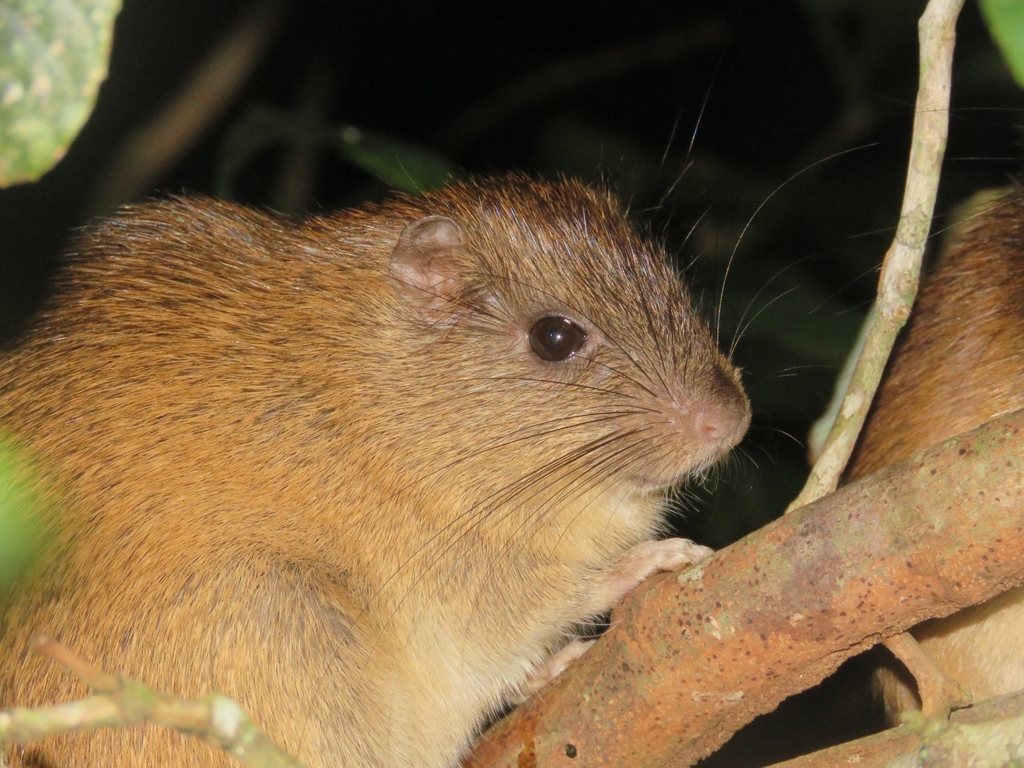
Atlantic Bamboo Rat
Kannabateomys amblyonyx
The Atlantic bamboo rat (Kannabateomys amblyonyx), or southern bamboo rat, is a spiny rat species from South America, found in humid tropical forests in Argentina, Brazil and Paraguay. It is the only member of the genus Kannabateomys.
From the article Atlantic bamboo rat on Wikipedia (CC BY-SA), quoted section by section
Description
The Atlantic bamboo rat can reach a head-and-body length of 25 cm (10 in) with a tail of 32 cm (12.6 in). Its weight is about 475 g (1 lb 1 oz). The pelage is the typical agouti brown-to-grey colour of many rodents, grading to chestnut on the flanks. The chin and underparts are white tinged with reddish brown. The first 6 cm (2.4 in) of the tail are well-haired but the rest is sparsely haired. There is a distinct tuft of hairs at the tip. When fully grown, this bamboo rat with its long tail is unlikely to be mistaken for any other species.
Range & habitat
This species is native to South America, where its range includes southeastern Brazil, eastern Paraguay and northeastern Argentina. The typical habitat is moist forests near water with dense understorey of bamboos. It is particularly associated with the giant bamboo Guadua angustifolia, which forms thickets.
Wikipedia: “Distribution and habitat”
What it does
The Atlantic bamboo rat is nocturnal and is highly arboreal, scrambling around in trees and bamboos, especially near water. The home range is about 1,000 m2 (1,200 yd2). When alarmed it issues loud squeals. It probably feeds on grasses, leaves, shoots, fruits and tubers.
Wikipedia: “Ecology”
In human culture
The genus name Kannabateomys derives from three Ancient Greek words: κάννα (kánna), meaning "reed, cane", βατέω (batéō), meaning "I mount, cover", and μῦς (mûs), meaning "mouse, rat". The species name amblyonyx derives from the two Ancient Greek words ἀμβλύς (amblús), meaning "blunt, not sharp", and ὄνυξ (ónux), meaning "claw, fingernail".
Wikipedia: “Etymology”
Listen
Looking for field recordings…
Where it lives
Recorded sightings
—
geo-referenced records in GBIF, from museums, herbaria and field observers.
Drag the globe to turn it. Dots are where records exist, not a range map; darker means more records.
In the stacks
Searching the stacks…
Every page naming Kannabateomys amblyonyx in the Biodiversity Heritage Library →
This page is assembled live from iNaturalist, GBIF, Wikipedia, the Source Library and the Internet Archive. It is not yet part of the hand-edited codex. iNaturalist taxon 43937.