- Animals
- ›Chordates
- ›Vertebrates
- ›Mammals
- ›Therians
- ›Placental Mammals
- ›Primates, Rodents, and Allies
- ›Rodents
- ›Ctenohystricans
- ›Hystricognaths
- ›Degus, Hutias, Tuco-tucos, and Allies
- ›Spiny Rats and Hutias
- ›Echimyines
- ›Arboreal Spiny Rats
- ›Echimys
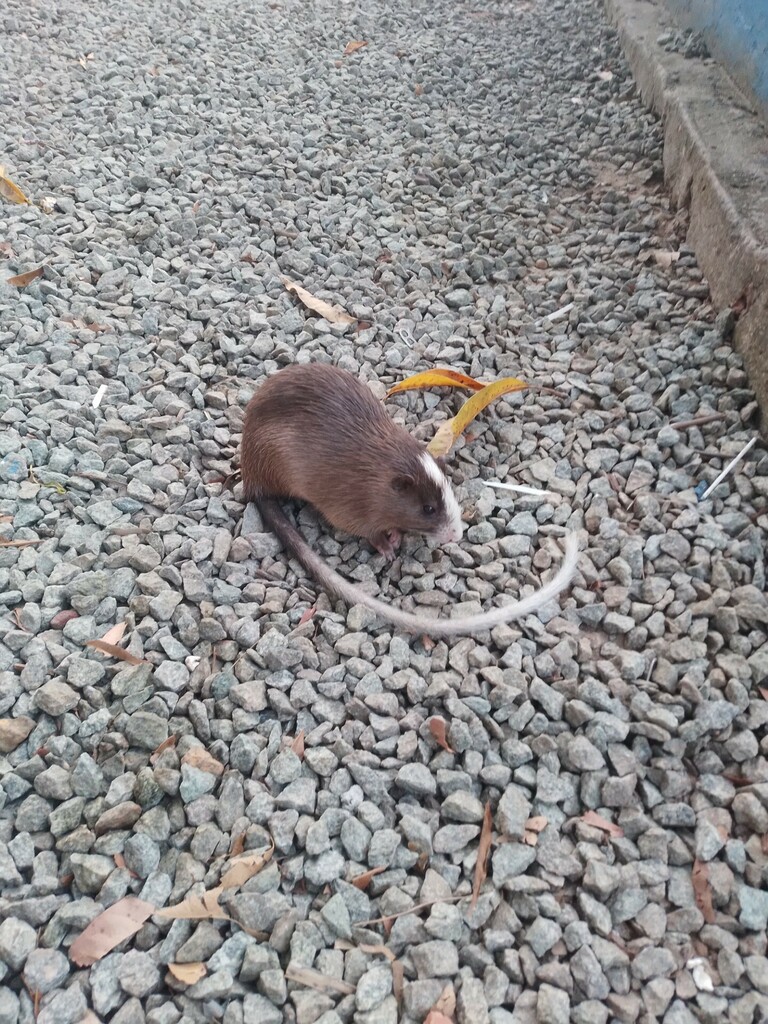
White-faced Spiny Tree Rat
Echimys chrysurus
The white-faced spiny tree-rat (Echimys chrysurus) is a South American species of rodent in the family Echimyidae. It is restricted to forest and rainforest habitats in Brazil, French Guiana, Guyana and Suriname, living among the branches and feeding on fruit, plants, and insects. The rat's fur is darkest near the back of the head, which also has a distinctive white stripe. Its body is covered in stiff, blunt-tipped guard hairs or spines. Adults weigh up to 760 grams (27 ounces) and are 24 to 33 centimetres (9.4 to 13.0 inches) long, plus a tail that measures about 120% of the head-body length.
The white-faced spiny tree-rat is nocturnal and produces two young in a litter. Its known predators include the ornate hawk-eagle and spectacled owl. First recorded in 1778 and described in 1780, it is a rarely seen species; few studies on the rat's ecology have been performed, and there are not many museum specimens. However, because it is widespread and occurs in several protected areas, it is considered a least-concern species by the International Union for Conservation of Nature, though deforestation is a hazard to its survival.
From the article White-faced spiny tree-rat on Wikipedia (CC BY-SA), quoted section by section
Description
White-faced spiny tree-rats typically weigh up to 760 grams (27 ounces) and have a length of 24 to 33 centimetres (9.4 to 13.0 inches) from the head to the base of the tail. The tail ranges in length from 25 to 40 cm (9.8 to 15.7 in), typically measuring 120% of the rodent's total head and body length, and is covered in hair that turns from brown to white towards the tip. The rat's fur is made up of a mixture of broad, heavy spines and dark hairs that are brown at the tip and grey along the shaft. The fur near the back of the head is darker than that along the rest of the animal's body. The ears are small, slightly haired, and brown. Its eyes are dark brown and have a red eye shine. The broad feet are covered with brown fur on top, and each digit has a claw. Females have three pairs of developed abdominal mammary glands between the front and hind legs, as well as one pair of small, possibly non-functional mammary glands in the groin region. Among members of the Echimyidae family, the genus Echimys has some of the most spinose guard hairs or spines, meaning that they are very stiff and robust and have blunt tips. …
Range & habitat
The white-faced spiny tree-rat lives throughout Guyana, Suriname, French Guiana, and parts of Brazil. In Brazil, it is known from the eastern Amazon Basin throughout Amapá and parts of Amazonas; east of the Rio Negro in parts north of the Amazon River, and east of the Xingu River south of the Amazon. It is uncertain if this rat is present in parts of Bolívar, Venezuela. Within French Guiana, specimens are rarely identified. Vine-covered areas of lowland rainforests are the preferred habitat of the white-faced spiny tree-rat. It is a strictly arboreal (tree-dwelling) species; it resides in the middle and upper strata of the rainforest at elevations ranging from sea level up to about 200 metres (660 feet). Though most sightings of the rat have been in tropical evergreen forests, it is known to live in regions where rainforest transitions to deciduous forest as well.
Wikipedia: “Distribution and habitat”
What it does
White-faced spiny tree-rats are nocturnal animals. One female specimen was discovered carrying two embryos, which is a typical number of young per litter for members of the spiny rat family Echimyidae; the young are born already covered in fur and have their eyes open. Members of this rodent family have fairly variable breeding habits, with monogamy giving way to polygyny when population densities allow for enough viable mates to be located in the same area; however, nothing specific has been recorded regarding the white-faced spiny tree-rat's mating behaviour. The species typically has a slow pace of movement, but may move quickly across branches to hide when startled by human or predator activity. When disturbed, it will find quickly shelter under foliage and subsequently remain motionless for minutes. It is known to make nests in tree holes, using leaves as nesting material. The species feeds on fruit, foliage, and some insects, mainly arthropods. The ornate hawk-eagle and the spectacled owl are known predators of the white-faced spiny tree-rat. Terrestrial mammals within the rodent's range that may prey upon it include ocelots and the common opossum. The white-faced spiny tree-rat is host to several parasites, including several members of the flea genus Polygenis and the sandfly species Bichromomyia flaviscutellata. …
Wikipedia: “Behaviour and ecology”
In human culture
The white-faced spiny tree rat was first described by German zoologist Eberhard August Wilhelm von Zimmermann in 1780. He drew upon the Swiss-Dutch natural philosopher Jean-Nicolas-Sébastien Allamand's 1778 addition to the Histoire Naturelle titled "Le Lérot à queue dorée", a brief article containing a description and 13 measurements. Zimmermann gave the species the scientific name of Myoxus chrysurus and wrote that its type locality was "Surinam" (at the time a Dutch colony). The original Histoire Naturelle article was based on the type specimen that was sent "without any information regarding either the name by which it is known in its country nor the places where it lives" to the private collector Jacob Christoph Klöckner in Amsterdam, who often wrote to Allamand about interesting new specimens. It is unknown what happened to the type specimen, though Klöckner's collection was auctioned off in 1783. Another species description of the white-faced spiny tree rat was written in 1817 by French zoologist Anselme Gaëtan Desmarest, who noted that the rodent's original description of "golden-tailed" may have stemmed from the solution it was preserved in, as a stuffed specimen used for comparison had no such yellow colour. …
Wikipedia: “Systematics and etymology”
Listen
Looking for field recordings…
Where it lives
Recorded sightings
—
geo-referenced records in GBIF, from museums, herbaria and field observers.
Drag the globe to turn it. Dots are where records exist, not a range map; darker means more records.
In the stacks
Searching the stacks…
Every page naming Echimys chrysurus in the Biodiversity Heritage Library →
This page is assembled live from iNaturalist, GBIF, Wikipedia, the Source Library and the Internet Archive. It is not yet part of the hand-edited codex. iNaturalist taxon 43934.