- Animals
- ›Cnidarians
- ›Sea Anemones and Corals
- ›Hexacorallians
- ›Sea Anemones
- ›Enthemonae
- ›Actinioidea
- ›Actiniid Sea Anemones
- ›Epiactis
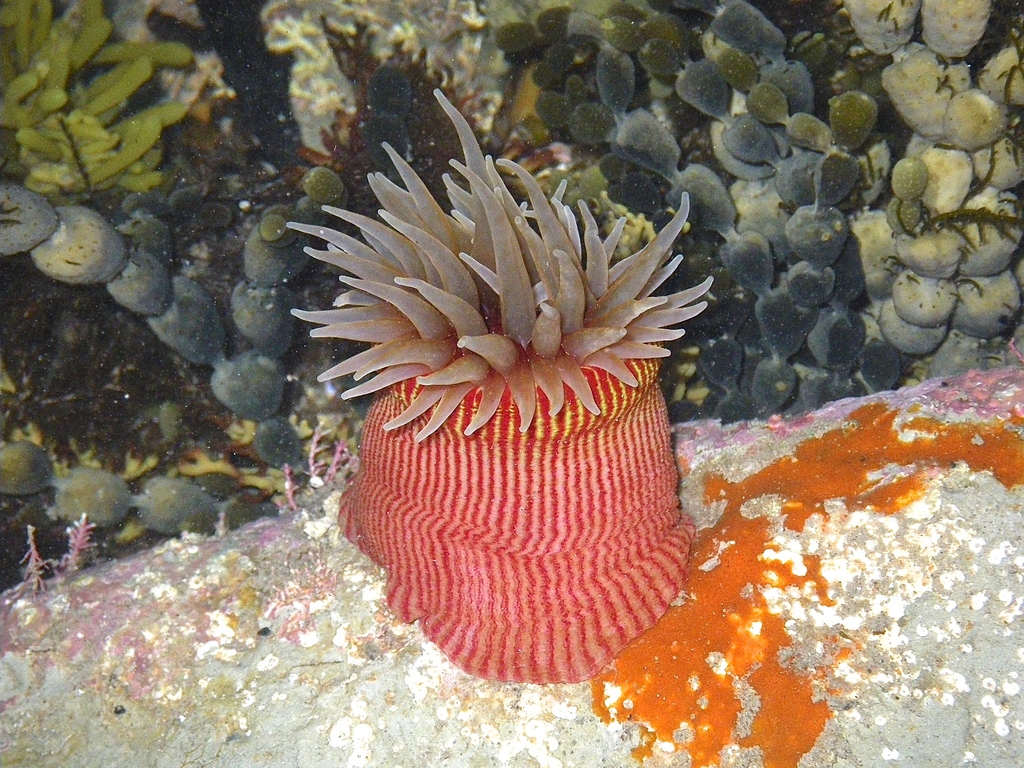
Epiactis thompsoni
Epiactis thompsoni, the red-striped anemone, is a species of marine invertebrate in the family Actiniidae, found in New Zealand and South Australia. They are commonly found in the rocky intertidal zone.
From the article Epiactis thompsoni on Wikipedia (CC BY-SA), quoted section by section
Description
The red-striped anemone is relatively large, up to 75 mm. The pedal disc protrudes at the base, diameter of the disc is up to 45 mm. Red and white stripes run vertically up the body, the white sometimes turning a strong yellow or even lime green near the elevated mouth. 60 or so tentacles are arranged in 3 whorls, are usually white with a mauve tip and can be up to 25 mm long. Habits rock pools around the low tide mark, adhering to stones and boulders. Broods its young.
Wikipedia: “Description and habitat”
What it does
Epiactis thompsoni exhibit internal brooding which is when the offspring remain within the gastrovascular cavity. Internal brooding is beneficial in the harsh intertidal zone and is a means of reducing dispersal. Some offspring in the broods of Epiactis thompsoni are born with multiple oral disks and tentacular crowns. This is thought to be due to the process of fusion of two or more embryos. They are known as being the primary species that brood offspring. Epiactis thompsoni also exhibit continuous reproduction in that they can breed throughout the year. They are also gonochoric meaning that the sexes are separate.
Wikipedia: “Reproduction”
In human culture
There has been confusion with the species name in the literature. In Australian literature, the 'p' from thompsoni has been dropped. The 'p' was originally dropped in Carlgren (1949), so it may be a spelling error that has been since present throughout subsequent literature. The correct spelling is with the 'p', as the species was named after a harbour master in Otago, Captain Thompson.
== References ==
Wikipedia: “History”
Where it lives
Recorded sightings
—
geo-referenced records in GBIF, from museums, herbaria and field observers.
Drag the globe to turn it. Dots are where records exist, not a range map; darker means more records.
In the stacks
Searching the stacks…
Every page naming Epiactis thompsoni in the Biodiversity Heritage Library →
This page is assembled live from iNaturalist, GBIF, Wikipedia, the Source Library and the Internet Archive. It is not yet part of the hand-edited codex. iNaturalist taxon 437491.