 NL·0519
Herbarium of the Nature Library
- Name
- Loris tardigradus
- Family
- Lorisidae
- Native to
- Endemic to the wet zone of southwestern Sri Lanka, including a highland form in the central hills
- Habitat
- Tropical lowland rainforest, Montane forest, Home gardens
Red slender loris
Loris tardigradus
Also calledUnahapuluwa (Sinhala) · Thevāngu (Tamil, for slender lorises) · Slender loris
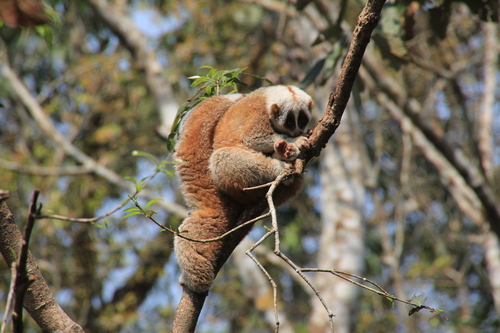
A tiny, pencil-limbed nocturnal primate of Sri Lanka's wet southwest, with enormous forward-facing eyes for hunting insects at night. It moves slowly and silently along branches, then lunges with both hands. The related grey slender loris lives in drier Sri Lanka and southern India.
The red slender loris is a small, nocturnal strephsirrhine primate native to the rainforests of Sri Lanka. This is No. 6 of the 10 focal species and No. 22 of the 100 EDGE mammal species worldwide considered the most evolutionarily distinct and globally endangered. Wikipedia
What it can do
- iHuge eyes with a reflective tapetum for vision in near darkness
- iiGrasp so strong it can hang for long periods, aided by special blood vessels (retia mirabilia) in its limbs
- iiiEats toxic or bad-tasting insects that other predators avoid
In the field
Field marks
- aVery thin limbs and tiny body with no tail
- bHuge round eyes ringed with dark patches and divided by a white stripe down the nose
- cReddish-brown fur (redder than the grey slender loris)
- dAt night, eyes show bright orange-red eyeshine in torchlight; moves hand over hand slowly
- Not to be confused with
- Grey slender loris (Loris lydekkerianus) of Sri Lanka's dry zone and southern India is greyer with a paler underside. Slow lorises (northeast India and Southeast Asia) are much stockier.
- Where to see it
- Masmullah Proposed Forest Reserve; Kottawa Forest and Kanneliya Forest Reserve; Sinharaja Forest Reserve (all Sri Lanka); best with a guided night walk
- When
- Resident; active at night year-round
Listen
Looking for field recordings…
Life & habits
- Diet
- Mostly insects (including ants and beetles), plus other invertebrates, small lizards, eggs and some plant matter
- Habitat
- Wet lowland and submontane forest and nearby gardens with dense vine tangles
- Size
- Body about 17–26 cm, no external tail; 85–170 g
- Lifespan
- About 15–18 years in captivity
Strictly nocturnal and arboreal. Sleeps by day curled up in a ball among dense foliage, often in small groups.
Where it lives
Recorded sightings
—
geo-referenced records in GBIF, from museums, herbaria and field observers.
Native range
Endemic to the wet zone of southwestern Sri Lanka, including a highland form in the central hills
Drag the globe to turn it. Dots are where records exist, not a range map; darker means more records.
In the old herbals & bestiaries
Woodcuts and engravings matched from the Source Library’s scanned books by name. Plates marked “relative” show a close kin rather than this exact species. Click a plate to read the page it came from, with translation.

Jean Baptiste Audebert — Histoire naturelle des singes et des makis (1800)
Jean Baptiste Audebert · 1800 · p.275

François Bouchard — Recueil de cent-trente-trois oiseaux des plus belles especes (1775)
François Bouchard · 1775 · p.147

Jean Baptiste Audebert — Histoire naturelle des singes et des makis (1800)
Jean Baptiste Audebert · 1800 · p.280
In the stacks
Searching the stacks…
Every page naming Loris tardigradus in the Biodiversity Heritage Library →
Marginalia
In Sri Lankan and South Indian folk belief, loris eyes and body parts were used in charms and remedies, which, with the pet trade, has long contributed to their persecution.
Curiosity
Its species name tardigradus means 'slow-stepping', the same root as the microscopic tardigrades.
Kinship




Photographs: iNaturalist contributors under the licences shown. Records: GBIF.org. Historical plates: Source Library (CC BY-SA 4.0; originals public domain). Summary text: Nature Library editors and Wikipedia (CC BY-SA). Medicinal and edibility notes are historical and educational, not advice. iNaturalist taxon 43632.