On eBird ↗
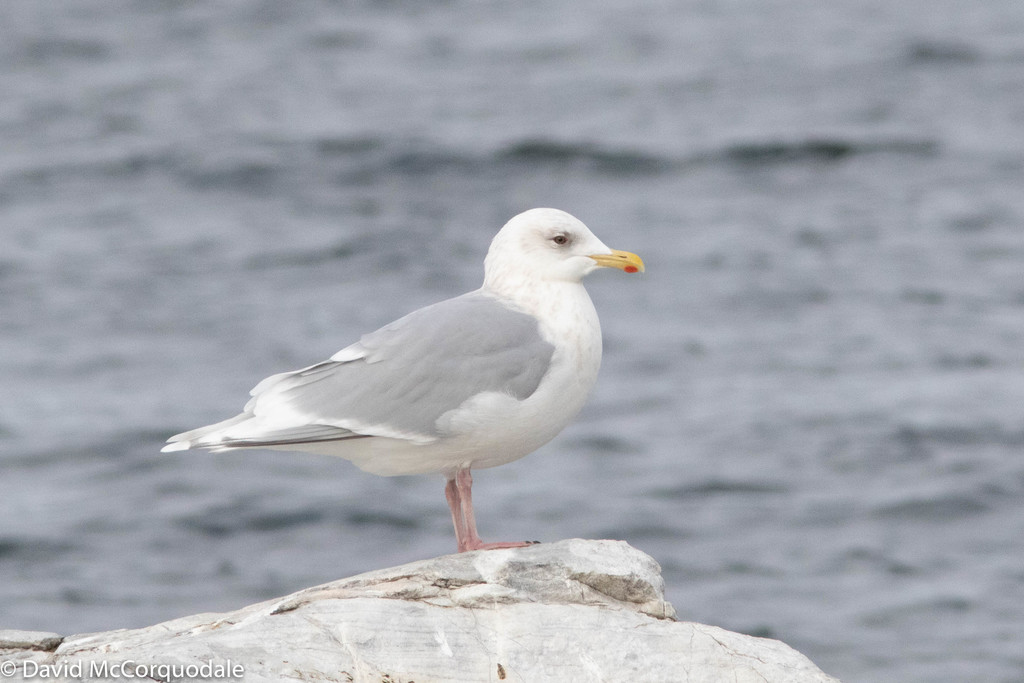
Iceland Gull
Live sightings near you, the range map, bar charts of when it is seen, and Macaulay Library photos and recordings.
Iceland Gull
Larus glaucoides
The Iceland gull (Larus glaucoides) is a medium-sized gull that breeds in the Arctic regions of Canada and Greenland, but not in Iceland (as its name suggests), where it is only seen during winter. The genus name is from Latin larus, which appears to have referred to a gull or other large seabird. The specific name glaucoides denotes its resemblance to Larus glaucus, a synonym of Larus hyperboreus, the glaucous gull; -oides is Ancient Greek and means "resembling".
From the article Iceland gull on Wikipedia (CC BY-SA), quoted section by section
Description
The Iceland gull is a medium-sized gull, although relatively slender and light in weight. In length, it can measure from 50 to 64 cm (20 to 25 in), wingspan is from 115 to 150 cm (45 to 59 in), and weight is from 480 to 1,100 g (1.06 to 2.43 lb). Among standard measurements, the wing chord is 37.9 to 44.3 cm (14.9 to 17.4 in), the bill is 3.6 to 5.4 cm (1.4 to 2.1 in), and the tarsus is 4.9 to 6.7 cm (1.9 to 2.6 in). It is smaller and thinner-billed than the very large glaucous gull, and is usually smaller than the herring gull. It takes four years to reach maturity.
What it does
It is migratory, wintering from in the North Atlantic as far south as the British Isles and northernmost states of the eastern United States, as well as in the interior of North America as far west as the western Great Lakes. It is much scarcer in Europe than the similar glaucous gull. This species breeds colonially or singly on coasts and cliffs, making a nest lined with grass, moss, or seaweed on the ground or cliff. Normally, two or three light brown eggs are laid. They breed in Canada and Greenland, but not in Iceland. Like most Larus gulls, these are omnivores, eating fish, molluscs, offal, scraps, and eggs. They forage while flying, picking up food at or just below the water's surface, and they also feed while walking or swimming. Their scavenging habits lead them to frequent garbage dumps, sewage outlets, and places where fish are cleaned.
Wikipedia: “Ecology”
Listen
Looking for field recordings…
Where it lives
Recorded sightings
—
geo-referenced records in GBIF, from museums, herbaria and field observers.
Drag the globe to turn it. Dots are where records exist, not a range map; darker means more records.
In the stacks
Searching the stacks…
Every page naming Larus glaucoides in the Biodiversity Heritage Library →
This page is assembled live from iNaturalist, GBIF, Wikipedia, the Source Library and the Internet Archive. It is not yet part of the hand-edited codex. iNaturalist taxon 4361.