- Animals
- ›Chordates
- ›Vertebrates
- ›Mammals
- ›Therians
- ›Placental Mammals
- ›Ungulates, Carnivorans, and Allies
- ›Odd-toed Ungulates
- ›Rhinoceroses
- ›Rhinoceros
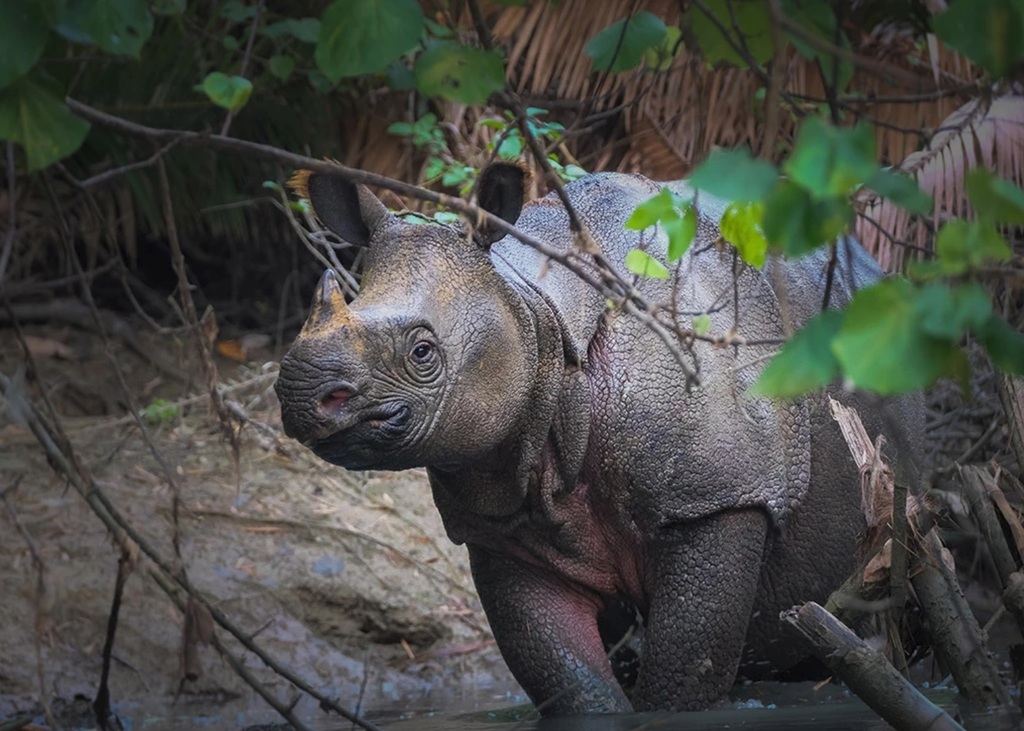
Javan Rhinoceros
Rhinoceros sondaicus
The Javan rhinoceros (Rhinoceros sondaicus), also called Javan rhino, Sunda rhinoceros and lesser one-horned rhinoceros is a critically endangered member of the genus Rhinoceros of the family Rhinocerotidae, and one of the five remaining extant rhinoceros species. It has a plate-like skin with protective folds and is one of the smallest rhinoceros species with a body length of 3.1–3.2 m (10.2–10.5 ft) and a 1.4–1.7 m (4.6–5.6 ft) long tail. The heaviest specimens weigh around 2,300 kg (5,100 lb). Its horn is usually shorter than 25 cm (9.8 in).
Until the mid-19th to about the early 20th century, the Javan rhinoceros had ranged beyond the islands of Java and Sumatra and onto the mainland of Southeast Asia and Indochina, northwest into East India, Bhutan, and the south of China. Today, it is the rarest of all rhinoceroses, and among the rarest of all living animal species, with only one currently known wild population, and no individuals successfully kept in captivity. It is among the rarest large mammals in the world with a population around 74 within Ujung Kulon National Park, at the far western tip of Java, Indonesia.
From the article Javan rhinoceros on Wikipedia (CC BY-SA), quoted section by section
Description
Javan rhinos are smaller than the Indian rhinoceros, and are close in size to the black rhinoceros. They are the largest animal in Java and the second-largest animal in Indonesia after the Asian elephant. The length of a Javan rhino including its head is 2 to 4 m (6.6 to 13.1 ft), and it can reach a height of 1.4–1.7 m (4.6–5.6 ft). Adults are variously reported to weigh between 900 and 2,300 kg (2,000 and 5,100 lb), although a study to collect accurate measurements of the animals has never been conducted and is not a priority because of their extreme conservation status. No substantial size difference is seen between genders, but cows may be slightly bigger. The rhinos in Vietnam appeared to be significantly smaller than those in Java, based on studies of photographic evidence and measurements of their footprints. Like the Indian rhino, the Javan rhino has a single horn (the other extant species have two horns). Its horn is the smallest of all extant rhinos, usually less than 20 cm (7.9 in) with the longest recorded only 27 cm (11 in). Only bulls have horns. Cows are the only extant rhinos that remain hornless into adulthood, though they may develop a tiny bump of an inch or two in height. …
Range & habitat
Fossil remains of Javan rhinoceros have been found at the Neolithic site of Hemudu in Zhejiang, China, and the 4th century BCE Classic of Mountains and Seas appears to describe one living in the Yangtze River basin. Remains were also found in the Tam Hay Marklot cave site in northeastern Laos that date to the Pleistocene. Historically, Javan rhinoceroses were widespread from Assam and Bengal, eastward to Myanmar, Thailand, Cambodia, Laos, Vietnam, and southwards to the Malay Peninsula and the islands of Sumatra, Java, and Borneo. Today, the species only occurs in Ujung Kulon National Park in southwestern Java, where fewer than 100 individuals are estimated to survive. The range of the Javan rhinoceros has been shrinking for at least 3,000 years. Starting around 1000 BC, the northern range of the rhinoceros extended into China, but began moving southward at roughly 0.5 km (0.31 mi) per year, as human settlements increased in the region. It likely became locally extinct in India in the first decade of the 20th century. The Javan rhino was hunted to extinction on the Malay Peninsula by 1932. …
Wikipedia: “Distribution and habitat”
What it does
The Javan rhinoceros is a solitary animal with the exception of breeding pairs and mothers with calves. They sometimes congregate in small groups at salt licks and mud wallows. Wallowing in mud is a common behavior for all rhinos; the activity allows them to maintain cool body temperatures and helps prevent disease and parasite infestation. The Javan rhinoceros does not generally dig its own mud wallows, preferring to use other animals' wallows or naturally occurring pits, which it uses its horn to enlarge. Salt licks are also very important because of the essential nutrients the rhino receives from the salt. Bull home ranges are larger at 12–20 km2 (4.6–7.7 sq mi) compared to the cow, which are around 3–14 km2 (1.2–5.4 sq mi). Bull territories overlap each other less than those of the cow. Whether territorial fights occur is unknown. Bulls mark their territories with dung piles and by urine spraying. Scrapes made by the feet in the ground and twisted saplings also seem to be used for communication. Members of other rhino species have a peculiar habit of defecating in massive rhino dung piles and then scraping their back feet in the dung. The Sumatran and Javan rhinos, while defecating in piles, do not engage in the scraping. …
Wikipedia: “Behavior and ecology”
In human culture
The generic name Rhinoceros is a combination of the ancient Greek words ῥίς (ris) meaning nose and κέρας (keras) meaning horn of an animal. The specific name sondaicus is derived from sunda, the biogeographical region that comprises the islands of Sumatra, Java, Borneo, and surrounding smaller islands. The Javan rhino is also known as the lesser one-horned rhinoceros (in contrast with the greater one-horned rhinoceros, another name for the Indian rhino).
Wikipedia: “Etymology”
Listen
Looking for field recordings…
Where it lives
Recorded sightings
—
geo-referenced records in GBIF, from museums, herbaria and field observers.
Drag the globe to turn it. Dots are where records exist, not a range map; darker means more records.
In the stacks
Searching the stacks…
Every page naming Rhinoceros sondaicus in the Biodiversity Heritage Library →
This page is assembled live from iNaturalist, GBIF, Wikipedia, the Source Library and the Internet Archive. It is not yet part of the hand-edited codex. iNaturalist taxon 43346.