- Animals
- ›Chordates
- ›Vertebrates
- ›Mammals
- ›Therians
- ›Placental Mammals
- ›Afromammals
- ›Sengis
- ›Sengis
- ›Giant Sengis
- ›Rhynchocyon
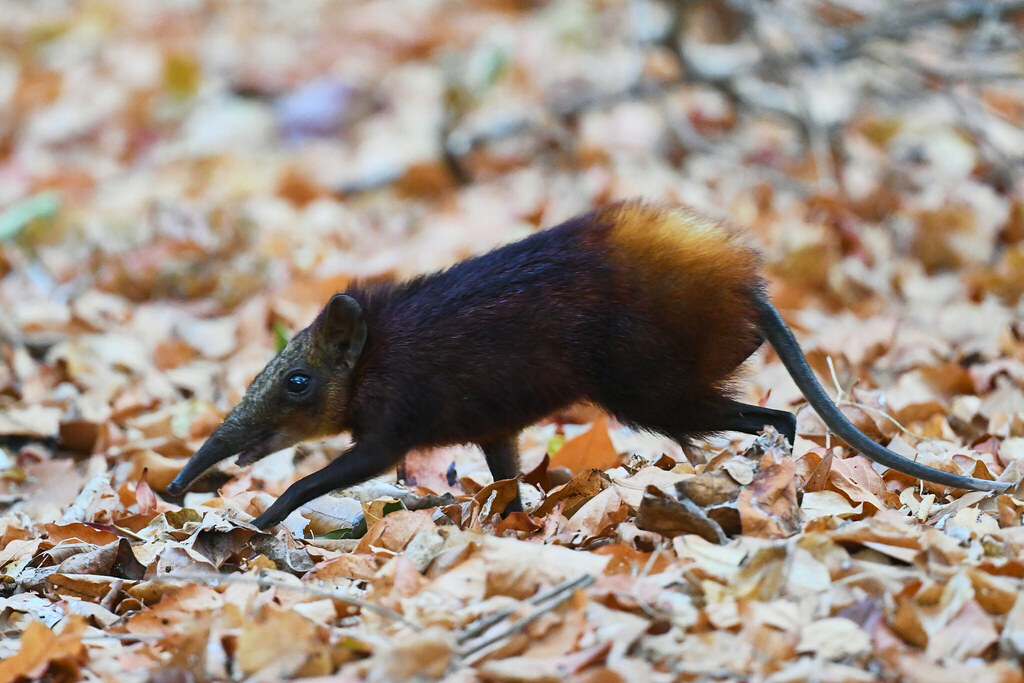
Golden-rumped Sengi
Rhynchocyon chrysopygus
The golden-rumped sengi or golden rumped elephant shrew (Rhynchocyon chrysopygus) is a small African mammal. It is the largest species of the sengi family (Macroscelididae) along with its close relative the grey-faced sengi. It is classified as endangered.
From the article Golden-rumped sengi on Wikipedia (CC BY-SA), quoted section by section
Range & habitat
The golden-rumped sengi is a diurnal animal, which lives in densely vegetated forests, avoiding clear and open areas to help protect themselves from predators. Golden-rumped sengis build up to six nests at a time, alternating nests every night to leave no pattern for hunting predators to follow. It inhabits coastal regions and is found in moist, dense-brush forests and lowland semi-deciduous forests. Males have slightly larger home areas than females, and are more likely to trespass into neighboring territories, which makes them more vulnerable to predators.
Wikipedia: “Habitat and distribution”
What it does
The golden-rumped sengi are monogamous and territorial behavior is seen in both males and females defending overlapping territories. They mate year round. Females give birth to one young in an approximate 42-day cycle. The newborn offspring are usually ready to leave the mother's den after two weeks, and it takes approximately five days after leaving the nest for them to become fully independent in the wild. The male does not take part in any parental care of the newborns.
Wikipedia: “Reproduction”
Listen
Looking for field recordings…
Where it lives
Recorded sightings
—
geo-referenced records in GBIF, from museums, herbaria and field observers.
Drag the globe to turn it. Dots are where records exist, not a range map; darker means more records.
In the stacks
Searching the stacks…
Every page naming Rhynchocyon chrysopygus in the Biodiversity Heritage Library →
This page is assembled live from iNaturalist, GBIF, Wikipedia, the Source Library and the Internet Archive. It is not yet part of the hand-edited codex. iNaturalist taxon 43222.