- Animals
- ›Chordates
- ›Vertebrates
- ›Mammals
- ›Therians
- ›Placental Mammals
- ›Primates, Rodents, and Allies
- ›Lagomorphs
- ›Hares and Rabbits
- ›Nesolagus
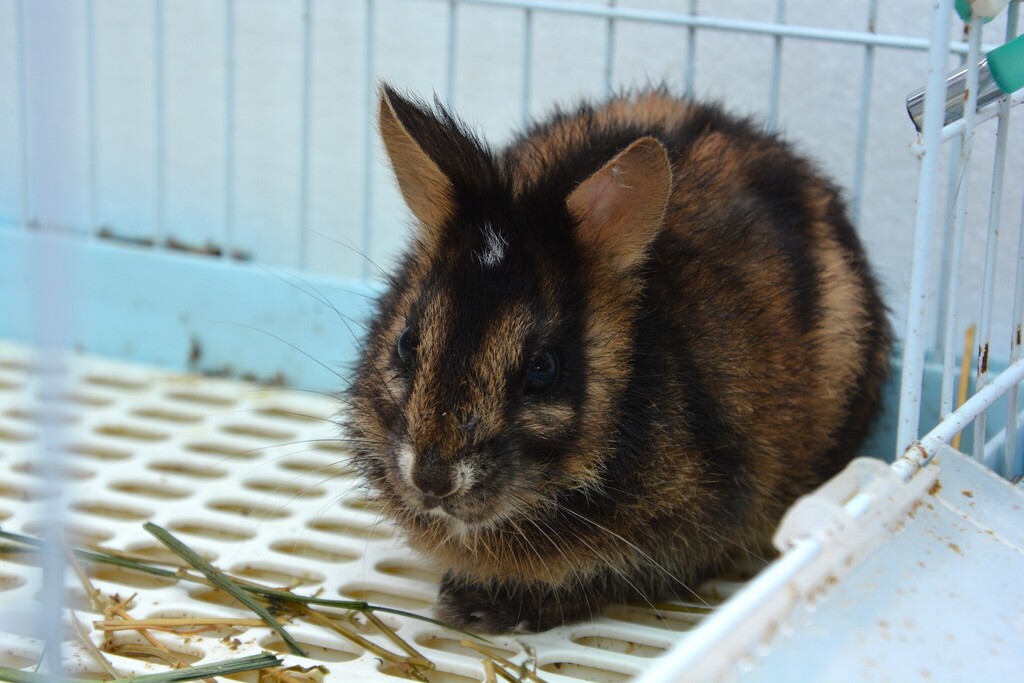
Annamite Striped Rabbit
Nesolagus timminsi
The Annamite striped rabbit (Nesolagus timminsi) is a species of rabbit native to the Annamite mountain range on the Laos–Vietnam border. The rabbit has short ears, black or dark brown stripes against a buff-colored body, and a red rump. It resembles the Sumatran striped rabbit, a closely related species that lives in the Barisan Mountains of Indonesia. The species was first observed in 1996 by biologist Robert Timmins in a market in Ban Lak in Laos, and was formally described in 2000, when it was named after Timmins' find. It is known as the thỏ vằn in Vietnamese and ka tai lai seua in Lao.
Little is known about the Annamite striped rabbit's ecology and behavior. It is herbivorous and lives a solitary lifestyle. As many large carnivores within its range have declined in population, the rabbit is thought to be threatened only by one predator, the leopard cat. It lives alongside the Burmese hare, a species that is more widespread across Southeast Asia. The Annamite striped rabbit is threatened by hunting and poaching and is listed by the International Union for Conservation of Nature as an endangered species. Efforts to conserve the existing rabbit populations include captive breeding programs and removal of snare traps.
From the article Annamite striped rabbit on Wikipedia (CC BY-SA), quoted section by section
Description
The Annamite striped rabbit is a short-eared, short-tailed rabbit with black or dark brown stripes running along its body against the buff base color of its fur. A single dark stripe runs along the rabbit's body from its nose to the base of its tail. Stripes run up from under the eyes along the ears, forking near the eyes. It has a rust-colored rump and is white on its underside. No typical measurements are available for the species due to the absence of a complete specimen, besides one measurement of a skull that describes its greatest length as 78.9 millimeters (3.11 in). It resembles the Sumatran striped rabbit morphologically, but has a cranium that is roughly 12% larger. Compared to the Sumatran striped rabbit, the Annamite striped rabbit additionally has a narrow, small foramen lacerum (a triangular hole in the base of the skull) and a small frontal supraorbital process (the part of the skull directly above the eyes) that has a shorter posterior projection and completely lacks an anterior projection. Further research on the Annamite striped rabbit has been suggested to determine if any variations occur across its distribution.
Range & habitat
The Annamite striped rabbit's distribution includes the northern, central, and southern regions of the Annamite Range. It is known from Vietnam and Laos; photos of the rabbit were taken only in Vietnam for several years, with the first photo of a live specimen seen in Laos being published in 2007. Molecular analysis indicates that the two diverged from a common ancestor about eight million years ago, in the Pliocene epoch. N. timminsi apparently coexists with the Burmese hare (Lepus peguensis) in a sympatric relationship. The species' distribution is predicted to shrink by more than half its current size by 2060, with existing populations becoming more reliant on climatically stable regions spanning the Vietnam-Laos border. Annamite striped rabbits live in wet evergreen forest habitats, and have been found at altitudes ranging from 50 to 1,400 meters (160 to 4,590 ft) above sea level. These habitats are characterized by palm species in the genera Licuala and Lanonia that require a consistently wet climate, and the Dalat pine, which prefers shorter dry seasons. While the species could potentially live closer to sea level, there are few extant habitats at such low elevations. It is not found in drier evergreen forests, but in wet regions has been recorded in heavily logged rice fields and degraded forests. …
Wikipedia: “Distribution and habitat”
What it does
The Annamite striped rabbit is nocturnal and herbivorous. Records from camera traps indicate that it is a solitary animal, with one study reporting only one pair of rabbits found in 104 recorded events. Little is known about N. timminsi with regard to its reproduction, as its young have been found on only two occasions: one pair of kittens in a shallow depression found in January and another pair of 10–12 week old rabbits found in May. Females closely guard their young, and adults generally avoid open areas. Because many of the larger carnivores have been depleted throughout its distribution, the only likely predator of the rabbit is the leopard cat. It is unknown if any parasites or diseases affect the species.
Wikipedia: “Behavior and ecology”
Listen
Looking for field recordings…
Where it lives
Recorded sightings
—
geo-referenced records in GBIF, from museums, herbaria and field observers.
Drag the globe to turn it. Dots are where records exist, not a range map; darker means more records.
In the stacks
Searching the stacks…
Every page naming Nesolagus timminsi in the Biodiversity Heritage Library →
This page is assembled live from iNaturalist, GBIF, Wikipedia, the Source Library and the Internet Archive. It is not yet part of the hand-edited codex. iNaturalist taxon 43162.