- Animals
- ›Chordates
- ›Vertebrates
- ›Mammals
- ›Therians
- ›Placental Mammals
- ›Primates, Rodents, and Allies
- ›Lagomorphs
- ›Hares and Rabbits
- ›Nesolagus
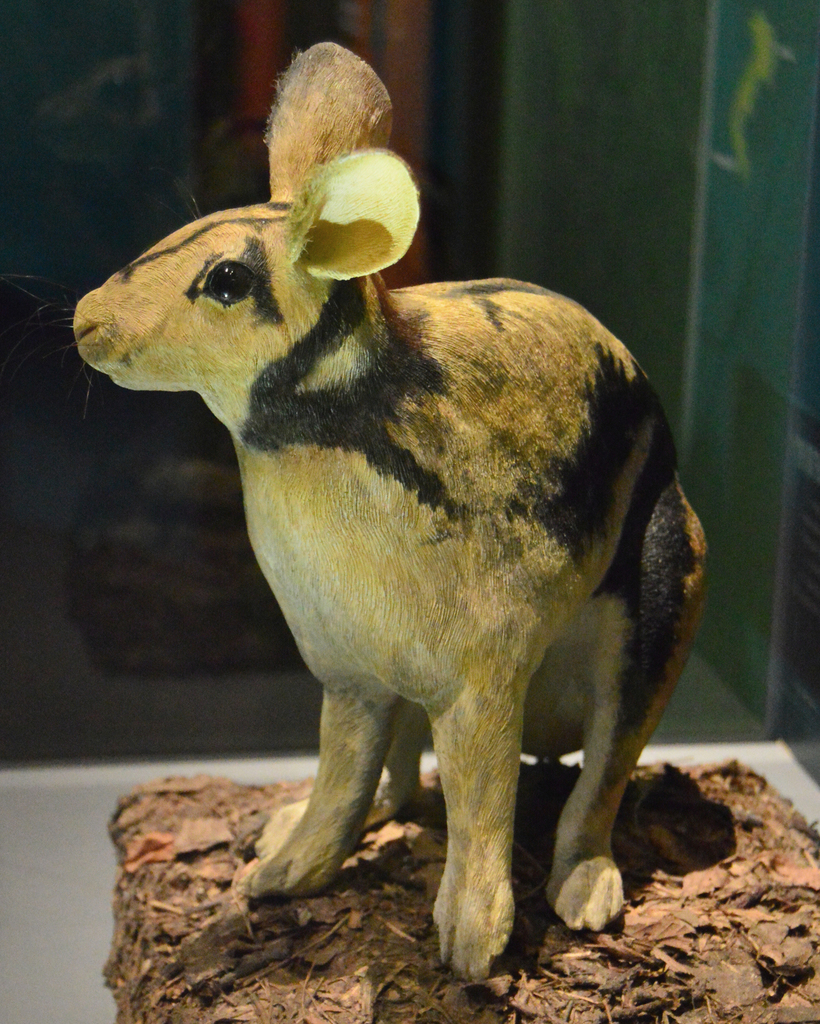
Sumatran Striped Rabbit
Nesolagus netscheri
The Sumatran striped rabbit (Nesolagus netscheri), also known as the Sumatra short-eared rabbit or Sumatran rabbit, is a species of rabbit found in the montane forests of the Barisan Mountains in northwestern Sumatra and surrounding areas. Similar in size to the European rabbit, but with shorter limbs and muzzle and a broader head, the Sumatran striped rabbit is distinguished by the black or dark brown stripes running across its yellowish grey body. Its close relative, the recently discovered Annamite striped rabbit, has similar fur patterns, but is only found on the Laos–Vietnam border.
Like other rabbits, the Sumatran striped rabbit eats plants. It prefers the vegetation of those in the genus Cyrtandra, but will feed on fallen fruit and plants in the Araceae family as well. It avoids cultivated fruits and grains. Studies on the rabbit suggest that it is a solitary, nocturnal animal. Little else is known about its ecology.
From the article Sumatran striped rabbit on Wikipedia (CC BY-SA), quoted section by section
Description
The Sumatran striped rabbit has an adult weight of 1.5 kilograms (3.3 lb) and is between 37 and 39 centimetres (14.6 and 15.4 in) in length, with a tail 17 millimetres (0.67 in) long, a skull length of 67–74 mm (2.6–2.9 in), hind foot length of 67–87 mm (2.6–3.4 in), and ear length of 34–45 mm (1.3–1.8 in). Its yellowish grey body is marked by stripes of dark brown or black. Towards the rump, the rabbit's base color tends towards a rusty brown. It has whitish underparts, including the chin and insides of the legs. Its black ears are so short as to reach only to the eye when folded forwards. The limbs are grey-brown and the tail, notably short and having only 12 bones, is reddish. Most leporids have between 19 and 24 bones in their tail. Coloration patterns vary between individuals. Their fur is soft and dense, overlaid by longer coarse guard hairs. The skin is notably delicate. One specimen was found from South Sumatra that had unusually long ears and shorter feet and tail. …
Range & habitat
This species is endemic to the Barisan Mountains in northwest Sumatra, Indonesia. It has also been found in South, southwest, and West Sumatra. It lives in forests at altitudes of 600–1,600 metres (2,000–5,200 ft) above sea level. Some sightings have occurred in lowland forests as low as 544 metres (1,785 ft) above sea level. The Sumatran striped rabbit prefers to live in montane forests with volcanic soil. It makes its shelter and feeds among the dense understory, generally avoiding clearings. Records of the rabbit are known from every Sumatran national park that includes montane forest habitats.
Wikipedia: “Distribution and habitat”
What it does
The Sumatran striped rabbit is nocturnal, spending the day nearly motionless when observed in captivity. A unique genus of fleas, Nesolagobius, relies upon it as a host. Its social structure is largely unknown, but it is thought to be a solitary animal. Compared to other rabbits, it is a slow-moving species, and may freeze on discovery. Nothing is known about its reproduction. The rabbit rests in the burrows of other animals and the hollows of trees. It usually eats the stalk and leaves of understory plants, but captive rabbits will eat grain and tropical fruits. Its preferred food is the vegetation of plants in the genus Cyrtandra, but other plants such as those in the Araceae family and native fallen fruits are eaten if necessary.
Wikipedia: “Behaviour and ecology”
In human culture
German biologist Hermann Schlegel first described the Sumatran striped rabbit in 1880, based on a specimen provided to the Rijksmuseum van Natuurlijke Historie by E. Netscher. Netscher had obtained the specimen while working in Padang Pandjang, and Schlegel named the species, Lepus netscheri, after him. It was given the type locality of "Sumatra: Padang-Padjang" at an elevation of 2,000 feet (610 metres). Swiss naturalist Charles Immanuel Forsyth Major erected a new genus, Nesolagus, for the Sumatran striped rabbit in 1899, which was recognised by the American mammalogist Marcus Ward Lyon Jr. in his 1904 work that reclassified many of the leporids. The vernacular terminology for "rabbit" in Indonesia is either borrowed from other languages to refer to foreign species of rabbit (arnab from the Arabic أرنب and kelinci from the Dutch word konijntje) or not distinguished from the word used to describe felines (kuching, with rabbits or hares known as e.g. kuching belanda or kuching tapai). Local Sumatrans did not have a name for the Sumatran rabbit at the time of its discovery, as they were not aware that the species even existed. Some have reportedly referred to the species as a "marmot". The species is closely related to the Annamite striped rabbit (Nesolagus timminsi), which was discovered in 1996 and described in 2000. …
Wikipedia: “Etymology and taxonomy”
Listen
Looking for field recordings…
Where it lives
Recorded sightings
—
geo-referenced records in GBIF, from museums, herbaria and field observers.
Drag the globe to turn it. Dots are where records exist, not a range map; darker means more records.
In the stacks
Searching the stacks…
Every page naming Nesolagus netscheri in the Biodiversity Heritage Library →
This page is assembled live from iNaturalist, GBIF, Wikipedia, the Source Library and the Internet Archive. It is not yet part of the hand-edited codex. iNaturalist taxon 43161.