- Animals
- ›Chordates
- ›Vertebrates
- ›Mammals
- ›Therians
- ›Placental Mammals
- ›Primates, Rodents, and Allies
- ›Lagomorphs
- ›Hares and Rabbits
- ›Pronolagus
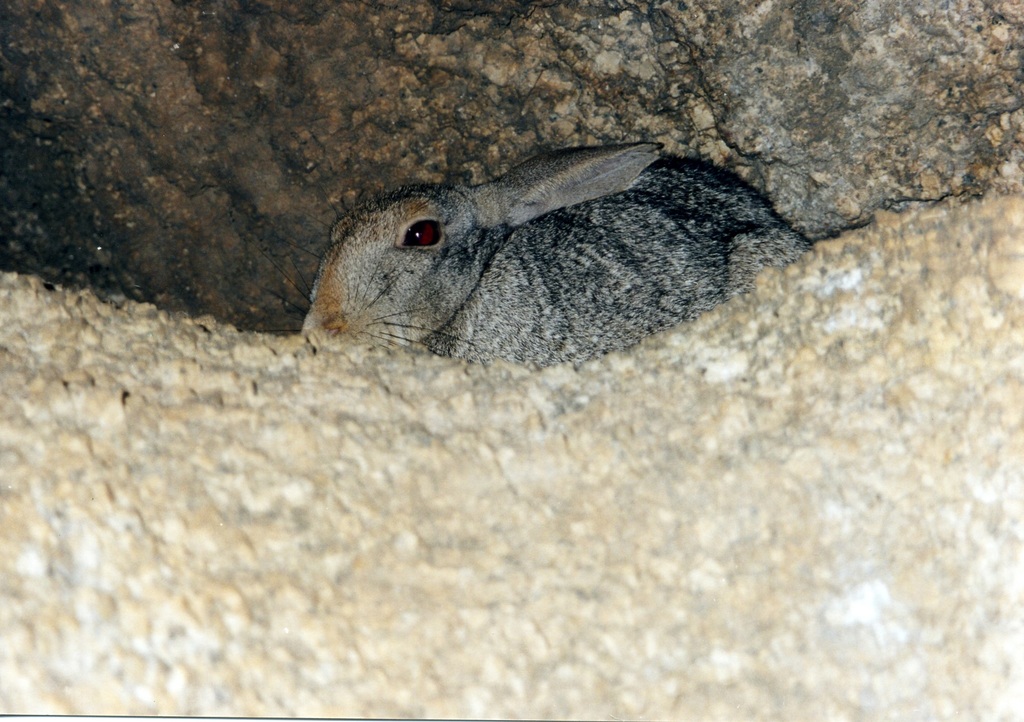
Jameson's Red Rockhare
Pronolagus randensis
Jameson's red rock hare (Pronolagus randensis) is a species of rabbit in the family Leporidae found in rocky habitats in Zimbabwe, Angola, Namibia, South Africa, Botswana, and Mozambique. It is rufous and brown-furred, nocturnal, 42 to 50 cm (17 to 20 in) in length and 1.82 to 2.95 kg (4.0 to 6.5 lb) in weight—slightly smaller than the largest of the red rock hare species, the Natal red rock hare (P. crassicaudatus).
The species is generally solitary when not breeding or grazing. Jameson's red rock hare feeds only at night. While grazing, it is sometimes seen in small groups feeding upon grasses and fresh shoots. Little is known about its mating behaviour, and its predators are similar to those of other red rock hares. It is classified as a least-concern species by the International Union for Conservation of Nature (IUCN), being abundant in the protected areas its distribution overlaps, but its population is decreasing.
From the article Jameson's red rock hare on Wikipedia (CC BY-SA), quoted section by section
Description
Pronolagus randensis has a fine, silky fur which is grizzled rufous-brown on the upper parts of the body. It has a whitish chin and slightly lighter fur on the ventrum. The base of its hairs is a pale cinnamon color. The sides of the neck, lower jaw and cheeks are light grey in colour. It has a 6–13.5-centimetre (2.4–5.3 in) reddish-brown, black tipped tail. The large (8–10 cm (3.1–3.9 in)) ears are sparsely haired and sometimes are tipped with black. When fully grown, P. randensis can weigh from 1.82 to 2.95 kilograms (4.0 to 6.5 pounds), with body length measuring from 42 to 50 cm (17 to 20 in). It is slightly smaller than the largest red rock hare, the Natal red rock hare (Pronolagus crassicaudatus), though on average it has longer ears and tail.
Skeletal morphology. Pronolagus randensis possesses several characteristics in its skeletal morphology that are useful in distinguishing it from other members of Pronolagus, particularly in museum collections where external features may not be preserved. The skull of P. randensis has a much more pronounced curve in profile compared to other members of the genus. Another notable feature is the frontal-parietal suture, which is positioned behind the rear attachments of the cheekbones, creating a larger frontal bone surface on the skull's roof compared to other species. …
Wikipedia: “Characteristics”
Range & habitat
Pronolagus randensis has a disjunct distribution, with one population extending from southern Angola to western and central Namibia and the other occurring mainly in Zimbabwe, extending into South Africa, Botswana, and slightly into Mozambique. The two populations are separated by roughly 900 kilometres (560 mi) of unsuitable habitat. It is particularly abundant in Zimbabwe's Matopos Hills and around sandstone formations found in eastern Botswana. Jameson's red rock hare inhabits rocky environments such as kopjes, canyons, and cliffs, relying on rock crevices and boulders for shelter. It occupies lower elevations than Hewitt's red rock hare (Pronolagus saundersiae), where there is less rainfall; the two species can also be distinguished in regions where they are sympatric by their ears and tail, as P. saundersiae has on average longer ears and a shorter tail than P. randensis. P. randensis inhabits rocky areas with grass or scrub and generally remains within its habitat, though it may disperse up to 22 km (14 mi) when needed. P. randensis does not share its distribution with that of either the Natal red rock hare (Pronolagus crassicaudatus) or Smith's red rock hare (Pronolagus rupestris).
Wikipedia: “Distribution and habitat”
What it does
Primarily nocturnal, Pronolagus randensis remains in hiding during the day, though it will emerge in the early morning from shelter to bask in the sun. Unlike hyraxes, similarly sized mammals that share the same rocky habitat and frequently bask on exposed rocks, P. randensis remains hidden and does not use observation boulders. P. randensis is solitary in its habits, although it is sometimes seen in groups when grazing. It also appears in groups consisting of a female, her young, and one to two males. An oestrus female is often followed by courting males. Jameson's red rock hare is strictly nocturnal, foraging only at night when it is most active. It feeds on the vegetation in and around its habitat including grasses, and prefers eating fresh shoots following brush fires. If it cannot find grass within its rocky habitat, it will venture out into flat areas to forage, retreating back into rocky outcroppings afterwards or if startled. When disturbed, it will remain under cover until the last moment, at which point it flees behind nearby rocks. It avoids eating some plants, such as Croton gratissimus and Indigofera filipes, possibly due to the presence of hazardous compounds in the plants that present in the form of strongly aromatic leaves. Like other leporids, it consumes its own cecotropes. …
Wikipedia: “Behavior and ecology”
Listen
Looking for field recordings…
Where it lives
Recorded sightings
—
geo-referenced records in GBIF, from museums, herbaria and field observers.
Drag the globe to turn it. Dots are where records exist, not a range map; darker means more records.
In the stacks
Searching the stacks…
Every page naming Pronolagus randensis in the Biodiversity Heritage Library →
This page is assembled live from iNaturalist, GBIF, Wikipedia, the Source Library and the Internet Archive. It is not yet part of the hand-edited codex. iNaturalist taxon 43159.