- Animals
- ›Chordates
- ›Vertebrates
- ›Mammals
- ›Therians
- ›Placental Mammals
- ›Primates, Rodents, and Allies
- ›Lagomorphs
- ›Hares and Rabbits
- ›Lepus
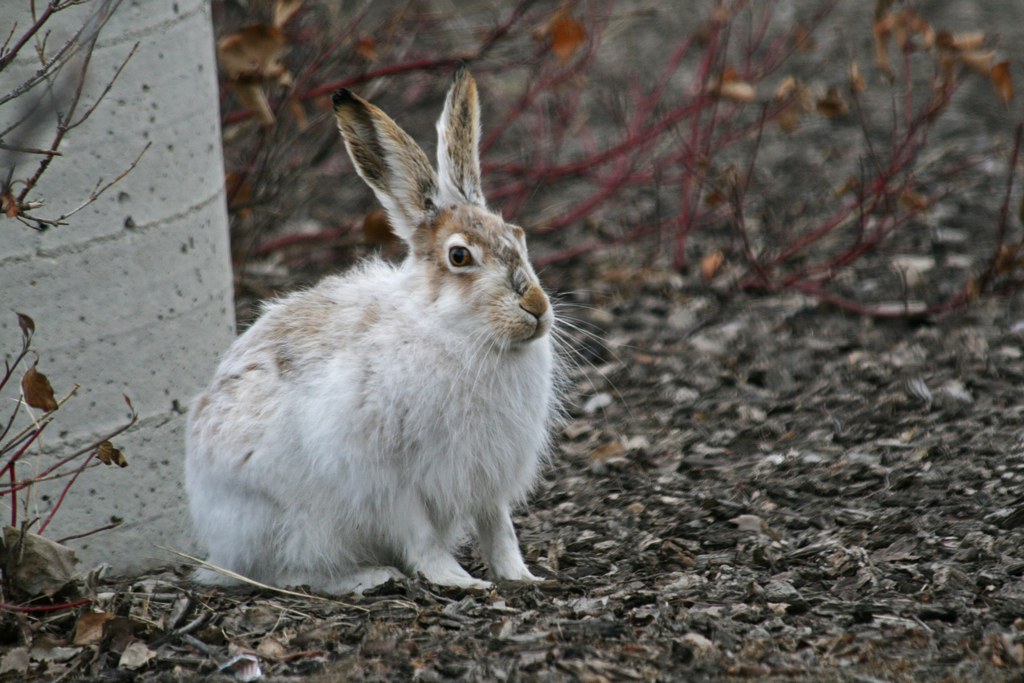
White-tailed Jackrabbit
Lepus townsendii
The white-tailed jackrabbit (Lepus townsendii), also known as the prairie hare and the white jack, is a species of hare found in western North America. Like all hares and rabbits, it is a member of the family Leporidae of order Lagomorpha. It is a solitary individual except where several males court a female in the breeding season. Litters of four to five young are born in a form, a shallow depression in the ground, hidden among vegetation. This jackrabbit has two described subspecies: L. townsendii townsendii occurring west of the Rocky Mountains and L. townsendii campanius occurring east of the Rocky Mountains.
From the article White-tailed jackrabbit on Wikipedia (CC BY-SA), quoted section by section
Description
The white-tailed jackrabbit is a large species of hare and is the largest species called "jackrabbit". This jackrabbit has an adult length of 22 to 26 inches (56 to 65 centimeters), including a tail measuring 2.6 to 4.0 in (6.6 to 10.2 cm), and a weight between 5.5 and 9.5 pounds (2.5 and 4.3 kilograms). From winter to spring, weight tends to increase in females due to pregnancy, but decrease in males due to the stresses of reproductive competition. Thus, females in Iowa went from averaging 7.9 lb (3,600 g) in winter to 8.4 lb (3,800 g) in spring and males from averaging 7.5 lb (3,400 g) in winter to 6.8 lb (3,100 g) in spring. At the northernmost extremity of its range, it can be almost twice as large as in the middle of its range. In Saskatchewan, rare specimens have been recorded over 20 lb (9 kg). It has distinctive large black-tipped grey ears that are chestnut brown and white on the inner surface, and the long, powerful hind legs characteristic of hares. The back, flanks and limbs are dark brown or greyish-brown and the underparts are pale grey. The ear, from the notch, measures from 3.9 to 4.4 in (10 to 11.3 cm) and the hindfoot measures 5.7 to 6.5 in (14.5 to 16.5 cm). The tail is white with a dark central stripe above. Females are slightly larger than males. In northern populations, this hare moults in the autumn and becomes white all over except for its ears. …
Range & habitat
The white-tailed jackrabbit is native to western and central parts of North America. Its range includes British Columbia, Alberta, Saskatchewan, Manitoba and Ontario in Canada and Washington, Oregon, California, Nevada, Utah, Idaho, Montana, Wyoming, Colorado, New Mexico, North Dakota, South Dakota, Nebraska, Kansas, Minnesota, Wisconsin, Iowa, Missouri and Illinois in the United States. It is found in plains and prairie and in alpine meadows with scattered coniferous trees up to an elevation of about 3,000 m (10,000 ft) in Colorado. The white-tailed jackrabbit is slightly larger than the black-tailed jackrabbit (Lepus californicus) and where their ranges overlap, they are segregated by their habitat, as the former tends to live in higher altitudes and the latter in more arid lowland habitats. Whitetails are often seen in urban parks and on suburban parks in Western Canada. People often come across bunnies alone during the day in spring and mistakenly assume they are abandoned by their mothers. The Edmonton Humane Society has issued public statements asking that bunnies not be brought into animal shelters.
Wikipedia: “Distribution and habitat”
What it does
The white-tailed jackrabbit is nocturnal and lies up during the day in a form, a shallow depression in the ground hidden under vegetation, emerging at dusk to feed. The forms of this species range from 46 to 61 cm (18 to 24 in) long, 20 to 30 cm (7.9 to 11.8 in) wide, and up to 20 cm (7.9 in) deep. Often, discernible paths lead away from the form and others among the plants at often-visited feeding sites. In winter snow, the forms are interconnecting, cave-like structures. This jackrabbit is a solitary species and feeds on grasses and other green plants, including cultivated crops. In southern Colorado, from summer through fall into winter, the diet varied from 70% (summer) to 4% (winter) forbs, 43% (fall) to 4% (winter) grasses and 76% (winter) to 7% (summer) scrubs. During the winter its diet includes buds, twigs and bark from low shrubs. It tends to be more selective in its feeding habits than the black-tailed jackrabbit, which puts the white-tailed at a disadvantage where their ranges overlap. It has good eyesight, excellent hearing, and sensitive whiskers, and is probably able to detect olfactory clues as to whether another jackrabbit is ready to breed. The breeding season is variable and depends upon latitude and environmental factors; it extends from February to July in different parts of the range. …
Wikipedia: “Behaviour”
Listen
Looking for field recordings…
Where it lives
Recorded sightings
—
geo-referenced records in GBIF, from museums, herbaria and field observers.
Drag the globe to turn it. Dots are where records exist, not a range map; darker means more records.
In the stacks
Searching the stacks…
Every page naming Lepus townsendii in the Biodiversity Heritage Library →
This page is assembled live from iNaturalist, GBIF, Wikipedia, the Source Library and the Internet Archive. It is not yet part of the hand-edited codex. iNaturalist taxon 43145.