- Animals
- ›Chordates
- ›Vertebrates
- ›Mammals
- ›Therians
- ›Placental Mammals
- ›Primates, Rodents, and Allies
- ›Lagomorphs
- ›Hares and Rabbits
- ›Sylvilagus
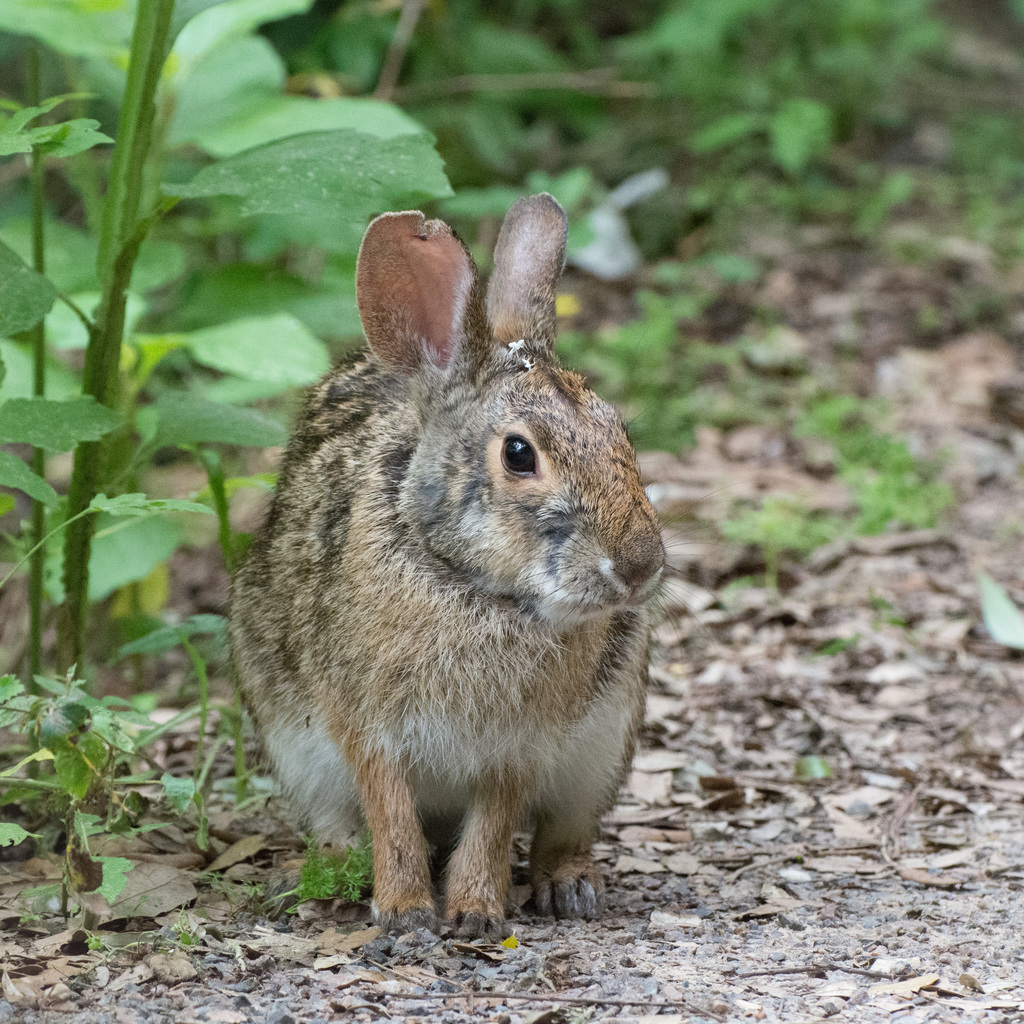
Swamp Rabbit
Sylvilagus aquaticus
The swamp rabbit (Sylvilagus aquaticus), also known as the cane cutter, swamper, or cane jake, is a species of cottontail rabbit found in the swamps and wetlands of the southern United States. It is herbivorous, territorial, and nocturnal. The largest of the cottontail rabbits, it is similar in appearance to the eastern cottontail, but has distinctly smaller ears and orange-colored hind legs. Swamp rabbits are closely related to the marsh rabbit. The two species likely separated during the Pleistocene epoch.
The swamp rabbit is most abundant in Alabama, Mississippi, and Louisiana, and also inhabits South Carolina, Arkansas, Tennessee, Texas, Oklahoma, Missouri, Kentucky, Illinois, Indiana, Georgia. Its habitat is largely dominated by regions near lowland water. Unlike other cottontail rabbits, the swamp rabbit is territorial and maintains a social order between higher- and lower-ranking males and females via displays of dominance, vocalizations, and occasional fighting. This rabbit is unique in that it ventures into water on its own, unlike other Texas rabbits, and is rarely spotted during the day due to its secretive nature. When threatened, it will take to water and swim. Swamp rabbits in a given population usually breed around the same time, giving birth to young that are born blind, immobile, and completely dependent for the first few days. Their nests—called forms—are lined with fur and grass. Each litter produces one to six young.
From the article Swamp rabbit on Wikipedia (CC BY-SA), quoted section by section
Description
Sylvilagus aquaticus is the largest of the cottontail species, although its ears are smaller than those of other cottontails, being medium-sized with relation to the rest of its body. The head and back are typically dark or rusty brown or black, while the throat, ventral surface, and tail are white, and there is a cinnamon-colored ring around the eye. While largely similar to eastern cottontails (S. floridanus) in appearance, the swamp rabbit differs in the sizes of its ears and skull; the former are much smaller, and the latter is larger. Additionally, the back portions of the swamp rabbit's hind legs are orange, in contrast to the tan or white feet of the eastern cottontail. Like other leporids, it has a dental formula of 2.0.3.31.0.2.3 × 2 = 28—two pairs of upper and one pair of lower incisors, no canines, three upper and two lower premolars on each side, and three upper and lower molars on either side of the jaw. Sylvilagus aquaticus males vary in weight from approximately 4 to 5.6 lb (1.8 to 2.5 kg), with an average of about 5 lb (2.3 kg); females vary from approx. 3.6 to 5.9 lb (1.6 to 2.7 kg), averaging about 4.8 lb (2.2 kg). S. aquaticus ranges in length from approx. 17.8 inches (45 cm) to 21.7 in (55 cm), with an average length of about 19.7 in (50 cm). Males and females of the species show very little sexual dimorphism with regard to size. The subspecies S. a. …
Wikipedia: “Characteristics”
Range & habitat
The swamp rabbit is found in much of the south-central United States and along the Gulf coast. It is most abundant in Alabama, Mississippi, and Louisiana, but also inhabits South Carolina, Arkansas, Tennessee, Texas, Oklahoma, Missouri, Kentucky, Illinois, Indiana, and Georgia. It is possibly extirpated (locally extinct) from Kansas. Swamp rabbits mainly live close to lowland water, often in cypress swamps, marshland, floodplain, and river tributaries. Swamp rabbits spend much of their time in depressions which they dig in tall grass or leaves, providing cover while they wait until the nighttime to forage. The swamp rabbit has been suggested for use as an indicator species, as its preferred habitat is shared by many other species, the rabbit makes use of different aspects of its habitat, and monitoring is easy to do. The ranges of both the marsh rabbit and eastern cottontail overlap with that of the swamp rabbit. Habitat loss and fragmentation have caused declines in swamp rabbit populations. In the northernmost regions of its range, the rabbit is particularly vulnerable during snowy days, as its dark coat makes it particularly visible against the white background, making it more vulnerable to predators. Snow cover constrains both hiding ability and availability of food resources.
Wikipedia: “Range and habitat”
What it does
Swamp rabbits are territorial, though they will tolerate some overlap between the home ranges of individuals depending on the season. These home ranges can vary in size from 1 to 12 hectares (2.5 to 29.7 acres). They will mark their territory by "chinning"—marking objects with pheromones produced from glands near the chin. This behavior is also noted in the European rabbit. Males that are competing for territory or status may fight, with battles sometimes resulting in the death of an individual. Males will stand up on their hind legs, lashing out with their teeth and claws, and will even use the claws on their hind feet in jumping attacks. However, compared to nonviolent displays of dominance and submission, fighting is rare. Swamp rabbits maintain social order through displays of dominance, and communicate directly through vocalizations such as squeaks, chirps, squeals and alert calls. Higher-ranking males will display dominance over lower-ranking males more frequently, and will move within the home ranges of females more frequently, with the alpha male copulating most often in a given season. The system of male dominance prevents injury between subordinate breeding males under the alpha, as the lower-ranking individuals will avoid higher-ranking males to prevent conflict. …
Wikipedia: “Ecology and behavior”
In human culture
The swamp rabbit was first described in 1837 by the American naturalist John Bachman as Lepus aquaticus, described as being collected in "western Alabama". In 1904, it was placed in the genus Limnolagus as the type species by American mammalogist Marcus Ward Lyon Jr.; the name was previously used as the subgenus of both the swamp rabbit and marsh rabbit (S. palustris) in an 1899 work by the Swiss physician Charles Immanuel Forsyth Major. Edward William Nelson, an American naturalist, clarified several years later in 1909 that the species belonged to Sylvilagus and grouped it alongside the marsh rabbit. Common names of the swamp rabbit include "cane cutter", "swamper", and "cane jake". Two subspecies are recognized: Sylvilagus aquaticus aquaticus, the nominate subspecies that occupies most of the swamp rabbit's recognized distribution, and Sylvilagus aquaticus littoralis, the coast swamp rabbit, which is found only in a narrow band of marshes in Mississippi, Louisiana, and Texas along the Gulf of Mexico coast. Nelson made the distinction between the subspecies in the same 1909 work where the species was classified as a member of Sylvilagus, noting that the littoralis form had "remarkable" differences from the nominate subspecies and that it had been assumed to be the "true aquaticus" in prior studies.
Fossil record. …
Wikipedia: “Taxonomy and etymology”
Listen
Looking for field recordings…
Where it lives
Recorded sightings
—
geo-referenced records in GBIF, from museums, herbaria and field observers.
Drag the globe to turn it. Dots are where records exist, not a range map; darker means more records.
In the stacks
Searching the stacks…
Every page naming Sylvilagus aquaticus in the Biodiversity Heritage Library →
This page is assembled live from iNaturalist, GBIF, Wikipedia, the Source Library and the Internet Archive. It is not yet part of the hand-edited codex. iNaturalist taxon 43116.