- Animals
- ›Chordates
- ›Vertebrates
- ›Birds
- ›Gannets, Cormorants, and Allies
- ›Cormorants and Shags
- ›Phalacrocorax
On eBird ↗
Black-faced Cormorant
Live sightings near you, the range map, bar charts of when it is seen, and Macaulay Library photos and recordings.
Black-faced Cormorant
Phalacrocorax fuscescens
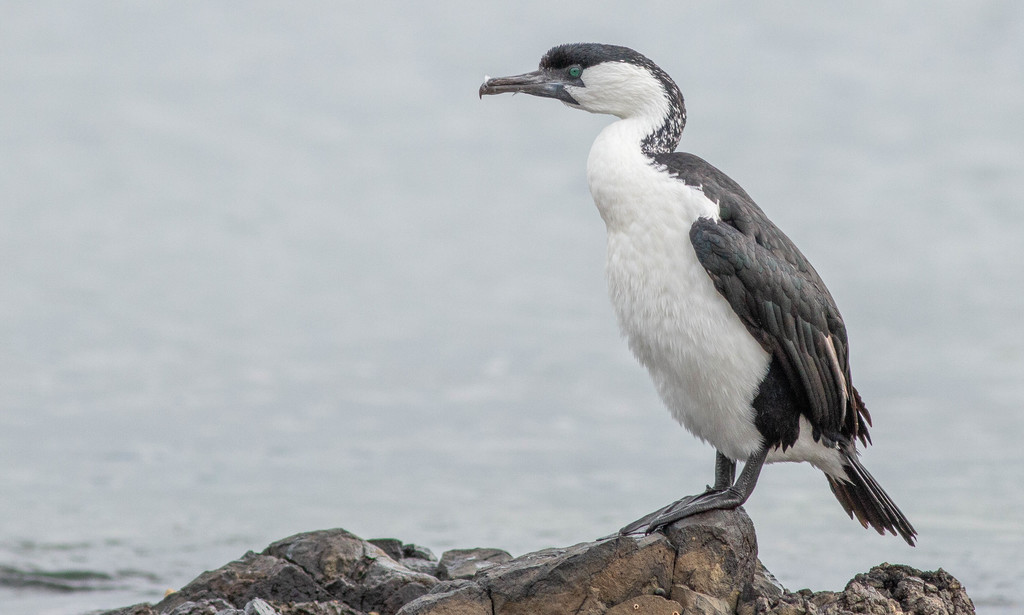
The black-faced cormorant (Phalacrocorax fuscescens), also known as the black-faced shag, is a medium-sized member of the cormorant family. Upperparts, including facial skin and bill, are black, with white underparts. It is endemic to coastal regions of southern Australia.
From the article Black-faced cormorant on Wikipedia (CC BY-SA), quoted section by section
Description
Like other cormorant species, the black-faced cormorant is a large aquatic bird, with a long hooked bill, webbed feet, and monochromatic plumage. This is one of the largest cormorants found in south-western Australia and has pied plumage with the upper half of its body black and the undersides white. Its face is naked and black, hence the "black-faced" name, and the tail, feet, and thighs are also black. The back feathers are glossy, and its bill is dark grey with a prominent hook at the tip. It has blue-green eyes. When flying, it holds its head level or lower than its body and holds its wings in a cross-shape like most cormorants. Species that are similar in appearance include the pied cormorant (slightly larger) and the little pied cormorant (slightly smaller).
Plumages. The breeding and non-breeding plumages are very similar, with the formation of fine white streaks along the neck during breeding until eggs are laid. Juveniles have dark-brown upper feathers, including dark ear coverts and a dark face, with a lighter underside streaked with brown. Following the Juvenile plumage, black-faced cormorants have immature plumage which are similar to adult plumage.
Sexual Dimorphism. Black-faced cormorants have very subtle sexual dimorphism, making it difficult to differentiate sexes in the field. …
Range & habitat
Black-faced cormorants are endemic to the coastal regions of southern Australia and Tasmania. The population is estimated to in the tens of thousands, and is distributed across Western Australia, South Australia, Victoria and Tasmania, particularly in the Bass Strait and Spencer Gulf. There are two independent populations: one on the southern coast of Western Australia, and the other on the coasts of Southern Australia, Victoria and Tasmania.
Habitat. Unlike the other cormorants found around the Australian continent, the habitat of the black-faced cormorant is exclusively coastal and marine. They can be found in coastal waters, inlets, rocky shores, and offshore islands. Occasionally black-faced cormorants can be found in estuaries of rivers. Colonies are usually found on steep cliffs and rocky islands where they nest. In the winter, black-faced cormorants leave coastal waters to breed in these colonies.
Wikipedia: “Habitat and Distribution”
What it does
Because the black-faced cormorant is an exclusively marine bird, its behaviours enable it to be well-adapted to its environment. It uses pursuit-diving to capture fish, and nests high on cliffs to avoid predators.
Diet. The black-faced cormorant eats fish almost exclusively. Its diet generally consists of benthic or demersal fish, as well as some cephalopods, and varies between breeding and non-breeding seasons. It forages along the coast and at the mouths of rivers, and will dive up to 12 m to catch its prey. After diving, the black-faced cormorant will spread its wings to dry its feathers in the sun. Black-faced cormorants will occasionally forage together in flocks. While breeding, its preferred prey items are wrasse and silver trevally. After the breeding season, silverbelly, wrasse, whiting and hardyheads are consumed most frequently. Prey is consumed whole, and non-digestible parts are regurgitated in pellets.
Reproduction. Breeding cormorants nest in pairs or breeding colonies on islands or cliffs. They are likely monogamous like other cormorant species. Nesting sites are on bare rocks, often close to water, and are solidly built of driftwood, seaweed, and other plants with a 35–45 cm diameter. 2 to 3 elongated oval eggs are then laid. …
Wikipedia: “Behaviour and Ecology”
Listen
Looking for field recordings…
Where it lives
Recorded sightings
—
geo-referenced records in GBIF, from museums, herbaria and field observers.
Drag the globe to turn it. Dots are where records exist, not a range map; darker means more records.
In the stacks
Searching the stacks…
Every page naming Phalacrocorax fuscescens in the Biodiversity Heritage Library →
This page is assembled live from iNaturalist, GBIF, Wikipedia, the Source Library and the Internet Archive. It is not yet part of the hand-edited codex. iNaturalist taxon 4311.