- Animals
- ›Chordates
- ›Vertebrates
- ›Mammals
- ›Therians
- ›Placental Mammals
- ›Primates, Rodents, and Allies
- ›Lagomorphs
- ›Hares and Rabbits
- ›Sylvilagus
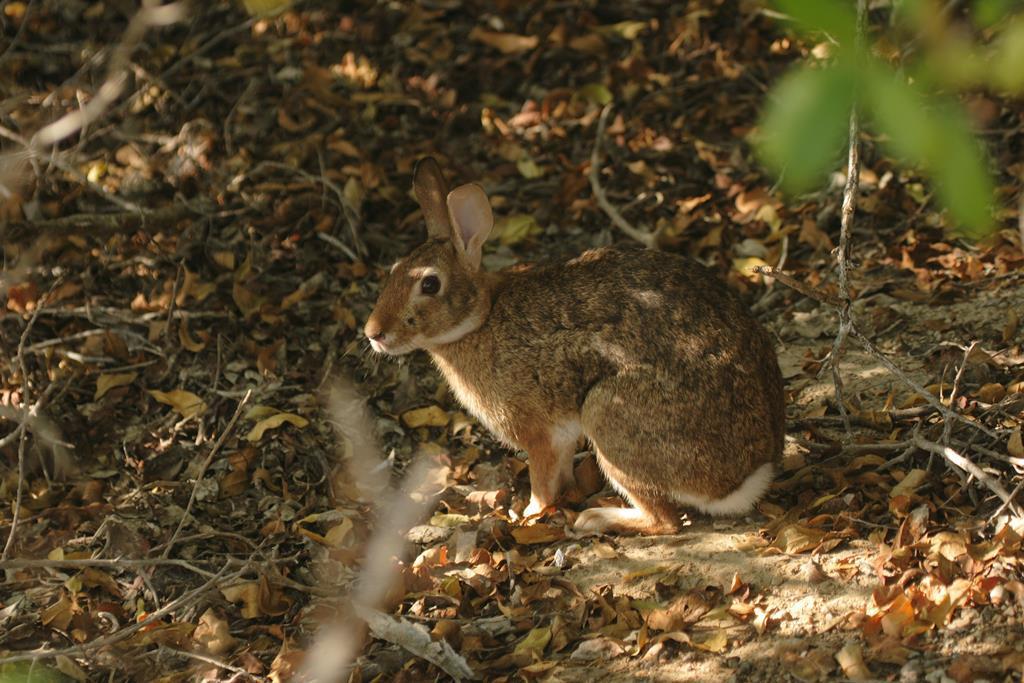
Tres Marías Cottontail
Sylvilagus graysoni
The Tres Marias cottontail or Tres Marias rabbit (Sylvilagus graysoni) is a medium-sized species of rabbit that is endemic to the Islas Marías in Mexico. Relatively unafraid of humans, the rabbit is the only member of the family Leporidae found on the islands. It prefers the island's dry, tropical forests, and regions with plenty of bushes for cover, which it will rest under for most of the day. It has few predators, with the known native species that feed on it being birds of prey and the Tres Marias raccoon, though it has been threatened by habitat loss due to human developments, as well as browsing by introduced white-tailed deer and goats. The Tres Marias cottontail is considered to be an endangered species by the Mexican government and the International Union for Conservation of Nature, and population declines have been reported across most of the species' range, with the exception of the island of San Juanito.
From the article Tres Marias cottontail on Wikipedia (CC BY-SA), quoted section by section
Description
Sylvilagus graysoni is a medium-sized cottontail rabbit. Its adult body length measures from 437 to 480 millimeters (17.2 to 18.9 inches), and it has short ears that measure from 57 to 64 mm (2.2 to 2.5 in). The skull is also of medium size, measuring from 78 to 80 mm (3.1 to 3.1 in). Its fur is rufous, and brightens near the nape and rump areas. The underside and tail is whitish, and there is a brown section present on the throat. The skin is noted as being very thin. The skull of the Tres Marias cottontail has a long upper jaw with long incisive foramina (ducts in the palate of the mouth). There is a long gap between the incisors and premolars. The basilar part of its occipital bone is notably narrow. Similar to the marsh rabbit (S. palustris), it has bony extensions on the back of the brow (the supraorbital margin) that are fused to the rear part of the skull that surrounds the brain (the braincase). Like other rabbits and hares, it has a dental formula of 2.0.3.31.0.2.3 × 2 = 28—two pairs of upper and one pair of lower incisors, no canines, three upper and two lower premolars on each side, and three upper and lower molars on either side of the jaw. S. graysoni is similar in shape to the closely related Mexican cottontail (S. cunicularius), which is present in mainland Mexico. It is similar to S. …
Range & habitat
Sylvilagus graysoni is endemic to the Islas Marías, part of the Mexican state of Nayarit. A late 19th century account of the rabbit noted that it was abundantly found on both María Madre and María Magdalena, but was rarely encountered on María Cleofa. Later accounts found the species on the three northern islands, but not María Cleofa. More recent accounts describe S. graysoni as occurring on all four islands in the archipelago, with the population on San Juanito making up the subspecies S. g. badistes. The rabbit occupies a total area of less than 500 square kilometers (190 sq mi) across the islands. It is the only species in the family Leporidae found on the islands. Its natural habitat is deciduous tropical forest, though the region it occupies on the Islas Marías is more arid than mainland Mexico. The region is dominated by plants in the genus Bursera, the false tamarind, and the chupandía. The rabbit thrives in regions of San Juanito where there are dense trees, bushes, and agaves that rise to 3–4 meters (9.8–13.1 ft) in height. It may also spread to abandoned farmlands across the islands, though it prefers areas with plenty of low bushes. It occurs from sea level up to elevations of roughly 350 meters (1,150 ft).
Wikipedia: “Distribution and habitat”
What it does
Due to its isolation, Sylvilagus graysoni does not fear humans like other species on the mainland. Individuals on San Juanito are notable in their lack of escape behavior. Members of this species will spend much of the day resting in shallow depressions under bushes, waiting until sunset to emerge into open areas. The Tres Marias cottontail has few known predators. These include the Tres Marias raccoon, a subspecies of the common raccoon, and two birds of prey, the red-tailed hawk and the crested caracara. The species' reproductive behavior is largely unknown. One expedition in March 1978 found 11 lactating females, and two females that were pregnant with 75-millimeter (3.0 in) embryos. The species has 42 diploid chromosomes, a number shared with the Mexican cottontail, the eastern cottontail and the desert cottontail (S. audubonii).
Wikipedia: “Behavior and ecology”
Listen
Looking for field recordings…
Where it lives
Recorded sightings
—
geo-referenced records in GBIF, from museums, herbaria and field observers.
Drag the globe to turn it. Dots are where records exist, not a range map; darker means more records.
In the stacks
Searching the stacks…
Every page naming Sylvilagus graysoni in the Biodiversity Heritage Library →
This page is assembled live from iNaturalist, GBIF, Wikipedia, the Source Library and the Internet Archive. It is not yet part of the hand-edited codex. iNaturalist taxon 43100.