On eBird ↗
Chilean Flamingo
Live sightings near you, the range map, bar charts of when it is seen, and Macaulay Library photos and recordings.
Chilean Flamingo
Phoenicopterus chilensis
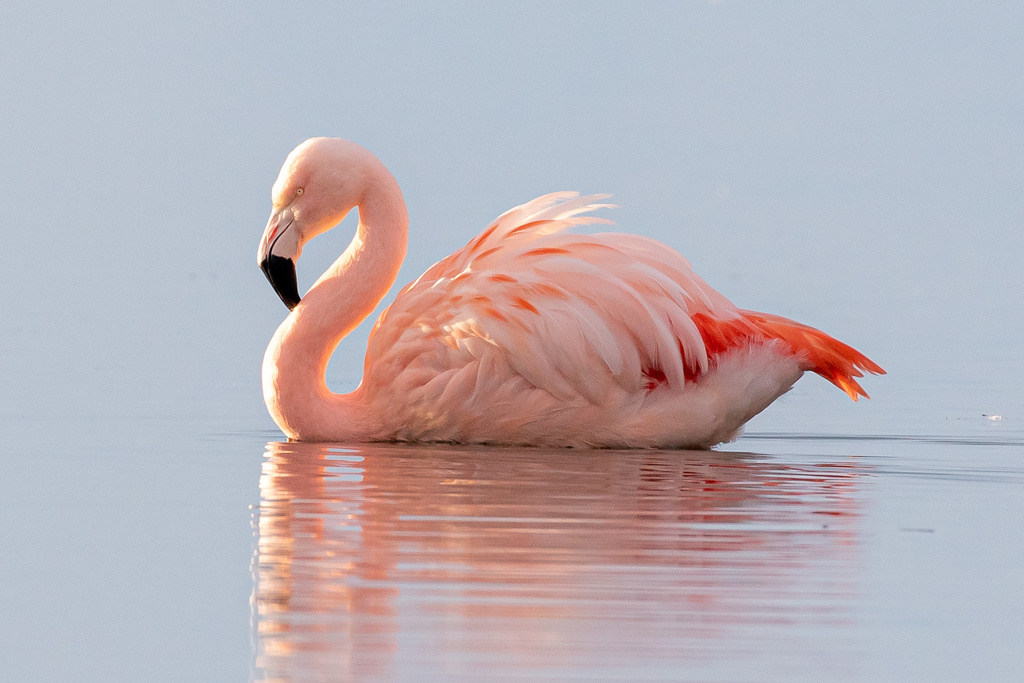
The Chilean flamingo (Phoenicopterus chilensis) is a species of large flamingo at a height of 110–130 cm (43–51 in) closely related to the American flamingo and the greater flamingo, with which it was previously considered a subspecies before being classified as its own species as a result of their lighter color, smaller size and behavioral differences. The species is listed as Near Threatened on the IUCN Red List.
The species breeds in South America from Ecuador and Peru to Chile and Argentina and east to Brazil. Like all flamingos, it lays a single chalky-white egg on a mud mound.
From the article Chilean flamingo on Wikipedia (CC BY-SA), quoted section by section
Description
The Chilean flamingo's plumage is pinker than the slightly larger greater flamingo, but less so than the American flamingo. It can be differentiated from these species by its grayish legs with pink joints, by the larger amount of black on the bill (more than half), and also by being a foot shorter than the American flamingo. Young chicks may have no sign of pink coloring whatsoever, but instead remain gray or peach. Young chicks will slowly gain their pink color as pigments called carotenoids from their diet accumulate in their feathers. Chilean flamingos reach sexual maturity at 6 years and have one of the longest lifespans of any bird, living up to 50 years in the wild and up to 40 years in captivity.
What it does
The Chilean flamingo's bill is equipped with comb-like structures that enable it to filter food—mainly algae, plankton, crustaceans, insects, mollusks and other invertebrates—from the water of the coastal mudflats, estuaries, lagoons, and salt lakes where it lives. The species filter feeds with its head upside down in shallow water. The flamingo then uses its muscular tongues to push water in and out of the lamellae on its bill. This allows the flamingo to filter different sizes of food to consume. Because the species feeds upside down, only the flamingo's upper bill can move as opposed to most animals that can only move their lower mandible. Chilean Flamingoes can consume 10% of their body weight every day. The species has been known to stand on one leg while feeding in water. Strong evidence suggests this behavior limits heat loss from standing in water for extended periods of time. Their long legs also help stir up the sediment to dislodge the small organisms they filter feed on.
Wikipedia: “Diet”
Listen
Looking for field recordings…
Where it lives
Recorded sightings
—
geo-referenced records in GBIF, from museums, herbaria and field observers.
Drag the globe to turn it. Dots are where records exist, not a range map; darker means more records.
In the stacks
Searching the stacks…
Every page naming Phoenicopterus chilensis in the Biodiversity Heritage Library →
This page is assembled live from iNaturalist, GBIF, Wikipedia, the Source Library and the Internet Archive. It is not yet part of the hand-edited codex. iNaturalist taxon 4258.