- Animals
- ›Arthropods
- ›Crustaceans
- ›Typical Crustaceans
- ›Malacostracans
- ›Decapods, Isopods, and allies
- ›Decapods and Krill
- ›Decapods
- ›Crabs, Lobsters, Shrimps, and Allies
- ›True Crabs
- ›Eubrachyuran Crabs
- ›Heterotrematan Crabs
- ›Spider Crabs and Decorator Crabs
- ›Kelp Crabs
- ›Pisinae
- ›Libinia
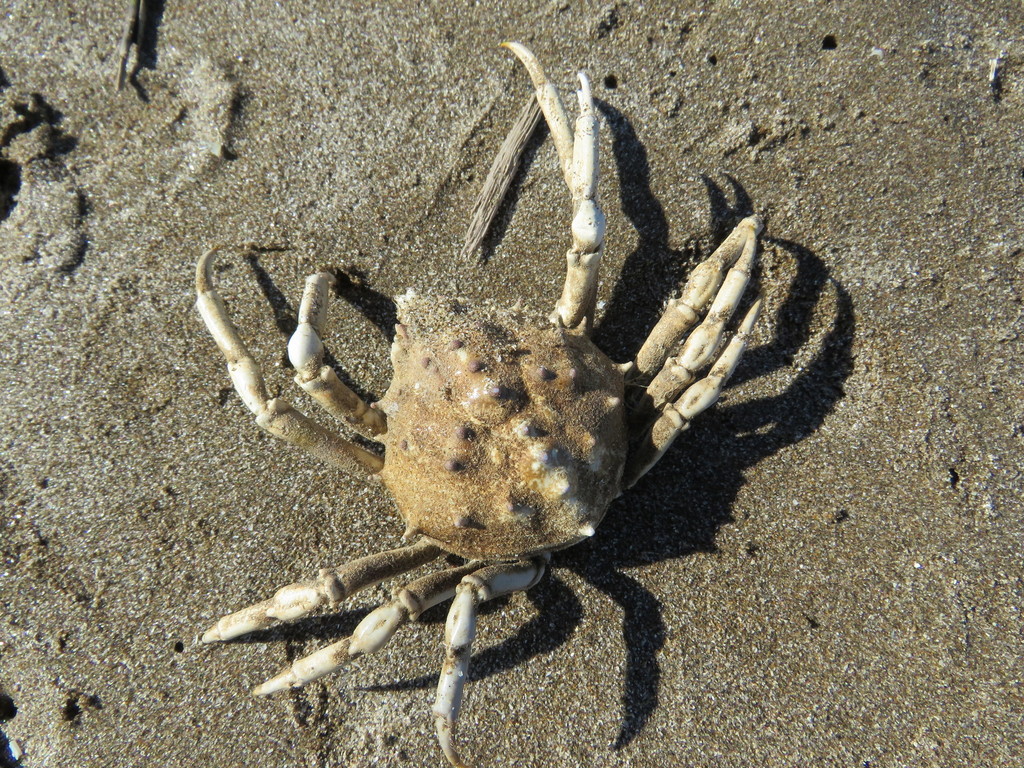
Spinyback Spider Crab
Libinia spinosa
Libinia spinosa is a majoid crab found in mud and sand bottoms of the Southwestern Atlantic and Pacific oceans. It is a generalist feeder on organisms such as algae, sponges, cnidarians, mollusks, polychaetes, crustaceans, and small fish. It commonly engages in a symbiotic relationship with the medusa Lychnorhiza lucerna.
From the article Libinia spinosa on Wikipedia (CC BY-SA), quoted section by section
Description
Libinia spinosa is a member of the crab superfamily Majoidea which are commonly known as the spider crabs. The carapaces of this organism can measure up to 89 mm and its leg span can be up to 568 mm. The number of median spines of Libinia spinosa can vary, with 7 being the most common number, but Libinia spinosa with 5, 8, and 10 median spines are also seen commonly. Testes are visibly flat, transparent structures that are coiled anteriorly.
Range & habitat
Libinia spinosa is commonly found at both mud and sand bottoms in the Southwestern Atlantic and Pacific oceans. It inhabits Southwestern Atlantic waters ranging from Nova Scotia to Argentina. In the Pacific Ocean, it is found off the coasts of the United States, Baja California, Galápagos Islands, Hawaii, Peru, and Chile. The depths at which this organism is found at range from the intertidal zone to 170 m. It prefers sediment that contains both silt and clay.
Wikipedia: “Range and habitat”
What it does
Libinia spinosa engage in precopulatory courting using both olfactory and tactile cues, indirect sperm transfer is common. Females have been shown to exhibit sexual selection with their preference for larger males. The trait that has been shown to be most highly correlated with mate acquisition for males is large cheliped size. Males have been shown to exhibit mate guarding where they will maneuver their chelipeds around the female and fight off other males. Precopulatory mate guarding is exhibited significantly longer than postcopulatory mate guarding. Males breed with females by turning the female upside down and below them and subsequently inserting their gonopods into the female's gonophores. Male copulatory organs consist of a long first gonopod and a short stout second gonopod. Females produce 1-3 offspring for each breeding season.
Wikipedia: “Reproduction”
Where it lives
Recorded sightings
—
geo-referenced records in GBIF, from museums, herbaria and field observers.
Drag the globe to turn it. Dots are where records exist, not a range map; darker means more records.
In the stacks
Searching the stacks…
Every page naming Libinia spinosa in the Biodiversity Heritage Library →
This page is assembled live from iNaturalist, GBIF, Wikipedia, the Source Library and the Internet Archive. It is not yet part of the hand-edited codex. iNaturalist taxon 424964.