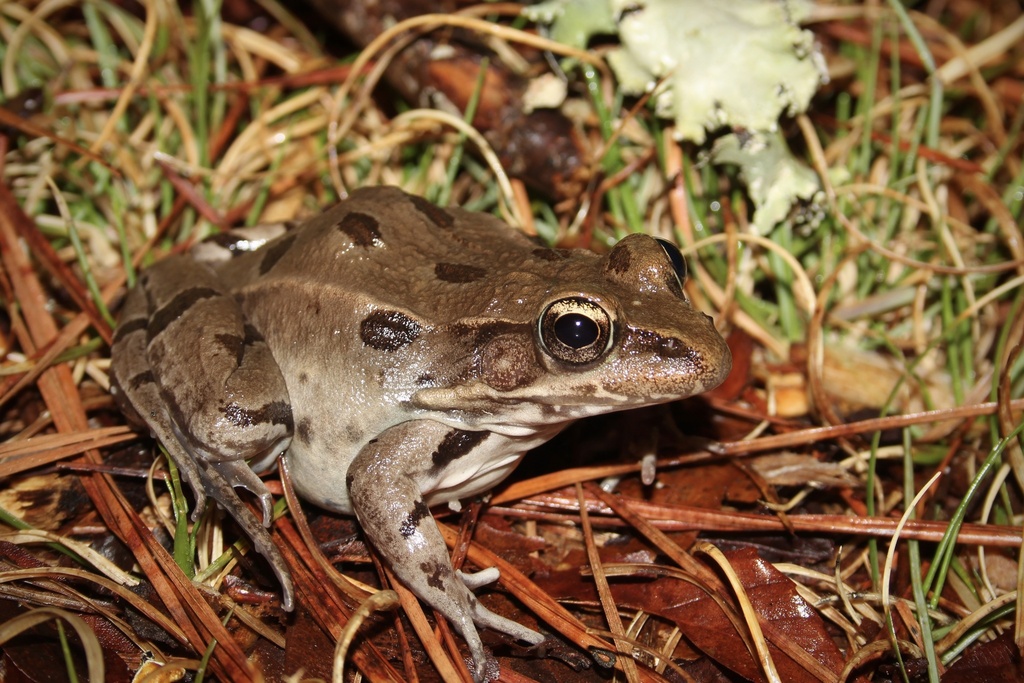
Atlantic Coast Leopard Frog
Lithobates kauffeldi
The Atlantic Coast leopard frog (Lithobates kauffeldi) is a species of amphibian that is endemic to the United States. The species was described in 2014 from Staten Island. As a member of the genus Rana sensu lato, it is classified as a true frog, with typical smooth skin and a narrow waist. Its range stretches along the northern part of Eastern Seaboard, from Connecticut to North Carolina. The species takes its common name from the speckles on its legs and back reminiscent of a leopard pattern.
It is one of several species classified as leopard frogs, distinguished as unique through its mating call, genetic differences, habitat, and morphological distinctions.
From the article Atlantic Coast leopard frog on Wikipedia (CC BY-SA), quoted section by section
Description
The frogs' coloring ranges from mint-gray to light olive green, and brown spots distribute irregularly across their backs and legs. Dark snout lines run along their heads. They have large eyes and strong legs used for leaping. Coloring has been observed to change between day and night as well as with the seasons, with many individuals taking nocturnal darker tones and diurnal lighter hues. Adult males have large vocal sacs on either side of the head which are used to produce a mating call. Distinguishing between Atlantic Coast leopard frogs and Southern leopard frogs is difficult. Key features that differentiate the Atlantic Coast leopard frog from the Southern leopard frog include the lack of a white spot on the tympanum, a femoral reticulum (inner thigh) that is primarily dark with unconnected light patches, a blunter snout, and duller coloration. However, there is significant overlap in these traits between the species and no single morphological trait can reliably differentiate the two. Mating call is the most reliable distinguishing feature of the Atlantic Coast leopard frog. The Atlantic Coast leopard frog's call is a single and distinct "chuck" sound rather than the repeated "ak-ak-ak" of the Southern leopard frog or the "snore" of a Northern leopard frog.
Wikipedia: “Characteristics”
Range & habitat
L. kauffeldi is found in nine states along the northeastern coast of the United States, from central Connecticut to northeastern North Carolina. The north-south range is approximately 780 km long, and the width is about 100 km from the Atlantic shoreline inward. The range narrows as it progressed southward, mostly along the I-95 corridor. It is thought to be extirpated from most of Connecticut, the Hudson Valley, and Long Island. The Atlantic Coast leopard frog is sympatric with the northern leopard frog in Connecticut and the southern leopard frog from New Jersey through North Carolina. It apparently hybridizes with these species where they come into contact. For a time the species remained undiscovered because of its similarity to both of the aforementioned in physical appearance and habitat.
Wikipedia: “Distribution and range”
In human culture
The Atlantic Coast leopard frog is one of several species of leopard frogs. Its species name, kauffeldi, is derived from the name of Staten Island herpetologist Carl Frederick Kauffeld, who in 1936 proposed that there could be a third species of leopard frog inhabiting the New York metropolitan area, specifically Staten Island. The author team that described the species in 2014 christened it after Kauffeld in honor of him.
Wikipedia: “Etymology”
Listen
Looking for field recordings…
Where it lives
Recorded sightings
—
geo-referenced records in GBIF, from museums, herbaria and field observers.
Drag the globe to turn it. Dots are where records exist, not a range map; darker means more records.
In the stacks
Searching the stacks…
Every page naming Lithobates kauffeldi in the Biodiversity Heritage Library →
This page is assembled live from iNaturalist, GBIF, Wikipedia, the Source Library and the Internet Archive. It is not yet part of the hand-edited codex. iNaturalist taxon 424676.