 NL·0658
Herbarium of the Nature Library
- Name
- Porphyrio hochstetteri
- Family
- Rallidae
- Native to
- South Island, New Zealand
- Habitat
- Alpine grassland, Island sanctuary
On eBird ↗
South Island Takahe
Live sightings near you, the range map, bar charts of when it is seen, and Macaulay Library photos and recordings.
Takahē
Porphyrio hochstetteri
Also calledTakahē (Māori) · South Island takahē (English)
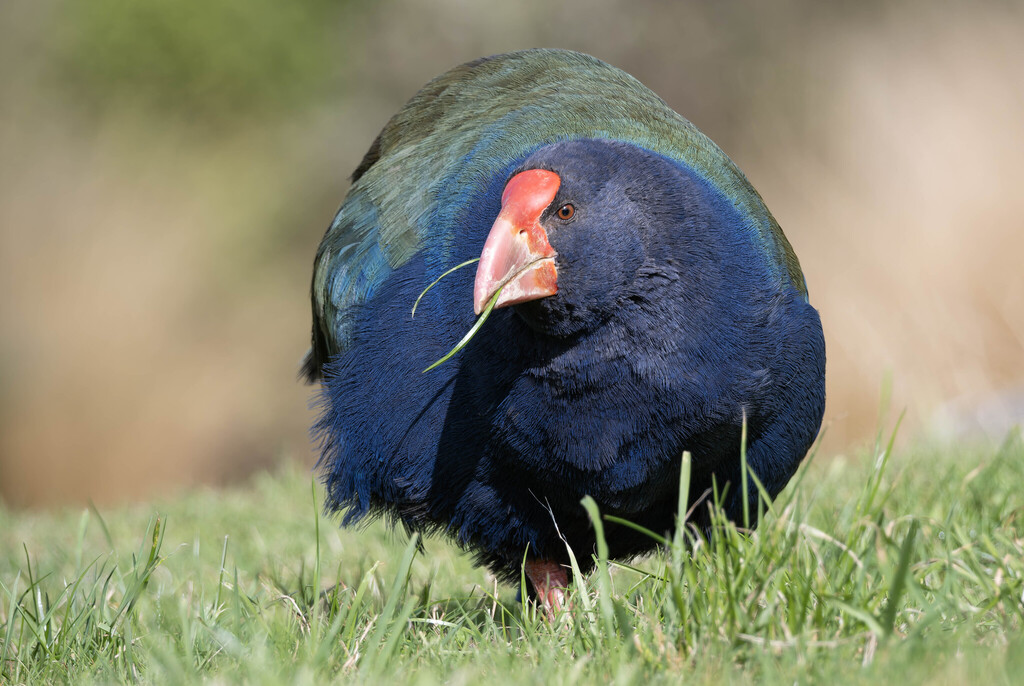
A large, flightless rail with brilliant blue-green plumage and a heavy red bill. Thought extinct for half a century, it was rediscovered in 1948 in New Zealand's Murchison Mountains.
The South Island takahē is a flightless swamphen indigenous to New Zealand and the largest living member of the rail family. It is often known by the abbreviated name takahē, which it shares with the recently extinct North Island takahē. The two takahē species are also known as notornis. Wikipedia
What it can do
- iFlightless and long-lived
- iiFeeds on tussock grasses, snipping off tender bases
- iiiRecovered from near extinction through intensive conservation
In the field
Field marks
- aDeep blue-purple head and breast
- bOlive-green back and wings
- cMassive red bill and frontal shield
- dStout red legs
- eFlightless, rounded body
- Voice
- Loud, resonant hooting and clucking contact calls, often exchanged between pair members; deeper than the pūkeko's screech.
- Not to be confused with
- Pūkeko is slimmer, with long legs and a smaller bill, and can fly.
- Where to see it
- Tiritiri Matangi Island, Zealandia, Orokonui Ecosanctuary, Burwood Takahē Centre
- When
- Resident
Listen
Looking for field recordings…
Life & habits
- Diet
- Tussock grasses, herbs, rhizomes
- Habitat
- Alpine grassland, now also predator-free islands and sanctuaries
- Size
- About 63 cm; 2–4 kg
- Lifespan
- Up to 20 years
Pairs defend territories and raise one to two chicks each year.
Where it lives
Recorded sightings
—
geo-referenced records in GBIF, from museums, herbaria and field observers.
Native range
South Island, New Zealand
Drag the globe to turn it. Dots are where records exist, not a range map; darker means more records.
In the old herbals & bestiaries
No plate in the Source Library names this exact species, so these show its closest relatives as the old naturalists drew them: same genus, or the same kind of animal. Click a plate to read the page it came from, with translation.

History of Animals, Book I: On Viviparous Quadrupeds
Relative · Conrad Gessner · 1554 · p.962

Historiae Animalium Liber III: De Avium Natura
Relative · Conrad Gesner · 1555 · p.817

Introductory Book
Relative · Michael Scot · 1350 · p.210

Garden of Health (Hortus Sanitatis)
Relative · Jacob Meydenbach · 1491 · p.597

Garden of Health
Relative · 1507 · p.539
In the stacks
Searching the stacks…
Every page naming Porphyrio hochstetteri in the Biodiversity Heritage Library →
Marginalia
Geoffrey Orbell rediscovered the takahē in 1948 near Lake Te Anau, 50 years after it was believed extinct.
Curiosity
The total population passed 500 birds in 2023 and was estimated at about 529 at the end of 2024, thanks to translocations and predator control.
Kinship





Fact-checked: 1 correction made to this sheet. Photographs: iNaturalist contributors under the licences shown. Records: GBIF.org. Historical plates: Source Library (CC BY-SA 4.0; originals public domain). Summary text: Nature Library editors and Wikipedia (CC BY-SA). Medicinal and edibility notes are historical and educational, not advice. iNaturalist taxon 424597.