On eBird ↗
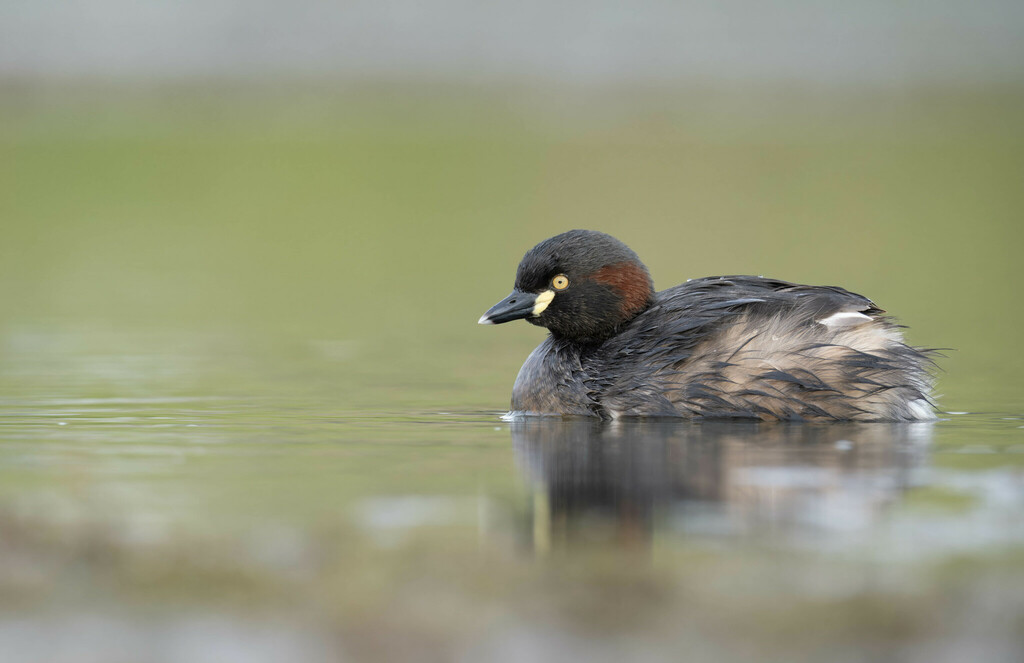
Australasian Grebe
Live sightings near you, the range map, bar charts of when it is seen, and Macaulay Library photos and recordings.
Australasian Grebe
Tachybaptus novaehollandiae
The Australasian grebe (Tachybaptus novaehollandiae) is a small waterbird common on fresh water lakes and rivers in greater Australia, New Zealand and on nearby Pacific islands. At 25–27 cm (9.8–10.6 in) in length, it is one of the smallest members of the grebe family, along with the least grebe and little grebe.
From the article Australasian grebe on Wikipedia (CC BY-SA), quoted section by section
What it does
The Australasian grebe is an excellent swimmer and diver, and usually dives immediately when alarmed and swims away under water. They are not strong flyers and will fly distances only at night, presumably to avoid predators. They tend not to leave their home base if there is sufficient food. If disturbed they will dive and re-surface 10–15 metres away rather than fly. Both parents will raise the chicks; however, the male will leave after a couple of months when the chicks are about three-quarters grown. Initially the young will ride on the parents back, hidden between their slightly raised wings. When the chicks begin to dive and feed themselves (at about 10 weeks) the mother may leave too, although mothers have been known to return soon after, apparently to check on the chicks. The parents are very protective and will try to drive away other water birds (ducks, herons) by confronting them and flapping their wings wildly or using their wings to splash water at the intruders.
Wikipedia: “Behaviour”
Listen
Looking for field recordings…
Where it lives
Recorded sightings
—
geo-referenced records in GBIF, from museums, herbaria and field observers.
Drag the globe to turn it. Dots are where records exist, not a range map; darker means more records.
In the stacks
Searching the stacks…
Every page naming Tachybaptus novaehollandiae in the Biodiversity Heritage Library →
This page is assembled live from iNaturalist, GBIF, Wikipedia, the Source Library and the Internet Archive. It is not yet part of the hand-edited codex. iNaturalist taxon 4243.