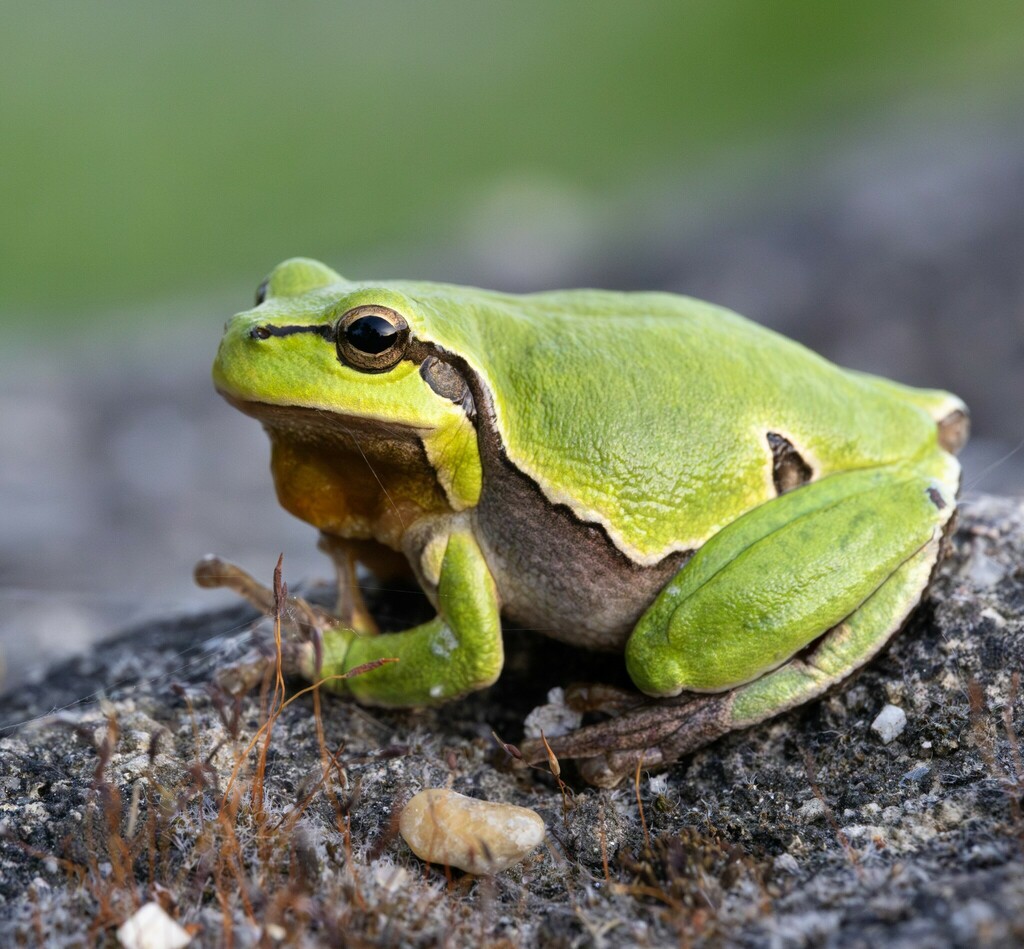
European Tree Frog
Hyla arborea
The European tree frog (Hyla arborea) is a small tree frog. As traditionally defined, it was found throughout much of Europe, Asia and northern Africa, but based on molecular genetic and other data several populations formerly included in it are now recognized as separate species (for example, H. intermedia of Italy and nearby, H. molleri of the Iberian Peninsula, H. meridionalis of parts of southwestern Europe and northern Africa, and H. orientalis of parts of Eastern Europe, Turkey and the Black Sea and Caspian Sea regions), limiting the true European tree frog to Europe from France to Poland and Greece.
From the article European tree frog on Wikipedia (CC BY-SA), quoted section by section
Description
European tree frogs are small; males range from 32–43 mm (1.3–1.7 in) in length, and females range from 40–50 mm (1.6–2.0 in) in length. They are slender, with long legs. Their dorsal skin is smooth, while their ventral skin is granular. Their dorsal skin can be green, gray, or tan depending on the temperature, humidity, or their mood. Their ventral skin is a whitish color, and the dorsal and ventral skin is separated by a dark brown lateral stripe from the eyes to the groin. Females have white throats, while males have golden brown throats with large (folded) vocal sacs. The head of H. arborea is rounded, the lip drops strongly, the pupil has the shape of a horizontal ellipse, and the tympanum is clearly recognizable. The discs on the frog's toes, which it uses to climb trees and hedges, is a characteristic feature of H. arborea. Like other frogs, their hind legs are much larger and stronger than the fore legs, enabling the frogs to jump rapidly.
Range & habitat
Members of the H. arborea species complex are the only representatives of the widespread tree frog family (Hylidae) indigenous to mainland Europe. and are found across most of Europe (except United Kingdom), northwest Africa, and temperate Asia to Japan. This species complex is native to Albania, Armenia, Austria, Azerbaijan, Belarus, Belgium, Bosnia and Herzegovina, Bulgaria, Croatia, Cyprus, the Czech Republic, Denmark, France, Georgia, Germany, Greece, Hungary, Jordan, Italy, Latvia, Liechtenstein, Lithuania; Luxembourg, North Macedonia, the Republic of, Moldova, Montenegro, the Netherlands, Poland, Portugal, Romania, Russia, Serbia, Slovakia, Slovenia, Sweden, Switzerland, Turkey, and Ukraine. In the United Kingdom, the species status is legally classed as non-native. It has been introduced, and now thought to be extinct. European tree frogs can be found in marshlands, damp meadows, reed beds, parks, gardens, vineyards, orchards, stream banks, lake shores, or humid or dry forests. They tend to avoid dark or thick forests, and they are able to tolerate some periods of dryness; therefore, sometimes they are found in dry habitats.
Wikipedia: “Distribution and habitat”
What it does
Historically, tree frogs were used as barometers because they respond to approaching rain by croaking. Depending on subspecies, temperature, humidity, and the frog's 'mood', skin colour ranges from bright to olive green, grey, brown and yellow. European tree frogs eat a variety of small arthropods, such as spiders, flies, beetles, butterflies, and smooth caterpillars. Their ability to take long leaps allows them to catch fast-flying insects, which make up most of their diets. They hibernate in walls, cellars, under rocks, under clumps of vegetation, or buried in leaf piles or manure piles.
Wikipedia: “Behavior”
Listen
Looking for field recordings…
Where it lives
Recorded sightings
—
geo-referenced records in GBIF, from museums, herbaria and field observers.
Drag the globe to turn it. Dots are where records exist, not a range map; darker means more records.
In the old herbals & bestiaries

In the stacks
Searching the stacks…
Every page naming Hyla arborea in the Biodiversity Heritage Library →
This page is assembled live from iNaturalist, GBIF, Wikipedia, the Source Library and the Internet Archive. It is not yet part of the hand-edited codex. iNaturalist taxon 424147.