- Animals
- ›Chordates
- ›Vertebrates
- ›Mammals
- ›Therians
- ›Placental Mammals
- ›Ungulates, Carnivorans, and Allies
- ›Even-toed Ungulates and Cetaceans
- ›Ruminants
- ›Bovids
- ›Antelopes, Goats, and Sheep
- ›Typical Antelopes
- ›Raphicerus
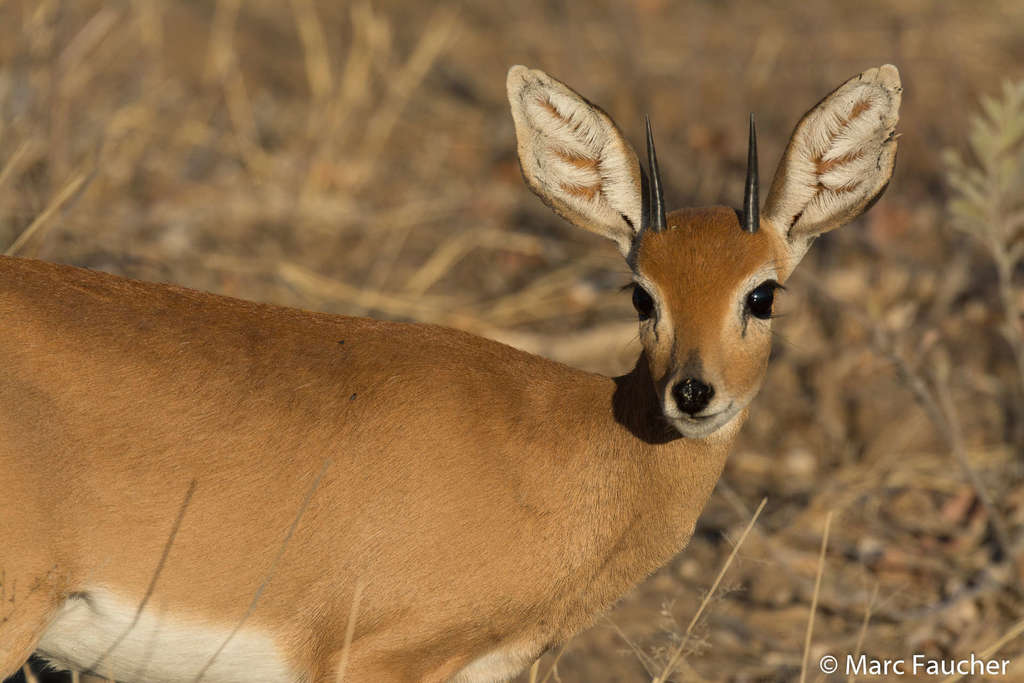
Steenbok
Raphicerus campestris
The steenbok (Raphicerus campestris) is a common small antelope of southern and eastern Africa. It is sometimes known as the steinbuck or steinbok.
From the article Steenbok on Wikipedia (CC BY-SA), quoted section by section
Description
Steenbok resemble small oribi, standing 45–60 cm (16"–24") at the shoulder, and weigh 7–16 kg (15–35 lb). Their coat is any shade from fawn to rufous, typically rather orange. The underside, including chin and throat, is white, as is the ring around the eye. Ears are large with "finger-marks" on the inside. Males have straight, smooth, parallel horns 7–19 cm (2.8–7.5 in) long (see image left). There is a black crescent-shape between the ears, a long black bridge to the glossy black nose, and a black circular scent-gland in front of the eye. The tail is not usually visible, being only 4–6 cm (1.6–2.4 in) long.
Range & habitat
There are two distinct clusters in steenbok distribution. In East Africa, it occurs in central and southern Kenya and northern Tanzania. It was formerly widespread in Uganda, but is now almost certainly extinct there. In Southern Africa, it occurs in Angola, Namibia, South Africa, Eswatini, Botswana, Mozambique, Zambia, Zimbabwe and probably Lesotho.
Wikipedia: “Distribution”
What it does
Steenbok typically browse on low-level vegetation (they cannot reach above 0.9 m), but are also adept at scraping up roots and tubers. In central Kruger National Park, Steenbok show a distinct preference for forbs, and then woody plants (especially Flueggea virosa) when few forbs are available. They will also take fruits and only very rarely graze on grass. They are almost entirely independent of drinking water, gaining the moisture they need from their food.
Wikipedia: “Diet”
Listen
Looking for field recordings…
Where it lives
Recorded sightings
—
geo-referenced records in GBIF, from museums, herbaria and field observers.
Drag the globe to turn it. Dots are where records exist, not a range map; darker means more records.
In the stacks
Searching the stacks…
Every page naming Raphicerus campestris in the Biodiversity Heritage Library →
This page is assembled live from iNaturalist, GBIF, Wikipedia, the Source Library and the Internet Archive. It is not yet part of the hand-edited codex. iNaturalist taxon 42375.