On eBird ↗
Clark's Grebe
Live sightings near you, the range map, bar charts of when it is seen, and Macaulay Library photos and recordings.
Clark's Grebe
Aechmophorus clarkii
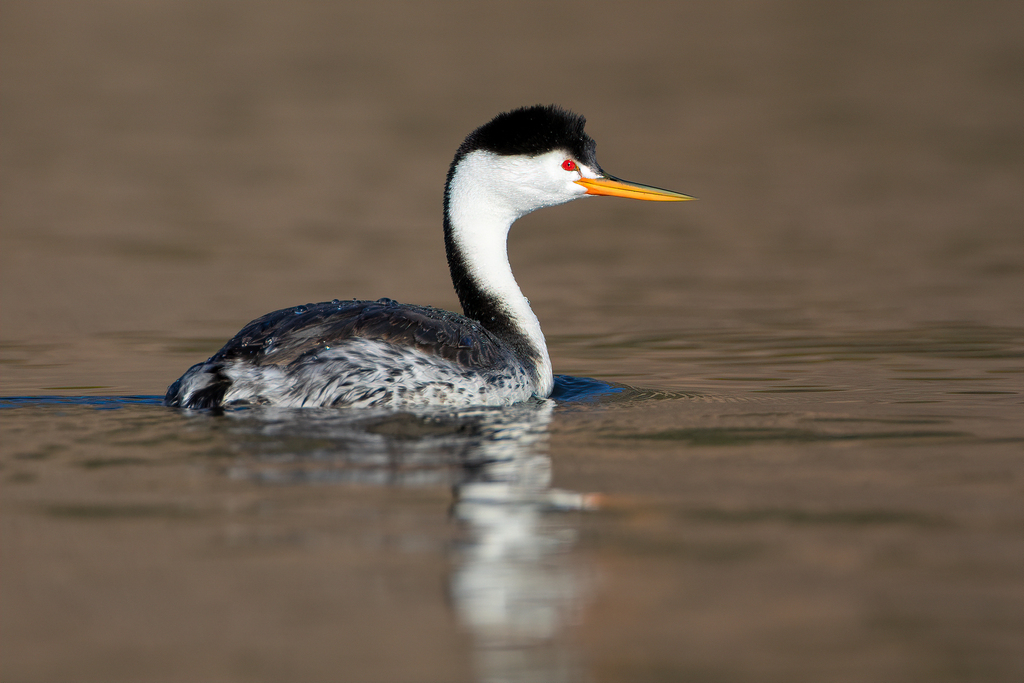
Clark's grebe (Aechmophorus clarkii) is a North American waterbird species in the grebe family. Until the 1980s, it was thought to be a pale morph of the western grebe, which it resembles in size, range, and behavior. Intermediates between the two species are known.
This species nests on large inland lakes in western North America and migrates to the Pacific coast over the winter. It maintains local populations year-round in California, Nevada, and Arizona (the Lower Colorado River Valley), as well as in central Mexico.
From the article Clark's grebe on Wikipedia (CC BY-SA), quoted section by section
Description
Clark's grebe closely resembles the western grebe and occurs in the same colonies together with it. Storer and Nuechterlein in 1992, following earlier morphological studies by Storer and others, define the species as being distinguished from the western grebe by an overall paler plumage on its back, as well as a larger portion of its face covered in white, as it extends above the eyes, rather than just below them. A distinguishing feature is its bill, which is bright yellow in the US, whereas the Western Grebe's bill is greenish-yellow in the US, which had been noted by others. Storer and Nuechterlein in 1992 claim that the bill is slightly upturned in this species whereas the western grebe has a straight bill, this was not noted in earlier studies. The grebe has a long, slender neck and the species ranges in size from 22–29 inches (56–74 cm), with a wingspan of 24 inches (61 cm). Clarks' grebe has a weight range of 25.3–44.4 oz (720–1,260 g). There are few changes between the sexes, the most notable feature that distinguishes males from females is the presence of a slight crest on the heads of males. In juveniles, the plumage is again similar to the Western Grebe, however it is also paler compared to the greyer Western species. Its relative size compared to the western grebe is confused. …
Range & habitat
Being waterbirds, they require bodies of water that offer the necessary food and shelter that they need to thrive—usually lakes or suitable wetlands—that are also in proximity to suitable tree cover that they can use for nesting.
Wikipedia: “Habitat”
What it does
Thought to be a fish specialist in the early 20th century as a result of the examination of their pellets and stomach contents, it was shown by 1962 that Clark's grebe is actually an opportunist when it comes to the food it eats, and is less picky with its selection than previously imagined. This means that the species will actually consume a wide variety of things such as salamanders, crustaceans, polychaete worms and insects while diving and foraging for their preferred small fish, so long as they fit the size constraints of the bill.
Wikipedia: “Diet”
In human culture
The "Clark" of its common name—and its specific epithet clarkii—honors John Henry Clark, a 19th-century American surveyor who was also a naturalist and collector. The genus name Aechmophorus comes from the Ancient Greek words αἰχμά (transliterated "aichme"), meaning 'point of a spear', and φόρος ("phoros"), meaning 'bearing'; together translating as 'spear point bearer' and referring to the bird's long, dagger-like beak. In Mexico, it is called achichilique pico naranja (the western grebe is called the achichilique pico amarillo). A common name advocated in Spain for this bird is the calque achichilique de Clark.
Wikipedia: “Etymology and common names”
Listen
Looking for field recordings…
Where it lives
Recorded sightings
—
geo-referenced records in GBIF, from museums, herbaria and field observers.
Drag the globe to turn it. Dots are where records exist, not a range map; darker means more records.
In the stacks
Searching the stacks…
Every page naming Aechmophorus clarkii in the Biodiversity Heritage Library →
This page is assembled live from iNaturalist, GBIF, Wikipedia, the Source Library and the Internet Archive. It is not yet part of the hand-edited codex. iNaturalist taxon 4234.