- Animals
- ›Chordates
- ›Vertebrates
- ›Mammals
- ›Therians
- ›Placental Mammals
- ›Ungulates, Carnivorans, and Allies
- ›Even-toed Ungulates and Cetaceans
- ›Ruminants
- ›Bovids
- ›Bovines
- ›Spiral-horned Antelopes
- ›Tragelaphus
- ›Strepsiceros
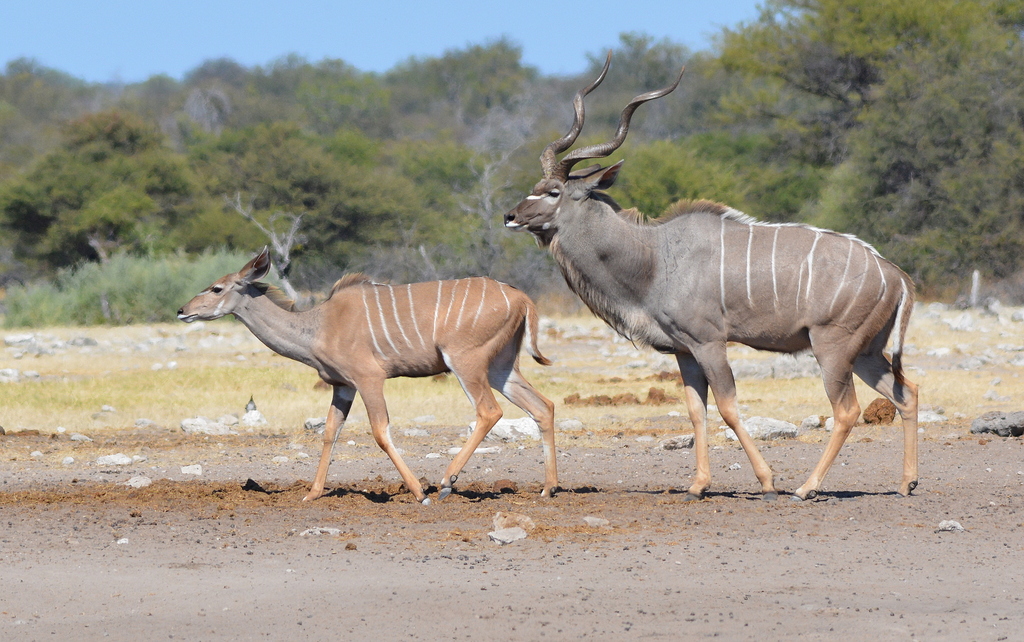
Greater Kudu
Tragelaphus strepsiceros
The greater kudu (Tragelaphus strepsiceros) is a large woodland antelope, found throughout eastern and southern Africa. Despite occupying such widespread territory, they are sparsely populated in most areas due to declining habitat, deforestation, and poaching. The greater kudu is one of two species commonly known as kudu, the other being the lesser kudu, T. imberbis. It was once placed as the only species in the genus Strepsiceros, which is now considered a subgenus.
From the article Greater kudu on Wikipedia (CC BY-SA), quoted section by section
Range & habitat
The range of the greater kudu extends from the east in Ethiopia, Tanzania, Eritrea and Kenya into the south where they are found in Zambia, Angola, Namibia, Botswana, Zimbabwe and South Africa. Other regions where greater kudu are located are Central African Republic, Chad, Democratic Republic of the Congo, Djibouti, Eswatini, Malawi, Mozambique, Somalia, and Uganda. They have also been introduced in small numbers into New Mexico, but were never released into the wild. Their habitat includes mixed scrub woodlands (the greater kudu is one of the few largest mammals that prefer living in settled areas – in scrub woodland and bush on abandoned fields and degraded pastures, mopane bush and acacia in lowlands, hills and mountains. They will occasionally venture onto plains only if there is a large abundance of bushes, but normally avoid such open areas to avoid becoming an easy target for their predators. Their diet consists of leaves, grass, shoots and occasionally tubers, roots and fruit (they are especially fond of oranges and tangerines).
During the day, greater kudus normally cease to be active and instead seek cover under woodland, especially during hot days. They feed and drink in the early morning and late afternoon, acquiring water from waterholes or roots and bulbs that have a high water content. …
Wikipedia: “Range and ecology”
What it does
Greater kudus have a lifespan of 7 to 8 years in the wild, and up to 23 years in captivity. They may be active throughout the 24-hour day. Herds disperse during the rainy season when food is plentiful. During the dry season, there are only a few concentrated areas of food so the herds will congregate. Greater kudu are not territorial; they have home areas instead. Maternal herds have home ranges of approximately 4 square kilometers and these home ranges can overlap with other maternal herds. Home ranges of adult males are about 11 square kilometers and generally encompass the ranges of two or three female groups. Females usually form small groups of 6–10 with their offspring, but sometimes they can form a herd up to 20 individuals. Male kudus may form small bachelor groups, but they are more commonly found as solitary and widely dispersed individuals. Solitary males will join the group of females and calves (usually 6–10 individuals per group) only during the mating season (April–May in South Africa). The male kudus are not always physically aggressive with each other, but sparring can sometimes occur between males, especially when both are of similar size and stature. The male kudus exhibit this sparring behavior by interlocking horns and shoving one another. Dominance is established until one male exhibits the lateral display. …
Wikipedia: “Behavior and social organization”
In human culture
Kudu ( koo-DOO), or koodoo, is the Khoikhoi name for this antelope. Trag- (Greek) denotes a goat and elaphos (Greek) a deer. Strepho (Greek) means 'twist', and strepsis is 'twisting'. Keras (Greek) refers to the horn of the animal.
Wikipedia: “Etymology”
Listen
Looking for field recordings…
Where it lives
Recorded sightings
—
geo-referenced records in GBIF, from museums, herbaria and field observers.
Drag the globe to turn it. Dots are where records exist, not a range map; darker means more records.
In the old herbals & bestiaries


In the stacks
Searching the stacks…
Every page naming Tragelaphus strepsiceros in the Biodiversity Heritage Library →
This page is assembled live from iNaturalist, GBIF, Wikipedia, the Source Library and the Internet Archive. It is not yet part of the hand-edited codex. iNaturalist taxon 42339.