- Animals
- ›Chordates
- ›Vertebrates
- ›Mammals
- ›Therians
- ›Placental Mammals
- ›Ungulates, Carnivorans, and Allies
- ›Even-toed Ungulates and Cetaceans
- ›Ruminants
- ›Bovids
- ›Antelopes, Goats, and Sheep
- ›Reduncines
- ›Pelea
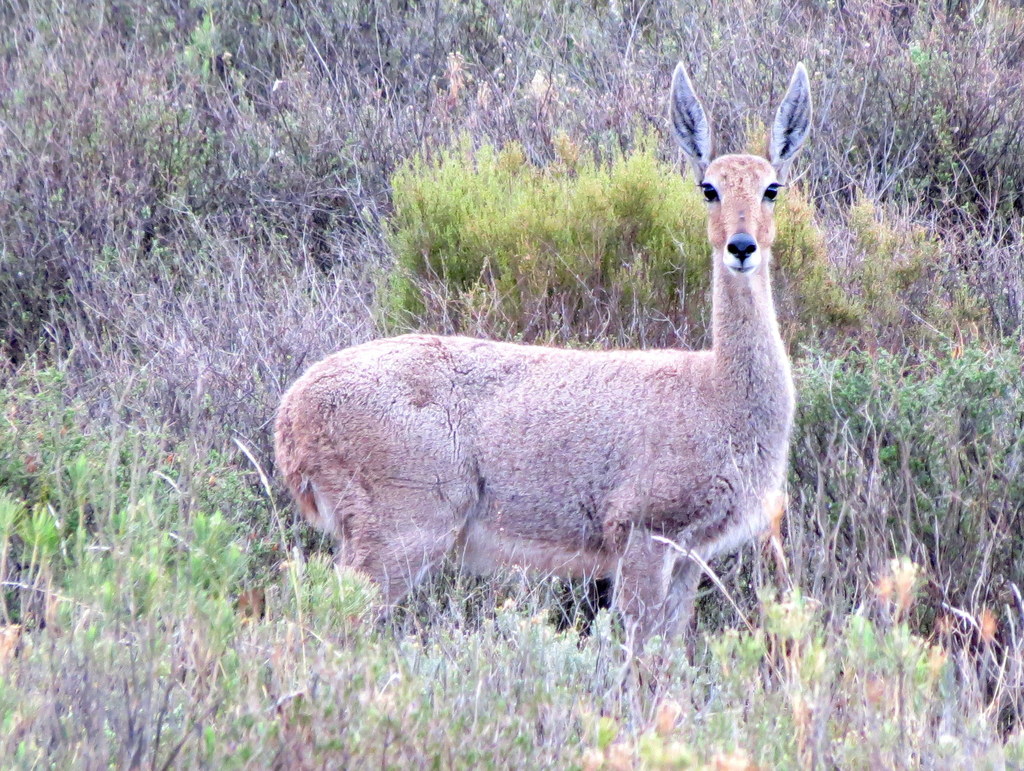
Grey Rhebok
Pelea capreolus
The grey rhebok or grey rhebuck (Pelea capreolus), locally known as the Vaal rhebok or Vaalribbok in Afrikaans, is a species of antelope endemic to South Africa, Zimbabwe, Lesotho, and Swaziland. The specific name capreolus is Latin for 'little goat'.
From the article Grey rhebok on Wikipedia (CC BY-SA), quoted section by section
Description
The grey rhebok is a medium-sized antelope weighing 19–30 kilograms (42–66 lb) with a long neck and narrow ears. The coat is short and dense and coloured in various shades of grey. Only the males carry horns, which are straight, sharp, ringed at the base, and around 15–25 centimetres (5.9–9.8 in) long.
Range & habitat
Generally confined to the higher areas of Southern Africa, they typically inhabit grassy, montane habitats - for example, sourveld - usually 1,000 metres (3,300 ft) above sea level, and carry a woolly grey coat to insulate them from the cold. They are not strictly limited to this habitat as they can be found in the coastal belt of the Cape, almost at sea level.
Wikipedia: “Distribution and habitat”
What it does
The grey rhebok is territorial and maintains its territory by urinating and defecating, standing or walking in an upright posture, and patrolling. Males become extremely aggressive during the breeding season. The grey rhebok usually aggregates in herds of one to 15 females and young and one mature male. This species is therefore polygynous. The grey rhebok is a seasonal breeder. This species is a browser, and gets most of its water from the food it eats, so it can utilise food sources a long distance from standing water.
Wikipedia: “Reproduction and behaviour”
In human culture
The Afrikaans spelling of the species, reebok, lends its name to the British-American sportswear manufacturing company Reebok. In 1958, Reebok founder Joseph William Foster found the name in US Webster's New School and Office Dictionary.
== References ==
Wikipedia: “In contemporary culture”
Listen
Looking for field recordings…
Where it lives
Recorded sightings
—
geo-referenced records in GBIF, from museums, herbaria and field observers.
Drag the globe to turn it. Dots are where records exist, not a range map; darker means more records.
In the stacks
Searching the stacks…
Every page naming Pelea capreolus in the Biodiversity Heritage Library →
This page is assembled live from iNaturalist, GBIF, Wikipedia, the Source Library and the Internet Archive. It is not yet part of the hand-edited codex. iNaturalist taxon 42336.