- Animals
- ›Chordates
- ›Vertebrates
- ›Mammals
- ›Therians
- ›Placental Mammals
- ›Ungulates, Carnivorans, and Allies
- ›Even-toed Ungulates and Cetaceans
- ›Ruminants
- ›Bovids
- ›Antelopes, Goats, and Sheep
- ›Reduncines
- ›Kobus
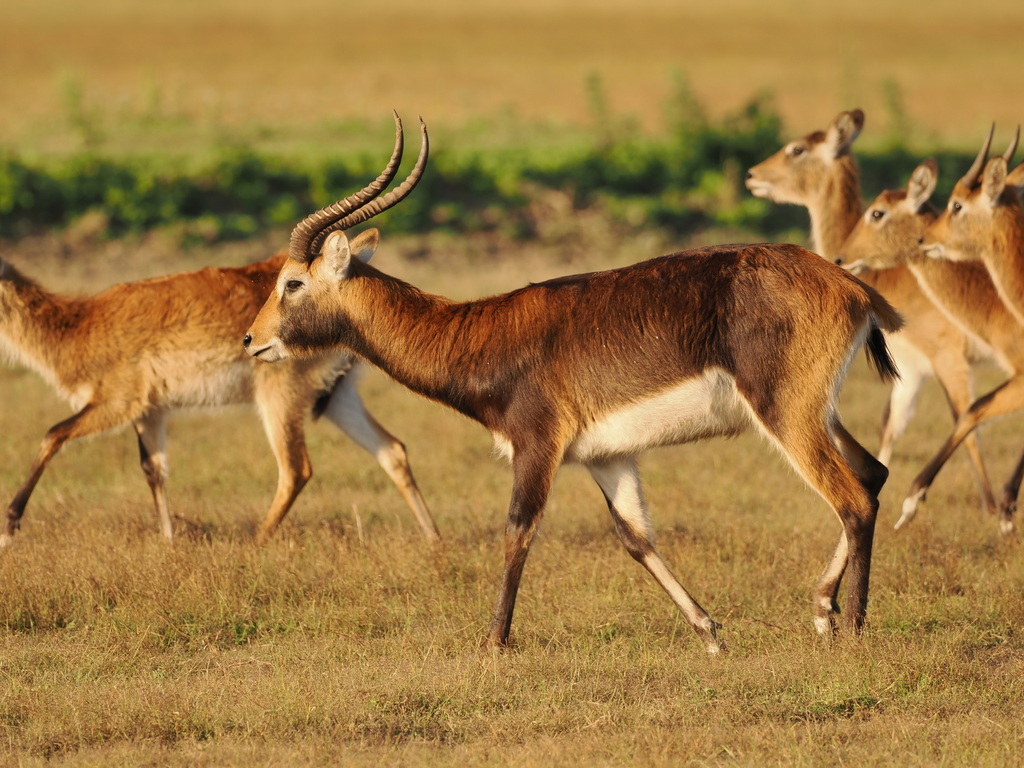
Lechwe
Kobus leche
The lechwe, red lechwe, or southern lechwe (Kobus leche) is an antelope found in wetlands of south-central Africa.
From the article Lechwe on Wikipedia (CC BY-SA), quoted section by section
Description
Adult lechwe typically stand 90 to 100 cm (35 to 39 in) at the shoulder and generally weigh from 50 to 120 kg (110 to 260 lb), with males being larger than females. They are golden brown with white bellies. Males are darker in colour, but exact hue and amount of blackish on the front legs, chest and body varies depending on subspecies. The long, spiral horns are vaguely lyre-shaped and borne only by males. The hind legs are somewhat longer in proportion than in other antelopes to ease long-distance running on marshy soil.
Range & habitat
The lechwe is native to Botswana, Zambia, southeastern Democratic Republic of the Congo, northeastern Namibia, and eastern Angola, especially in the Okavango Delta, Kafue Flats, and Bangweulu Wetlands. The species is fairly common in zoos and wild animal farms.
Wikipedia: “Range”
What it does
Lechwe mate during rain seasons of November to February. They have a gestation period of seven to eight months so a majority of calves are born from July to September. Although rare, hybrids between lechwe and waterbuck have been observed.
Wikipedia: “Reproduction”
Listen
Looking for field recordings…
Where it lives
Recorded sightings
—
geo-referenced records in GBIF, from museums, herbaria and field observers.
Drag the globe to turn it. Dots are where records exist, not a range map; darker means more records.
In the stacks
Searching the stacks…
Every page naming Kobus leche in the Biodiversity Heritage Library →
This page is assembled live from iNaturalist, GBIF, Wikipedia, the Source Library and the Internet Archive. It is not yet part of the hand-edited codex. iNaturalist taxon 42329.