On eBird ↗
Hoary-headed Grebe
Live sightings near you, the range map, bar charts of when it is seen, and Macaulay Library photos and recordings.
Hoary-headed Grebe
Poliocephalus poliocephalus
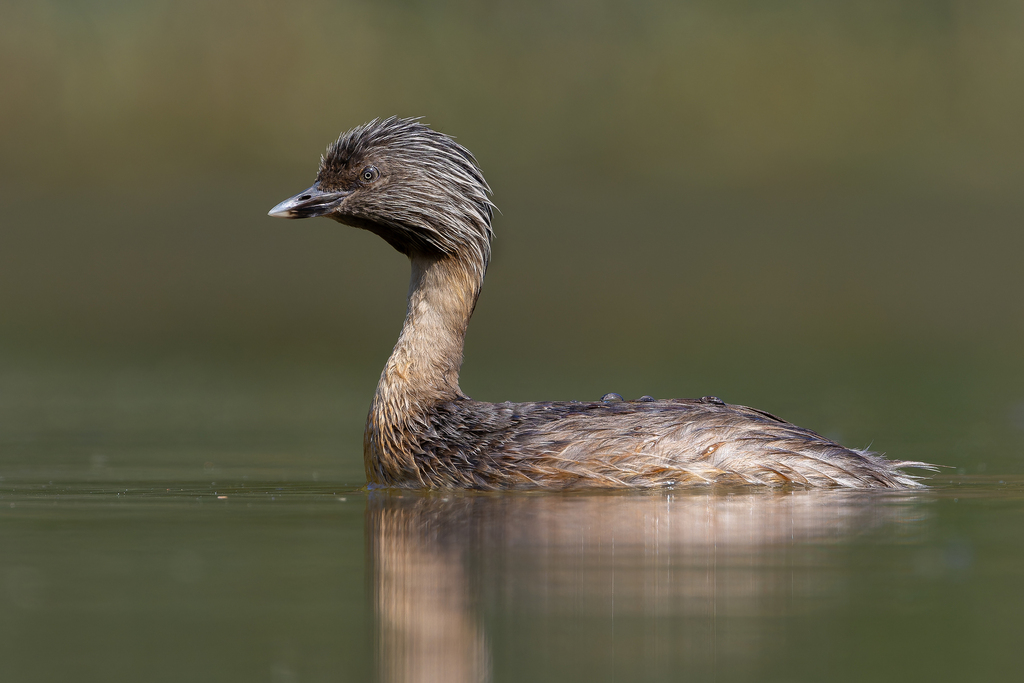
The hoary-headed grebe (Poliocephalus poliocephalus) is a member of the grebe family. It breeds in southern parts of Australia and Tasmania; it winters throughout the island. The bird takes its name from the silvery-white streaking on its black head. It is common in Australia, with a population of about 500,000. Its habitat is similar to that of the Australasian grebe.
From the article Hoary-headed grebe on Wikipedia (CC BY-SA), quoted section by section
Description
The hoary-headed grebe is a fairly small dark grey and white grebe. It has a brown eye and a black patch under the chin, and a narrow black streak down the back of the neck. During the breeding season the adult's plumage has white streaks over its entire head, giving them the common name of hoary-headed grebe. Juveniles have a white chin and throat and a striped face. Males have two plumage phases: after breeding they lose the buff breast and the white lines on the head, but can usually be identified then by the broad black bar down the nape.
Range & habitat
The hoary-headed grebe is found in all states and territories of Australia. It is generally absent from the central arid regions of Australia. The hoary-headed grebe is usually found away from the shoreline in large open waters, which may be estuarine, brackish or freshwater. It can also be found in sheltered coastal seas. It can sometimes be found in New Zealand, where it is much less common than Australia.
Wikipedia: “Distribution and habitat”
At the table
The hoary-headed grebe feeds on aquatic arthropods, mostly caught by deep diving. This species feeds during the day, and when the light is poor, forages mostly at the water surface.
Wikipedia: “Food”
Listen
Looking for field recordings…
Where it lives
Recorded sightings
—
geo-referenced records in GBIF, from museums, herbaria and field observers.
Drag the globe to turn it. Dots are where records exist, not a range map; darker means more records.
In the stacks
Searching the stacks…
Every page naming Poliocephalus poliocephalus in the Biodiversity Heritage Library →
This page is assembled live from iNaturalist, GBIF, Wikipedia, the Source Library and the Internet Archive. It is not yet part of the hand-edited codex. iNaturalist taxon 4232.