- Animals
- ›Chordates
- ›Vertebrates
- ›Mammals
- ›Therians
- ›Placental Mammals
- ›Ungulates, Carnivorans, and Allies
- ›Even-toed Ungulates and Cetaceans
- ›Ruminants
- ›Bovids
- ›Antelopes, Goats, and Sheep
- ›Horse-like Antelopes
- ›Oryx
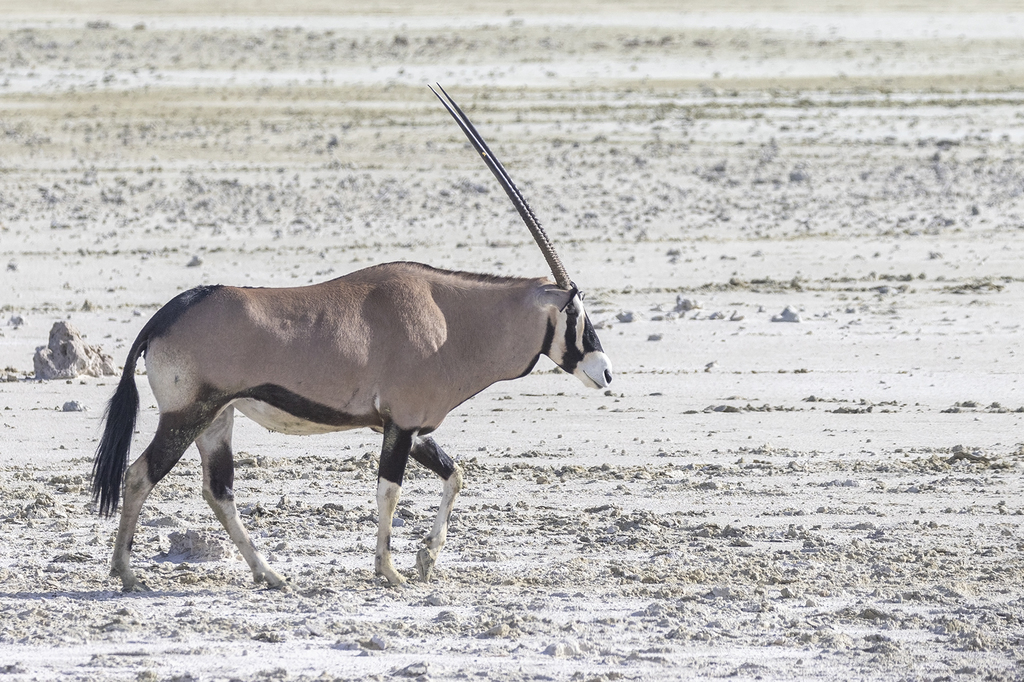
Gemsbok
Oryx gazella
The gemsbok (Oryx gazella), or South African oryx, is a large antelope in the genus Oryx. It is endemic to the dry and barren regions of Botswana, Namibia, South Africa and (parts of) Zimbabwe, mainly inhabiting the Kalahari and Namib Deserts, areas in which it is supremely adapted for survival. Previously, some sources classified the related East African oryx, or beisa oryx (Oryx beisa), as a subspecies.
From the article Gemsbok on Wikipedia (CC BY-SA), quoted section by section
Description
Gemsbok are light taupe to tan in color, with lighter patches toward the bottom rear of the rump. Their tails are long and black in color. A blackish stripe extends from the chin down the lower edge of the neck, through the juncture of the shoulder and leg along the lower flank of each side to the blackish section of the rear leg. They have muscular necks and shoulders, and their legs have white 'socks' with a black patch on the front of both the front legs, and both sexes have long, straight horns. Comparably, the East African oryx lacks a dark patch at the base of the tail, has less black on the legs (none on the hindlegs), and less black on the lower flanks. One very rare color morph is the "golden oryx", in which the gemsbok's black markings are muted and appear to be golden. Gemsbok are the largest species in the genus Oryx. They stand about 1.2 m (4 ft) at the shoulder. The body length can vary from 190 to 240 cm (75 to 94 in; 6.2 to 7.9 ft) and the tail measures 45 to 90 cm (18 to 35 in). Male gemsbok can weigh between 180 and 240 kg (400 and 530 lb), while females weigh 100–210 kg (220–460 lb).
Range & habitat
Gemsbok are found in arid and semi-arid bushlands in southwestern Africa, especially around the Namib and Kalahari deserts, in Botswana, Zimbabwe, Namibia, South Africa and formerly Angola (where they are considered extirpated). A sizeable introduced population of several thousand is also present in the Chihuahuan Desert in Southern New Mexico at the White Sands Missile Range where they are problematic for the local ecosystem.
Wikipedia: “Distribution and habitat”
What it does
Gemsbok live in herds of about 10–40 animals, which consist of a dominant male, a few nondominant males, and females. They are mainly desert-dwelling and do not depend on drinking water to supply their physiological needs. They can reach running speeds of up to 60 km/h (37 mph). Gemsbok are mostly crepuscular in nature, since temperatures are tolerable and predator detection rates are highest during these times.
Diet. The gemsbok is generally a grazer but changes to browsing during the dry season or when grass is sparse. It may dig up to a meter deep to find roots and tubers, supplementing its water intake by eating wild tsamma melons and cucumbers, which can provide all the water required (3 liters per 100 kg bodyweight a day).
Reproduction. The gemsbok is polygynous, with one resident male mating with the receptive females in the herd. The male is known to secure exclusive mating access to the females by attempting to herd mixed or nursery herds onto his territory. The gemsbok has no specified breeding season, but the young in a given herd tend to be of a similar age due to reproductive synchrony between females. Pregnant females leave the herd before giving birth. The gestation period lasts 270 days (9 months) and mothers give birth to 1–2 offspring. The calf remains hidden 6 weeks after birth, after which mother and calf rejoin the herd. …
Wikipedia: “Ecology and biology”
Listen
Looking for field recordings…
Where it lives
Recorded sightings
—
geo-referenced records in GBIF, from museums, herbaria and field observers.
Drag the globe to turn it. Dots are where records exist, not a range map; darker means more records.
In the old herbals & bestiaries

In the stacks
Searching the stacks…
Every page naming Oryx gazella in the Biodiversity Heritage Library →
This page is assembled live from iNaturalist, GBIF, Wikipedia, the Source Library and the Internet Archive. It is not yet part of the hand-edited codex. iNaturalist taxon 42308.