- Animals
- ›Chordates
- ›Vertebrates
- ›Mammals
- ›Therians
- ›Placental Mammals
- ›Ungulates, Carnivorans, and Allies
- ›Even-toed Ungulates and Cetaceans
- ›Ruminants
- ›Bovids
- ›Antelopes, Goats, and Sheep
- ›Impalas
- ›Aepyceros
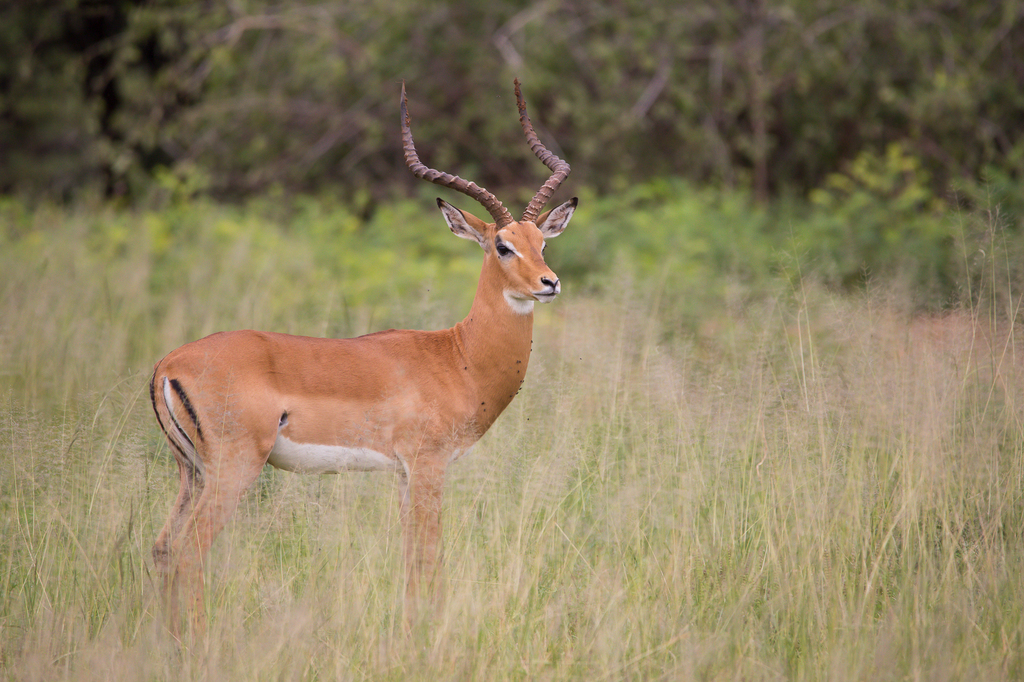
Impala
Aepyceros melampus
The impala or rooibok (Aepyceros melampus, lit. 'black-footed high-horn' in Ancient Greek) is a medium-sized antelope found in eastern and southern Africa. The only extant member of the genus Aepyceros, and tribe Aepycerotini, it was first described to Europeans by German zoologist Hinrich Lichtenstein in 1812. Two subspecies are recognised—the grassland-dwelling common impala (sometimes referred to as the Kenyan impala), and the larger and darker black-faced impala, which lives in slightly more arid, scrubland environments. The impala reaches 70–92 cm (28–36 in) at the shoulder and weighs 40–65 kg (88–143 lb). It features a glossy, reddish brown coat. The male's slender, lyre-shaped horns are 45–92 cm (18–36 in) long.
Active mainly during the day, the impala may be gregarious or territorial depending upon the climate and geography. Three distinct social groups can be observed: the territorial males, bachelor herds and female herds. The impala is known for two characteristic leaps that constitute an anti-predator strategy. Browsers as well as grazers, impala feed on monocots, dicots, forbs, fruits and acacia pods (whenever available). An annual, three-week-long rut takes place toward the end of the wet season, typically in May. Rutting males fight over dominance, and the victorious male courts females in oestrus. Gestation lasts six to seven months, following which a single calf is born and immediately concealed in cover. Calves are suckled for four to six months; young males—forced out of the all-female groups—join bachelor herds, while females may stay back.
From the article Impala on Wikipedia (CC BY-SA), quoted section by section
Description
The impala is a medium-sized, slender-bodied antelope, comparable to the kob, puku and Grant's gazelle in size and build. The head-and-body length is around 130 centimetres (51 in). Males reach approximately 75–92 cm (30–36 in) at the shoulder, while females are 70–85 cm (28–33 in) tall. Males typically weigh 53–76 kilograms (117–168 lb) and females 40–53 kg (88–117 lb). Sexually dimorphic, females are hornless and smaller than males. Males grow slender, lyre-shaped horns 45–92 cm (18–36 in) long. The horns, strongly ridged and divergent, are circular in section and hollow at the base. Their arch-like structure allows interlocking of horns, which helps a male throw off his opponent during fights; horns also protect the skull from damage. The glossy coat of the impala shows two-tone colouration – the reddish brown back and the tan flanks; these are in sharp contrast to the white underbelly. Facial features include white rings around the eyes and a light chin and snout. The ears, 17 cm (6.7 in) long, are tipped with black. Black streaks run from the buttocks to the upper hindlegs. The bushy white tail, 30 cm (12 in) long, features a solid black stripe along the midline. The impala's colouration bears a strong resemblance to the gerenuk, which has shorter horns and lacks the black thigh stripes of the impala. …
Range & habitat
The impala inhabits woodlands due to its preference for shade; it can also be found on the interface (ecotone) between woodlands and savannahs. Places near water sources are preferred. In southern Africa, populations tend to be associated with Colophospermum mopane and Acacia woodlands. Habitat choices differ seasonally – Acacia senegal woodlands are preferred in the wet season, and A. drepanolobium savannahs in the dry season. Another factor that could influence habitat choice is vulnerability to predators; impala tend to keep away from areas with tall grasses as predators could be concealed there. A study found that the reduction of woodland cover and creation of shrublands by the African bush elephants has favoured impala population by increasing the availability of more dry season browse. Earlier, the Baikiaea woodland, which has now declined due to elephants, provided minimum browsing for impala. The newly formed Capparis shrubland, on the other hand, could be a key browsing habitat. Impala are generally not associated with montane habitats; however, in KwaZulu-Natal, impala have been recorded at altitudes of up to 1,400 metres (4,600 ft) above sea level. The historical range of the impala – spanning across southern and eastern Africa – has remained intact to a great extent, although it has disappeared from a few places, such as Burundi. …
Wikipedia: “Distribution and habitat”
What it does
The impala is diurnal (active mainly during the day), though activity tends to cease during the hot midday hours; they feed and rest at night. Three distinct social groups can be observed – the territorial males, bachelor herds and female herds. The territorial males hold territories where they may form harems of females; territories are demarcated with urine and faeces and defended against juvenile or male intruders. Bachelor herds tend to be small, with less than 30 members. Individuals maintain distances of 2.5–3 m (8.2–9.8 ft) from one another; while young and old males may interact, middle-aged males generally avoid one another except to spar. Female herds vary in size from 6 to 100; herds occupy home ranges of 80–180 ha (200–440 acres; 0.31–0.69 sq mi). The mother–calf bond is weak, and breaks soon after weaning; juveniles leave the herds of their mothers to join other herds. Female herds tend to be loose and have no obvious leadership. Allogrooming is an important means of social interaction in bachelor and female herds; in fact, the impala appears to be the only ungulate to display self-grooming as well as allogrooming. In allogrooming, females typically groom related impalas, while males associate with unrelated ones. …
Wikipedia: “Ecology and behaviour”
In human culture
The first attested English name, in 1802, was palla or pallah, from the Tswana phala 'red antelope'; the name impala, also spelled impalla or mpala, is first attested in 1875, and is directly from Zulu. Its Afrikaans name, rooibok 'red buck', is also sometimes used in English. The scientific generic name Aepyceros (lit. 'high-horned') comes from Ancient Greek αἰπύς (aipus, 'high, steep') + κέρας (keras, 'horn'); the specific name melampus (lit. 'black-foot') from μελάς (melas, 'black') + πούς (pous, 'foot').
Wikipedia: “Etymology”
Listen
Looking for field recordings…
Where it lives
Recorded sightings
—
geo-referenced records in GBIF, from museums, herbaria and field observers.
Drag the globe to turn it. Dots are where records exist, not a range map; darker means more records.
In the stacks
Searching the stacks…
Every page naming Aepyceros melampus in the Biodiversity Heritage Library →
This page is assembled live from iNaturalist, GBIF, Wikipedia, the Source Library and the Internet Archive. It is not yet part of the hand-edited codex. iNaturalist taxon 42278.